Author: The Professor

  • Minnesota TRA Full Retirement Age: What Age 65 Really Means

    Minnesota TRA Full Retirement Age: What Age 65 Really Means

    Most Minnesota teachers hear terms like Rule of 90 or 60/30 long before they understand a simpler question: what is the standard full retirement age under TRA?

    Full retirement age, formally called normal retirement age or NRA, determines when you can receive your pension without an actuarial reduction. That age is defined under TRA statute and applies to both Tier I and Tier II members. However, how it interacts with early retirement provisions depends on your tier.

    Understanding this baseline age is critical before evaluating early retirement options or milestone provisions.

    What โ€œFull Retirement Ageโ€ Means in Minnesota TRA

    Under the Minnesota Teachers Retirement Association, full retirement age refers to the age at which a member may begin collecting pension benefits without a reduction for early commencement.

    This is sometimes referred to in plan documents as normal retirement age.

    Full retirement age determines:

    โ€ข Whether your pension is reduced
    โ€ข How early retirement penalties are calculated
    โ€ข The minimum age required for unreduced benefits if no special provision applies

    It is important to distinguish this from Social Security full retirement age. TRA and Social Security operate under separate systems with different eligibility rules.

    For a full overview of how the pension formula works, see our guide to the Minnesota TRA pension.

    Full Retirement Age for Tier I Members

    Tier I generally includes teachers who first became members before July 1, 1989.

    For Tier I members, the standard full retirement age is 65.

    However, unreduced retirement may be available earlier if service requirements are met.

    When Tier I Can Retire Without a Reduction

    Tier I members may receive an unreduced benefit at:

    โ€ข Age 65 with sufficient service, or
    โ€ข Earlier if they qualify under specific provisions such as the Rule of 90

    The key point is that full retirement age sets the baseline. Other provisions may allow retirement before 65 without reduction, but those are separate eligibility pathways.

    Those pathways are explained in detail in the Rule of 90 article.

    Full Retirement Age for Tier II Members

    Tier II generally includes teachers who first became members on or after July 1, 1989.

    Although Tier II differs from Tier I in contribution rates and early retirement reduction schedules, normal retirement age is now aligned at 65 for both tiers. This was reduced by legislation passed during the 2024 legislative session.

    What Happens If You Retire Before Full Retirement Age?

    Unless you qualify for an unreduced provision such as the Rule of 90, retiring before 65 will typically result in a permanent actuarial reduction.

    The reduction:

    โ€ข Is calculated based on how many months early retirement begins
    โ€ข Is permanent
    โ€ข Applies for the duration of the pension

    The specific reduction percentages vary and are detailed in the Minnesota TRA Early Retirement Reduction guide. This article focuses only on the age baseline, not the calculation schedule.

    How Full Retirement Age Interacts With Rule of 90 and 60/30

    Rule of 90 and full retirement age

    For certain Tier I members, the Rule of 90 allows retirement with an unreduced pension when age plus years of service equal 90.

    This provision effectively allows retirement before the standard full retirement age of 65, provided eligibility criteria are met.

    The Rule of 90 is a separate eligibility mechanism, not a redefinition of full retirement age.

    60/30 and full retirement age

    The 60/30 rule allows retirement at age 60 with 30 years of service.

    Whether the benefit is reduced depends on tier status and specific statutory provisions.

    The 60/30 rule creates eligibility. Full retirement age determines whether a reduction applies.

    Common Misunderstandings About Minnesota Teacher Retirement Age

    Can I retire at 55 with 30 years?

    Possibly, but early retirement reductions will likely apply unless you meet specific eligibility thresholds. Retirement eligibility and unreduced retirement are not the same.

    Is full retirement age 62 for Minnesota teachers?

    No. For TRA purposes, full retirement age is 65 for both Tier I and Tier II members. Age 62 is often referenced as an early retirement eligibility age, not full retirement age.

    Does 60/30 mean no reduction?

    Not necessarily. It provides eligibility at 60 with 30 years of service, but reduction rules depend on tier and statutory timing.

    Is TRA retirement age the same as Social Security?

    No. TRA retirement rules are independent of Social Security full retirement age.

    Retirement Age by Tier Quick Reference

    Tier I
    Full retirement age: 65
    Earlier unreduced retirement: Possible under Rule of 90

    Tier II
    Full retirement age: 65
    Earlier retirement: Generally subject to actuarial reduction unless specific provisions apply

    Why Knowing Your Full Retirement Age Matters

    Your full retirement age influences:

    โ€ข The size of your monthly pension
    โ€ข The cost of retiring early
    โ€ข Whether bridge savings in a 403(b) are necessary
    โ€ข Your long-term financial planning timeline

    Before evaluating Rule of 90 or 60/30 options, every Minnesota teacher should first know their tier and their full retirement age. For a complete financial picture, check out our Teacher Finances 101 page.

  • Minnesota TRA Early Retirement Reduction Explained

    Minnesota TRA Early Retirement Reduction Explained

    Teaching in Minnesota has become more demanding in recent years. Expectations are higher, classrooms are more complex, and many veteran educators are reassessing their retirement timelines.

    Under the rules of the Minnesota Teachers Retirement Association, or TRA, early retirement is possible. But it is not neutral. Retiring before full retirement age may trigger a permanent actuarial reduction to your monthly pension benefit.

    The real question is not whether you can retire early. It is how much it will cost over the course of your lifetime.

    This guide explains the Minnesota TRA early retirement reduction formula, shows how the reduction is calculated, and walks through real examples so you can evaluate the decision with precision.

    What Is the Minnesota TRA Early Retirement Reduction?

    Under the rules of the Minnesota TRA, teachers may begin collecting retirement benefits before reaching full retirement age. However, starting benefits early permanently reduces the monthly amount.

    This reduction is actuarial. It is not a temporary penalty, and it does not disappear once you reach full retirement age. The benefit is adjusted because it is expected to be paid over a longer period of time.

    The reduction percentage is determined by your age at retirement relative to your tierโ€™s full retirement age. The younger you are when benefits begin, the larger the permanent reduction.

    The key variables are:

    โ€ข Your tier status, Tier I or Tier II
    โ€ข Your full retirement age
    โ€ข Your age when benefits begin

    To determine your Tier status, check out our full guide.

    If you are unsure which tier applies to you, clarify that first. Tier status determines your full retirement age and the applicable reduction schedule.

    Where to Find the Official TRA Reduction Factors

    TRA publishes early retirement reduction factors organized by age at retirement. For each year below full retirement age, a specific actuarial reduction percentage applies.

    The schedule is structured around:

    โ€ข Your tier
    โ€ข Your full retirement age
    โ€ข Your age when you begin collecting benefits

    The reduction is permanent. Beginning benefits at age 62 instead of full retirement age will lock in the reduced amount for life.

    Always verify your specific reduction factor using official TRA materials before making a decision.

    How the Reduction Is Applied

    The reduction is applied after your base pension benefit is calculated.

    Step 1: Calculate Your Base Pension Benefit

    Your base benefit is determined by:

    โ€ข Your High-5 average salary
    โ€ข Years of allowable service
    โ€ข The TRA accrual formula

    To determine how to calculate your base benefit, see our Pension Calculation post.

    If you do not understand your base benefit, the reduction percentage will not be meaningful.

    Step 2: Identify Your Full Retirement Age

    Full retirement age differs by tier.

    Tier I and Tier II members both have a normal retirement age of 65. However, Tier I members may qualify for an unreduced benefit under the Rule of 90, while Tier II members do not.

    The reduction schedule measures your retirement age against this benchmark.

    Early retirement reductions apply when benefits begin before normal retirement age.

    Step 3: Apply the Age-Based Reduction Factor

    Once you determine your age at retirement, you locate the corresponding reduction percentage.

    For example:

    โ€ข Retiring three years before full retirement age results in a specific actuarial reduction.
    โ€ข Retiring ten years before full retirement age results in a much larger reduction.

    The younger you are at retirement, the larger the permanent adjustment.

    Real Minnesota Scenarios

    These examples assume current TRA reduction factors and a full retirement age of 65.

    Example 1: Tier I Teacher Retiring at Age 60

    Assume:

    โ€ข 25 years of service
    โ€ข A calculated base pension of $3,000 per month at full retirement age

    Since full retirement age is 65 and the teacher retires at 60, the TRA age-based reduction factor applies. Because this person did not fulfill the Rule of 90, their reduction would be 15%. A Tier I teacher retiring at age 60 with 30 years of service would meet the Rule of 90 and receive an unreduced benefit

    This means that their $3,000 benefit now becomes $2,550. That $450 less per month becomes $5,400 per year. Over a 25 year retirement that is $135,000 in lost income.

    Example 2: Tier II Teacher Retiring at 62

    Tier II members typically face larger reductions when retiring before full retirement age.

    Assume:

    โ€ข A calculated base benefit of $3,200 per month
    โ€ข Retirement at age 62 with 25 years of service
    โ€ข Full retirement age at 65

    This member would face a 21% reduction.

    That is a $672 monthly permanent reduction.

    Over decades of retirement, that difference compounds significantly.

    Check out our post on the key early retirement provision for Tier II: The “60-30 enhanced” rule.

    Example 3: Retiring at 55

    Retirement at 55 may be permitted depending on service requirements, but the reduction percentage at that age can exceed 50% depending on your tier!

    For many teachers, retiring at 55 without significant supplemental savings can drastically reduce long-term retirement income.

    For help planning your future retirement under this scenario, check out our Teacher Finance 101 guide.


    For this type of early retirement, you’ll also want to check out our 403b guide.

    This is where planning outside the pension system becomes essential.

    Tier I vs Tier II Differences in Early Retirement

    Tier I members generally have:

    โ€ข Lower penalties
    โ€ข More favorable early retirement treatment

    Tier II members:

    โ€ข Higher full retirement ages
    โ€ข Larger age-based reductions when retiring early

    Before making a decision, confirm your tier and your exact full retirement age. Those two variables determine your reduction factor.

    When Early Retirement May Be Reasonable

    Early retirement is not automatically a mistake.

    It may make sense if:

    โ€ข You have built substantial 403b or Roth IRA assets
    โ€ข You plan to continue working part-time
    โ€ข Health or family priorities outweigh maximizing pension income
    โ€ข You separate from employment but delay beginning benefits

    The sequence should be:

    1. Calculate the base pension.
    2. Apply the age-based reduction factor.
    3. Measure the permanent income difference.
    4. Evaluate whether other assets can close the gap.

    Retirement timing should be based on mathematics first. Emotion can inform the decision, but it should not override the math.

    Common Misunderstandings

    โ€ข The reduction does not disappear when you reach full retirement age.
    โ€ข It is not a temporary penalty.
    โ€ข Working elsewhere does not restore the unreduced benefit.
    โ€ข The Rule of 90 determines eligibility for Tier I members. It does not eliminate age-based reductions unless the Rule of 90 threshold is met.

    Check out our Rule of 90 guide for more information.

    Eligibility and actuarial reduction are separate concepts.

    Bottom Line

    The Minnesota TRA early retirement reduction schedule exists to quantify the cost of beginning benefits before full retirement age.

    Retiring early is allowed. It is not neutral.

    The difference between retiring at full retirement age and retiring several years early can represent hundreds of dollars per month and potentially six figures over a lifetime.

    Before making the decision, confirm:

    โ€ข Your tier
    โ€ข Your full retirement age
    โ€ข Your calculated base benefit
    โ€ข The official age-based reduction percentage

    Once those numbers are clear, you can decide whether early retirement aligns with your broader financial plan.

    Frequently Asked Questions About Minnesota TRA Early Retirement

    Can Minnesota teachers retire at age 55?

    Yes, depending on tier and years of service. However, retiring at age 55 typically results in a significant age-based reduction unless a Tier I member qualifies under the Rule of 90. The reduction at age 55 can exceed 50 percent depending on tier.

    Does the Rule of 90 eliminate early retirement reductions?

    For Tier I members who meet the Rule of 90 threshold, the pension is unreduced. If the Rule of 90 is not met, the age-based reduction schedule applies. Tier II members are not eligible for the Rule of 90.

    Is the Minnesota TRA early retirement reduction permanent?

    Yes. The reduction is permanent and does not increase once you reach full retirement age. The benefit amount is locked in at the age payments begin.

    How much does TRA reduce benefits at age 62?

    The reduction percentage depends on your tier and full retirement age. The official TRA reduction schedule lists the actuarial percentage for each retirement age below full retirement age. Always verify your specific factor using current TRA materials.

  • Minnesota TRA Tier I vs Tier II Explained

    Minnesota TRA Tier I vs Tier II Explained

    Minnesota TRA Tier I vs Tier II is not just a technical distinction. Your hire date determines which retirement tier applies to you, and that single detail changes your retirement age, eligibility for the Rule of 90, and how early retirement reductions are calculated.

    If you need a full overview of how the Teachers Retirement Association works, start with the Minnesota TRA overview.

    Minnesota TRA Overview

    Understanding your tier is the first step before running pension projections or planning retirement timing.

    What Determines Minnesota TRA Tier I vs Tier II Status

    Your tier is based entirely on your first date of covered service in Minnesota TRA.

    โ€ข Tier I applies to teachers first hired before July 1, 1989.
    โ€ข Tier II applies to teachers first hired on or after July 1, 1989.

    There is no election process. You cannot choose your tier. It is determined by statute and permanently attached to your employment start date.

    This distinction affects:

    โ€ข Access to the Rule of 90
    โ€ข Full retirement age
    โ€ข Early retirement reductions
    โ€ข Long term retirement planning strategy

    Minnesota TRA Tier I Eligibility and Retirement Rules

    Minnesota TRA Tier I applies to teachers hired before July 1, 1989.

    Rule of 90 Access

    Tier I members are eligible for the Minnesota Rule of 90. This allows retirement with no early reduction when age plus years of service equal 90.

    For example, age 55 with 35 years of service qualifies. So does age 58 with 32 years.

    Minnesota Rule of 90

    This provision creates significant flexibility for long career educators.

    Full Retirement Age

    Tier I members can reach unreduced retirement under the Rule of 90 or at statutory full retirement age. Because of Rule of 90 access, many Tier I teachers retire earlier without penalty.

    Early Retirement

    If a Tier I member retires before meeting Rule of 90 or full retirement age, early retirement reductions apply. However, the reduction structure is generally more favorable compared to Tier II.

    Pension Formula

    Tier status does not change the basic pension formula multiplier.

    Minnesota TRA pension calculation

    What changes is when you can access the full benefit without reduction.

    Minnesota TRA Tier II Eligibility and Retirement Rules

    Minnesota TRA Tier II applies to teachers first hired on or after July 1, 1989.

    No Rule of 90

    Tier II members do not have access to the Rule of 90.

    This is the most important structural difference in Minnesota TRA Tier I vs Tier II.

    Full Retirement Age

    Tier II full retirement age was adjusted during the 2024 legislative session when the full retirement age was reduced from 66 to 65.

    Unreduced retirement generally requires:

    โ€ข Reaching full retirement age, or
    โ€ข Meeting statutory service thresholds under the 60/30 structure

    Minnesota 60-30 Retirement Option

    Early Retirement Reductions

    Tier II members may retire as early as age 55 with sufficient service credit. However, benefits are permanently reduced for each month before full retirement age.

    These reductions compound over decades. That makes supplemental savings more important for Tier II teachers.

    Side by Side Comparison: Minnesota TRA Tier I vs Tier II

    Although Tier I and Tier II differ in contribution rates and early retirement reductions, both now share the same normal retirement age under TRA.

    Hire Date
    Tier I: Before July 1, 1989
    Tier II: On or after July 1, 1989

    Rule of 90
    Tier I: Yes
    Tier II: No

    Full Retirement Age
    Tier I: Rule of 90 or statutory full retirement age
    Tier II: Social Security aligned full retirement age

    Early Retirement Reduction
    Tier I: Reduced if retiring before Rule of 90 or FRA
    Tier II: Reduced if retiring before FRA, typically more significant

    Minimum Service Requirement
    Both tiers require vesting through statutory service thresholds.

    This captures the structural difference. The financial implications are where planning becomes critical.

    Why Minnesota TRA Tier I vs Tier II Changes Your Retirement Strategy

    Tier I members often have greater timing flexibility. The Rule of 90 creates options to retire earlier without permanent penalty.

    Tier II members face a longer timeline to full retirement age. Because early reductions are permanent and compound over time, Tier II teachers should prioritize:

    โ€ข Higher savings rates
    โ€ข Consistent 403b contributions
    โ€ข Strategic Roth IRA use
    โ€ข Bridge income planning before Social Security

    For a broader framework on building financial systems as a Minnesota educator, revisit:

    Teacher Finances 101

    Understanding Minnesota TRA Tier I vs Tier II is not just about eligibility. It is about aligning your savings behavior with your pension structure.

    Common Questions About Minnesota TRA Tier I vs Tier II

    Is Tier I better than Tier II?

    From a retirement age flexibility standpoint, Tier I is more favorable because of Rule of 90 access. However, both tiers retain the defined benefit pension structure.

    Can Tier II teachers retire early?

    Yes, as early as age 55 with sufficient service. However, benefits are permanently reduced if retiring before full retirement age.

    Can you switch tiers?

    No. Minnesota TRA Tier I vs Tier II classification is fixed by first hire date in covered service.

    Does tier status change the pension formula?

    No. The pension formula multiplier remains the same. What changes is retirement timing and reduction structure.

    Final Thoughts on Minnesota TRA Tier I vs Tier II

    Minnesota TRA Tier I vs Tier II is the structural backbone of retirement eligibility for Minnesota teachers.

    Before calculating retirement age or projecting income:

    โ€ข Confirm your tier
    โ€ข Review Rule of 90 if you are Tier I
    โ€ข Understand early reductions if you are Tier II
    โ€ข Run your numbers using the pension calculation guide
    โ€ข Align your savings accordingly

    Clarity prevents costly timing mistakes. Minnesota teachers who understand their tier plan more effectively.

    Keep Stackin!

  • Minnesota Rule of 90: Complete Guide for TRA Tier I Teachers

    Minnesota Rule of 90: Complete Guide for TRA Tier I Teachers

    Minnesotaโ€™s Rule of 90 is one of the most consequential retirement provisions in the history of the Teachers Retirement Association system. It applies only to a shrinking group of educators, yet it continues to shape retirement timelines across the state.

    If you were hired before July 1, 1989, this rule may determine the precise year you can retire without early reduction penalties. The Minnesota Rule of 90 applies only to teachers classified under Tier I of the retirement system. If you are unsure which tier you fall under, review the Minnesota TRA Tier I vs Tier II explanation before planning your retirement timeline.

    This guide explains the Rule of 90 in full detail, including historical context, formula mechanics, reduction math, comparisons to 60 and 30, and strategic planning considerations for Minnesota teachers at every career stage.

    For an overview of how your TRA pension works, check out this detailed post.

    What the Rule of 90 Actually Is

    The Rule of 90 is an eligibility provision within the Minnesota TRA pension structure that applies to Tier I members. Tier I generally includes educators first hired before July 1, 1989. The Rule of 90 allows certain members to retire without reduction even if they have not yet reached normal retirement age.

    The rule states:

    When a memberโ€™s age plus allowable years of service credit equals 90 or more, the member may retire with an unreduced pension benefit.

    There is no fixed minimum age. The threshold is based solely on the combined total.

    Examples:

    Age 54 with 36 years of service equals 90.
    Age 56 with 34 years equals 90.
    Age 59 with 31 years equals 90.

    Each qualifies.

    The phrase โ€œunreducedโ€ means that early retirement reduction factors are not applied to the calculated benefit.

    It does not mean your benefit is enhanced or increased. It means it is not reduced.

    Why the Rule Exists

    To understand its importance, it helps to understand pension design.

    Traditional defined benefit pensions assume retirement at a normal retirement age. If a member retires earlier, the system typically applies a reduction to account for longer expected payout duration.

    The Rule of 90 allowed certain long-serving teachers to retire earlier without reduction because their extended service was viewed as offsetting early retirement risk.

    From an actuarial perspective, this increases total lifetime payout. That is why the rule was eventually closed to new members.

    Tier I vs Tier II: Structural Differences

    This section summarizes the differences relevant to Rule of 90. For a full breakdown of retirement age and eligibility rules by tier, see Minnesota TRA Tier I vs Tier II.

    Minnesota divided members into tiers based on hire date.

    Tier I
    First hired before July 1, 1989
    Eligible for Rule of 90
    Different normal retirement age structure
    Legacy benefit multipliers

    Tier II
    First hired after June 30, 1989
    Not eligible for Rule of 90
    Higher normal retirement age
    Modified early reduction factors

    Tier II members must reach normal retirement age or use other provisions such as 60 and 30. They cannot rely on age plus service totaling 90 to eliminate reductions.

    This structural shift significantly changed retirement timing expectations for educators hired after 1989.

    Normal Retirement Age in Minnesota TRA

    Normal retirement age depends on tier.

    For Tier I members, normal retirement age has historically been age 65, with certain provisions for age 62 with sufficient service.

    For Tier II members, reforms have gradually aligned normal retirement age with Social Security standards, now generally age 65 for full benefits.

    If a member retires before normal retirement age and does not qualify under Rule of 90, early reduction factors apply.

    These reductions are permanent.

    Understanding Early Retirement Reduction Factors

    Reduction factors vary based on:

    โ€ข Age at retirement
    โ€ข Tier
    โ€ข Formula selected

    For example, if reduction equals 5 percent per year early and a teacher retires four years early, the benefit is reduced by 20 percent.

    If a pension would otherwise pay $50,000 annually, that reduction brings it down to $40,000 permanently.

    Over 25 years, that difference equals $250,000.

    Rule of 90 eliminates this reduction once eligibility is met.

    If a Tier I member retires before qualifying under the Rule of 90, the TRA age-based reduction schedule applies. See our full breakdown of Minnesota TRA early retirement reductions for examples and percentages.

    Step Formula vs Level Formula

    Minnesota TRA historically offered both Step and Level formulas.

    The Step formula increases multipliers at certain service thresholds. The Level formula applies a consistent multiplier across all years.

    Most Tier I members are associated with the Step formula.

    Rule of 90 interacts most commonly with the Step formula by eliminating reduction penalties once age plus service equals 90.

    It does not alter multiplier percentages.

    Detailed Scenario Modeling

    Scenario One
    Tier I teacher
    Age 55
    35 years of service
    High five average salary $82,000
    Multiplier average 1.7 percent

    Benefit calculation:

    $82,000 ร— 0.017 ร— 35 = $48,790 annually

    No reduction applied.

    Scenario Two
    Age 53
    33 years of service
    Total equals 86
    Not eligible.

    Assume reduction equals 4 percent per year early relative to normal retirement age. If four years early, 16 percent reduction.

    $82,000 ร— 0.017 ร— 33 = $45,942
    Reduced by 16 percent equals $38,592.

    Difference equals over $10,000 per year.

    Over 30 years, this difference exceeds $300,000.

    Rule of 90 vs 60 and 30

    Minnesotaโ€™s 60 and 30 provision allows retirement at age 60 with 30 years of service.

    For Tier II members, early reduction factors may still apply depending on normal retirement age.

    For Tier I members, Rule of 90 may allow earlier retirement than 60 and 30 and eliminate reductions entirely.

    Example comparison:

    Teacher A
    Tier I
    Age 58
    32 years of service
    Eligible under Rule of 90.

    Teacher B
    Tier II
    Same age and service
    Not eligible.

    Teacher B must either wait until 60, accept reduction, or wait until normal retirement age.

    The structural difference may produce six-figure lifetime income variation.

    Retirement Eligibility Comparison

    Rule of 90
    Eligibility: Age plus service equals 90
    Applies to Tier I: Yes
    Applies to Tier II: No
    Minimum Age Required: No fixed age
    Early Reduction Eliminated: Yes

    60 and 30 Provision
    Eligibility: Age 60 with 30 years of service
    Applies to Tier I: Yes
    Applies to Tier II: Yes
    Minimum Age Required: 60
    Early Reduction Eliminated: Depends on tier and timing

    Normal Retirement Age
    Eligibility: Reach normal retirement age based on tier
    Applies to Tier I: Yes
    Applies to Tier II: Yes
    Minimum Age Required: Typically 65
    Early Reduction Eliminated: Yes

    Coordinated vs Basic Members

    Minnesota teachers may be Coordinated or Basic members.

    Coordinated members participate in Social Security. Basic members do not.

    Rule of 90 eligibility does not change Social Security status. However, retirement timing decisions interact with Social Security claiming strategies for Coordinated members.

    A teacher eligible under Rule of 90 at 58 may still delay Social Security until 67 or 70.

    Understanding how these systems integrate is critical. Be sure to visit our TRA pension calculation post to see what your pension may look like.

    Legislative Context

    The Rule of 90 was preserved for Tier I members when reforms created Tier II.

    This approach protected previously promised benefits while reducing long term actuarial liability for future hires.

    Pension systems balance solvency with benefit design.

    Rule of 90 represents a legacy commitment to long-serving educators.

    Strategic Considerations

    Eligibility does not equal optimal retirement.

    Teachers must consider:

    โ€ข Health insurance bridge before Medicare
    โ€ข Inflation and cost of living adjustments
    โ€ข Spousal retirement timing
    โ€ข Supplemental savings balances
    โ€ข Longevity expectations

    In some cases, working one additional year increases both multiplier accumulation and eliminates reduction.

    In other cases, retiring at eligibility may align best with personal goals.

    If you are building a complete retirement plan, start with our Minnesota Teacher Finances 101 guide to understand how pension eligibility fits into your broader savings strategy.

    Career Stage Guidance

    Early Career Tier II

    Focus on understanding your actual eligibility framework. Rule of 90 does not apply. Supplemental savings becomes more important.

    Mid Career Tier I

    Track age plus service annually. Small timing adjustments may produce large lifetime differences.

    Late Career Tier I

    Run exact benefit estimates. Compare retiring immediately upon reaching 90 versus delaying one or two additional years.

    Common Misunderstandings

    Rule of 90 still applies to everyone.
    It does not.

    Rule of 90 increases pension multipliers.
    It does not.

    Reaching 90 guarantees maximum lifetime payout.
    Not necessarily. Timing matters.

    Why This Matters Now

    Many Tier I members are approaching retirement age.

    Understanding whether age plus service equals 90 may define the difference between retiring at 57 versus 60.

    For Tier II members, understanding the rule clarifies expectations and prevents planning based on outdated assumptions.

    Final Summary

    The Minnesota Rule of 90 applies exclusively to Tier I members hired before July 1, 1989.

    It allows retirement when age plus service equals 90.

    It eliminates early retirement reduction penalties.

    It does not increase formula multipliers.

    It remains one of the most powerful retirement provisions available to long-tenured Minnesota teachers.

    FAQ Section

    What year did Minnesota end the Rule of 90 for new teachers?
    The Rule of 90 applies only to Tier I members, which generally includes educators first hired before July 1, 1989. Teachers hired after June 30, 1989 are Tier II members and do not qualify for Rule of 90 eligibility.

    Does the Rule of 90 apply to Tier II Minnesota teachers?

    No. Tier II members are not eligible for the Rule of 90. They must rely on normal retirement age or other provisions such as the 60 and 30 rule. Early retirement reductions may apply depending on age and service.

    Does reaching 90 increase my pension multiplier?

    No. The Rule of 90 does not increase your pension formula multiplier. It eliminates early retirement reduction penalties once age plus service equals 90. Your benefit is still calculated using the standard TRA formula.

    Is the Rule of 90 better than retiring at age 60 with 30 years of service?

    For Tier I members, the Rule of 90 can allow earlier retirement without reduction compared to 60 and 30. For Tier II members, the 60 and 30 provision may still involve reduction factors. The impact depends on tier and timing.

    How do I confirm if I am Tier I or Tier II?

    Your tier is generally determined by your first date of TRA-covered employment. If you were hired before July 1, 1989, you are typically Tier I. You can confirm your status through your TRA member account or official documentation.

    Keep Stackin!

  • How the Minnesota TRA Pension Is Calculated (Formula, High-5, and Real Examples)

    How the Minnesota TRA Pension Is Calculated (Formula, High-5, and Real Examples)

    Most Minnesota teachers know they will receive a TRA pension through the Teachers Retirement Association, TRA. Fewer understand exactly how that pension is calculated.

    The formula itself is straightforward. The implications are not.

    Your TRA pension is determined by three primary variables: your multiplier, your total years of service credit, and your High-5 average salary. Every retirement decision you make, whether you retire at 60, 62, or 65, flows from this base calculation.

    Before early retirement reductions are applied, before 60/30 adjustments are considered, and before cost-of-living factors come into play, the core formula looks like this:

    Multiplier ร— Years of Service ร— High-5 Average Salary

    Understanding how each of those components works is critical. Small changes in years of service or final average salary can shift your lifetime benefit by tens of thousands of dollars.

    This article breaks down the Minnesota TRA pension formula step by step. We will walk through exactly how your benefit is calculated, what counts toward service credit, how High-5 salary is determined, and how early retirement reductions are applied.

    If you are trying to answer the question, โ€œWhat will my pension actually be?โ€, this is where the math begins.

    If you are a teacher that qualifies for Rule of 90, make sure to check out our full guide, here.

    The Basic Minnesota TRA Pension Formula

    At its core, the Minnesota TRA pension formula is straightforward.

    Your annual unreduced pension is calculated as:

    Multiplier ร— Years of Service ร— High-5 Average Salary

    For Tier II teachers, the multiplier depends on when your service was earned.

    โ€ข Service earned before July 1, 2006 uses a 1.7 percent multiplier.
    โ€ข Service earned on or after July 1, 2006 uses a 1.9 percent multiplier.

    That means each year of teaching does not necessarily earn the same percentage. Your benefit is calculated by applying the appropriate multiplier to each block of service credit.

    Here is a simplified example.

    Suppose you have:

    โ€ข 10 years of service earned before July 1, 2006
    โ€ข 20 years of service earned after July 1, 2006
    โ€ข A High-5 average salary of $85,000

    First calculate the percentage earned from each service period.

    Pre-2006:
    1.7% ร— 10 years = 17%

    Post-2006:
    1.9% ร— 20 years = 38%

    Total earned percentage:
    17% + 38% = 55%

    Now apply that total percentage to your High-5 salary.

    0.55 ร— $85,000 = $46,750 per year

    That $46,750 is your unreduced annual lifetime pension benefit at normal retirement age before any early retirement reductions are applied.

    This is why service timing matters.

    Two teachers with the same number of total years can have slightly different pension percentages depending on when those years were earned. The multiplier difference may look small, but over 30 years it compounds meaningfully.

    Before discussing early retirement options like the enhanced 60/30 rule, it is essential to understand this base calculation. Every reduction percentage is applied after this number is determined.

    After calculating your base benefit, the next step is understanding how early retirement reductions affect that amount.

    What Counts as Years of Service?

    Your total years of service credit is the second major driver of your pension.

    Under TRA, service credit is generally earned for each year you work in a TRA-covered position. If you work full time for the entire school year, you typically earn one full year of service credit.

    Part-time service is prorated. If you work at 50 percent of a full-time equivalent position, you earn half a year of service credit for that year. The percentage of your contract directly affects how much service credit you accumulate.

    This matters more than many teachers realize.

    Every additional year increases your total earned percentage under the formula. Because post-2006 service earns 1.9 percent per year, each additional year now adds nearly two percent of your High-5 salary to your pension.

    Using the earlier example of an $85,000 High-5 salary:

    One additional post-2006 year adds:

    1.9% ร— $85,000 = $1,615 per year

    That increase is permanent and paid for life.

    Over a 25-year retirement, that single additional year could produce more than $40,000 in additional lifetime pension payments. That is why retirement timing decisions often come down to small service differences. Retiring one year earlier does not just mean one less paycheck. It can mean a permanently smaller pension.

    Service credit can also include purchased service in certain situations. Teachers may be able to purchase eligible prior service, such as previously refunded Minnesota service or qualifying military time. Once approved by TRA, purchased service increases your total years of credit and is included in the pension formula calculation.

    It is important to verify your official service credit record directly with TRA before making retirement decisions. Small discrepancies can meaningfully change your projected benefit.

    A brief note on vesting. Minnesota TRA has relatively accessible vesting rules compared to many states. Once you are vested, you qualify for a lifetime pension benefit based on your earned service credit.

    If you leave Minnesota teaching after becoming vested, you generally have a decision to make. You can leave your contributions in the system and qualify for a deferred lifetime pension at retirement age, or you can request a refund of your employee contributions. That refund decision has long-term implications and is best evaluated carefully, but it is separate from how the pension formula itself is calculated.

    Service credit is not just a milestone. It is the engine of your defined benefit plan.

    How Your High-5 Average Salary Is Determined

    The third component of the TRA formula is your High-5 average salary.

    Under Minnesota TRA, your pension is based on the average of your five highest consecutive years of salary. โ€œConsecutiveโ€ is the key word. The years must follow one another without interruption.

    TRA reviews your salary history and identifies the five consecutive years that produce the highest average. That average becomes the salary base used in the pension formula.

    For example, suppose your final five consecutive salaries were:

    Year 1 โ€“ $78,000
    Year 2 โ€“ $80,000
    Year 3 โ€“ $83,000
    Year 4 โ€“ $86,000
    Year 5 โ€“ $89,000

    Add those five years together:

    $78,000 + $80,000 + $83,000 + $86,000 + $89,000 = $416,000

    Divide by five:

    $416,000 รท 5 = $83,200

    Your High-5 average salary would be $83,200.

    That number, not your final salary alone, is what feeds into the pension formula.

    This is why late-career salary movement matters.

    Lane changes, advanced degrees, and contract increases in your final years can materially shift your High-5 average. Even a $2,000 annual increase sustained over five years can meaningfully change your lifetime pension benefit.

    It is also important to understand that only pensionable earnings count toward your High-5. Not all compensation necessarily qualifies. Supplemental pay and other additional earnings may or may not be included depending on TRA rules and how the compensation is structured.

    Because High-5 must be consecutive, timing matters. A single lower salary year in the middle of an otherwise strong stretch can reduce the overall average.

    This is especially important if you are considering moving to part-time status late in your career. A reduced contract percentage during one of those five consecutive years will lower the High-5 average. That may be acceptable if you are comfortable with where your High-5 already sits, but it should be evaluated before making a schedule change.

    When teachers say, โ€œMy pension is based on my last salary,โ€ that is not technically correct. It is based on your highest five consecutive years averaged together.

    Understanding that distinction helps you make informed decisions in your final career years.

    Step-by-Step Pension Calculation Examples

    Now letโ€™s walk through three realistic scenarios to show how the formula works in practice.

    These examples assume Tier II rules and include both pre-2006 and post-2006 service. The age at which you begin collecting benefits relative to TRA’s normal retirement age determines whether your calculated pension is reduced.

    Scenario 1: 40 Years of Service, Retiring at Age 65

    Consider a teacher who began teaching at age 25 and retires at 65 with 40 years of service.

    Assume:

    โ€ข 10 years earned before July 1, 2006 at 1.7%
    โ€ข 30 years earned after July 1, 2006 at 1.9%
    โ€ข High-5 average salary of $95,000
    โ€ข Retirement at age 65

    Step 1: Calculate earned percentage.

    Pre-2006:
    1.7% ร— 10 = 17%

    Post-2006:
    1.9% ร— 30 = 57%

    Total earned percentage:
    17% + 57% = 74%

    Step 2: Apply percentage to High-5 salary.

    0.74 ร— $95,000 = $70,300 per year

    This teacher would receive approximately $70,300 annually as an unreduced lifetime pension at age 65.

    That is what a full 40-year career produces under the current multiplier structure.

    Scenario 2: 36 Years of Service, Retiring at Age 60 Under 60/30

    Now consider a teacher who began teaching at age 24 and retires at age 60 with 36 years of service.

    Assume:

    โ€ข 10 years pre-2006 at 1.7%
    โ€ข 26 years post-2006 at 1.9%
    โ€ข High-5 average salary of $90,000
    โ€ข Retirement at age 60 under the enhanced 60/30 rule

    Step 1: Calculate earned percentage.

    Pre-2006:
    1.7% ร— 10 = 17%

    Post-2006:
    1.9% ร— 26 = 49.4%

    Total earned percentage:
    17% + 49.4% = 66.4%

    Step 2: Apply to High-5 salary.

    0.664 ร— $90,000 = $59,760 per year (unreduced base)

    Step 3: Apply the 60/30 reduction of 13.05%.

    $59,760 ร— (1 โˆ’ 0.1305)
    = $51,961 per year

    Even with the early retirement reduction, this teacher would receive nearly $52,000 annually.

    Compared to Scenario 1, retiring five years earlier reduces the annual benefit by roughly $18,000 per year.

    That is the tradeoff between retiring earlier and allowing the multiplier and service credit to compound longer.

    Scenario 3: 25 Years of Service, Retiring at Age 62 Without 30 Years

    Now consider a mid-career teacher who retires at age 62 with only 25 years of service.

    Assume:

    โ€ข 5 years pre-2006 at 1.7%
    โ€ข 20 years post-2006 at 1.9%
    โ€ข High-5 average salary of $85,000
    โ€ข Retirement at age 62
    โ€ข Does not meet the 30-year threshold

    Step 1: Calculate earned percentage.

    Pre-2006:
    1.7% ร— 5 = 8.5%

    Post-2006:
    1.9% ร— 20 = 38%

    Total earned percentage:
    8.5% + 38% = 46.5%

    Step 2: Apply to High-5 salary.

    0.465 ร— $85,000 = $39,525 per year (unreduced base)

    Step 3: Apply the Tier II โ€œNo Career Ruleโ€ reduction at age 62.

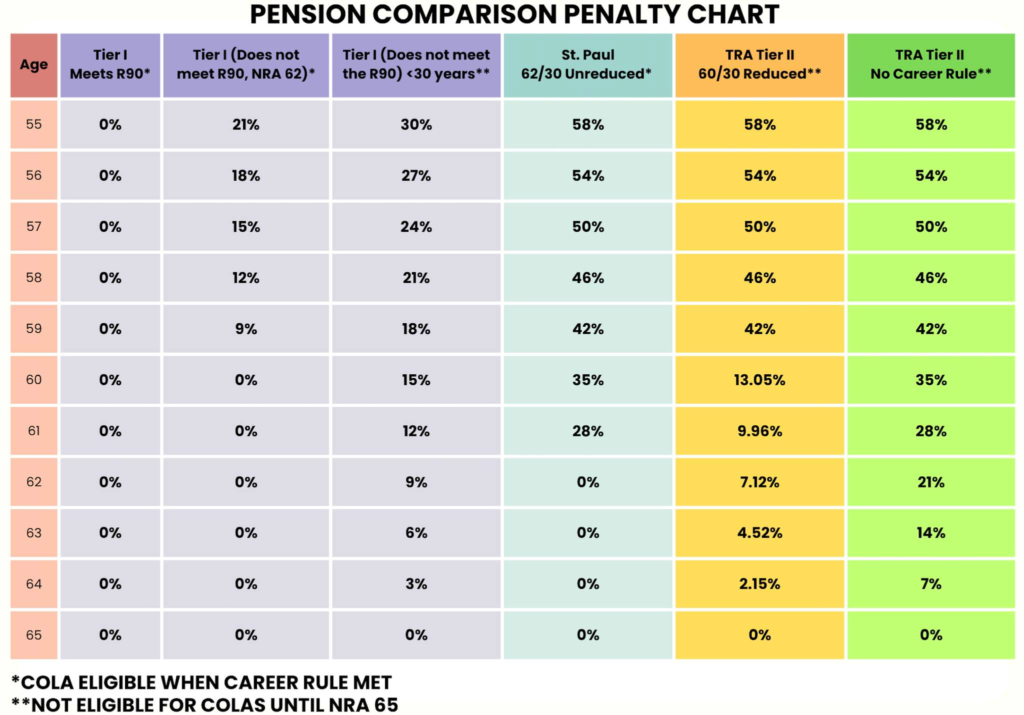
    From the reduction schedule, the age 62 reduction without meeting 30 years is 21%.

    $39,525 ร— (1 โˆ’ 0.21)
    = $31,225 per year

    That is less than half of the benefit in Scenario 1.

    This example illustrates how both service length and eligibility thresholds dramatically change outcomes.

    Years of service, multiplier timing, retirement age, and the 30-year rule all interact to determine your final pension.

    The formula is straightforward. The decisions are not.

    Comparing Lifetime Payouts and the Break-Even Question

    Now letโ€™s compare Scenario 1 and Scenario 2 more directly.

    Scenario 1
    Retires at 65 with $70,300 per year.

    Scenario 2
    Retires at 60 with $51,961 per year.

    First, consider the five years between age 60 and 65.

    The teacher retiring at 60 collects:

    $51,961 ร— 5 = $259,805

    The teacher waiting until 65 collects nothing during those five years.

    So by age 65, the early retiree is ahead by approximately $260,000 in pension payments.

    However, beginning at age 65, the teacher who waited is receiving:

    $70,300 โˆ’ $51,961 = $18,339 more per year.

    Now we can estimate a break-even point.

    To โ€œmake upโ€ the $259,805 collected earlier, the higher annual pension must close that gap.

    $259,805 รท $18,339 โ‰ˆ 14.2 years

    That means the break-even point occurs roughly 14 years after age 65, or around age 79.

    If both teachers live beyond 79, the teacher who waited until 65 will collect more total lifetime pension dollars.

    If both pass away before approximately age 79, the teacher who retired at 60 will have collected more in total pension benefits.

    This does not account for:

    โ€ข Investment of early payments
    โ€ข Continued salary earned from 60 to 65
    โ€ข COLA timing differences
    โ€ข Healthcare cost differences

    But it illustrates the core tradeoff.

    Retiring at 60 does not automatically mean you lose money. It changes the timeline of how money is received.

    Waiting until 65 increases your annual benefit permanently. Retiring at 60 gives you five additional years of income and freedom.

    The decision is not purely mathematical. It is personal, financial, and health-dependent.

    How Early Retirement Reductions Are Applied

    The TRA formula determines your base pension first. Early retirement reductions are applied after that base amount is calculated.

    If you retire before normal retirement age, your benefit is permanently reduced based on your age and whether you meet specific eligibility thresholds.

    For Tier II teachers:

    โ€ข Meeting the 30-year requirement qualifies you for the enhanced 60/30 reduction schedule.
    โ€ข Not meeting 30 years places you under the standard โ€œNo Career Ruleโ€ reduction schedule.

    The difference between those schedules can be significant. At age 60, the reduction is 13.05% if you meet 30 years. Without 30 years, the reduction at age 60 is 35%.

    These reductions are permanent. They do not disappear at age 65.

    For a full breakdown of the enhanced 60/30 schedule and how it compares across ages, see our detailed 60/30 guide.

    Understanding this structure is critical. The base formula determines how much you have earned. The reduction schedule determines how much you actually receive.

    What This Means for Your Retirement Planning

    If you are more than 10 years from retirement, focus on two levers:

    โ€ข Growing your High-5 salary
    โ€ข Continuing to build service credit

    Those two variables drive the formula more than anything else.

    If you are within five years of retirement, model multiple retirement ages. Compare 60, 62, and 65. Small differences in service and reduction percentages create large lifetime differences.

    If you are approaching 30 years of service, eligibility thresholds matter. Crossing that 30-year mark can significantly change the reduction schedule applied to your pension.

    If you are under 30 years and considering early retirement, run the reduction math carefully. The difference between meeting and not meeting that threshold can be dramatic.

    The TRA pension formula is simple. The decision about when to retire is not.

    Understanding your multiplier, service credit, High-5 average, and reduction schedule gives you the framework to make that decision with clarity.

    If you want a broader overview of how Minnesota teacher retirement works, including eligibility structures and legislative changes, review our complete Minnesota Teacher Retirement guide.

    KEEP STACKIN!

    Frequently Asked Questions About Minnesota TRA Pension Calculations

    Does coaching pay count toward my High-5 salary?

    Only compensation classified as pensionable earnings under TRA rules is included in your High-5 average. Not all supplemental pay automatically qualifies. Review your contract structure or confirm with TRA if you are unsure.

    Can I estimate my pension before I reach 30 years of service?

    Yes. The formula applies at any service level. Multiply your credited years by the appropriate multiplier and apply your High-5 average. Early retirement reductions would apply if you retire before normal retirement age.

    Is the multiplier guaranteed?

    The current multipliers are 1.7% for pre-2006 service and 1.9% for post-2006 service under Tier II. Pension systems are subject to legislative change, but benefits are calculated according to the law in effect at the time of retirement.

    What happens if I leave teaching before reaching 30 years?

    If you are vested, you may leave your contributions in TRA and qualify for a deferred pension at retirement age, or you may request a refund of your employee contributions. Not meeting 30 years primarily affects which early retirement reduction schedule applies.

    Does working part-time near retirement permanently reduce my pension?

    Potentially. Because your High-5 must be five consecutive years, a reduced contract percentage during those years can lower your average salary and therefore your pension. This should be evaluated before changing contract status late in your career.

  • Minnesota Teacher Retirement at 60: Understanding the Enhanced 60/30 Rule

    Minnesota Teacher Retirement at 60: Understanding the Enhanced 60/30 Rule

    For years, Minnesota teacher retirement at age 60 was financially unrealistic for most Tier II educators.

    If you were hired on or after July 1, 1989, you fell under Tier II rules. You could qualify for the 62/30 provision, meaning you were at least age 62 with 30 years of service, and you would receive a more favorable reduction schedule than the standard early retirement penalties.

    But age 60 was not part of that structure. Retiring at 60 meant falling under the harsher โ€œNo Career Ruleโ€ reduction schedule. For many teachers, that penalty was simply too steep.

    In May 2025, that changed.

    Minnesota enacted an enhanced 60/30 rule within the Teachers Retirement Association, TRA. The 60/30 option primarily applies to Tier II members who do not have access to the Rule of 90. If you are unsure which tier you are in, review the Minnesota TRA Tier I vs Tier II breakdown first.

    This change lowered the career-rule threshold from 62 to 60.

    Who Qualifies for the Enhanced 60/30 Rule?

    The enhanced 60/30 provision applies to:

    โ€ข Tier II teachers
    โ€ข At least 30 years of TRA service credit
    โ€ข Age 60 or older

    If you do not yet have 30 years of service, this rule does not apply.

    If you are Tier I, you are governed primarily by Rule of 90 provisions instead. Check out our full guide on Rule of 90 to see those rules.ย 

    Service credit generally includes years worked under TRA-covered employment. Purchased service and certain credited time may count, but you should verify your individual record directly with TRA.

    What Existed Before: The 62/30 Structure

    Before the 2025 reform, Tier II teachers with 30 years of service qualified for a more moderate reduction schedule beginning at age 62.

    At age 62, the reduction was significantly smaller than the general early retirement penalty. That made 62 a practical target retirement age for many long-career educators.

    However, retiring at age 60 still triggered the standard Tier II โ€œNo Career Ruleโ€ reductions.

    Under that prior structure:

    Age 60 carried a 35 percent reduction.
    Age 61 carried a 28 percent reduction.
    Age 62 under the general schedule was 21 percent, though the 62/30 provision improved that for career teachers.

    The gap between 60 and 62 was large enough that most teachers simply waited.

    What Changed Under the Enhanced 60/30 Rule

    The 2025 legislation lowered the career-rule threshold from 62 to 60 for teachers with at least 30 years of service. The 60/30 provision creates eligibility at age 60, but reduction rules are still tied to normal retirement age.

    The new reduction schedule for 30-year career teachers is:

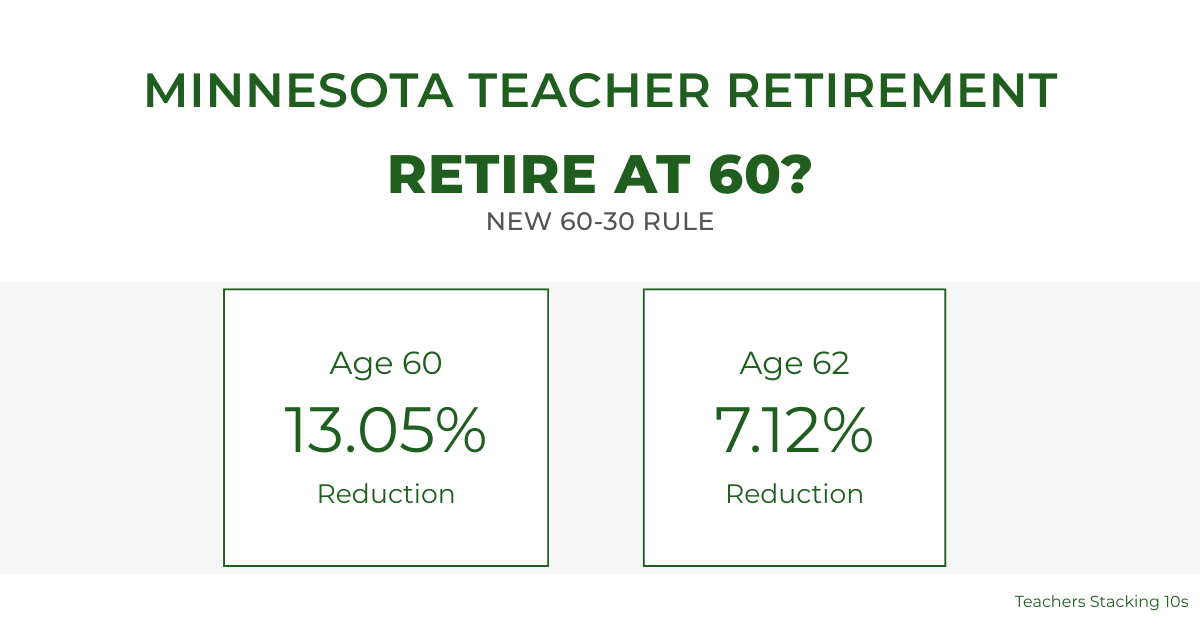
    Age 60 โ€“ 13.05 percent reduction
    Age 61 โ€“ 9.96 percent reduction
    Age 62 โ€“ 7.12 percent reduction
    Age 63 โ€“ 4.52 percent reduction
    Age 64 โ€“ 2.15 percent reduction
    Age 65 โ€“ 0 percent reduction

    This replaces the much steeper early retirement factors that previously applied at ages 60 and 61.

    In practical terms, Minnesota teacher retirement at 60 is now financially realistic in a way it was not before.

    Although the 60/30 provision enhances eligibility for certain members, retiring before full retirement age may still trigger age-based reductions. Review our early retirement reduction guide for full details.

    How the TRA Formula Still Works

    The 60/30 rule does not change the underlying TRA formula. It only changes the reduction factors.

    Your base pension is calculated as:

    Multiplier ร— Years of Service ร— High-5 Average Salary

    For Tier II teachers, the multiplier is 1.7 percent for years of service pre-2006 and 1.9 percent for years of service post-2006.

    Example:

    If your High-5 salary average is $80,000
    And you have 30 years of service

    Your unreduced annual pension would be:

    0.017 ร— 30 ร— $80,000
    = $40,800 per year

    If you retire at 60 under the enhanced 60/30 rule, that benefit is reduced by 13.05 percent.

    $40,800 ร— (1 โˆ’ 0.1305)
    = approximately $35,475 per year

    The reduction is permanent. It does not disappear at 65.

    Before applying early retirement reductions, your base pension is determined by the TRA formula. If you need a full breakdown of how that formula works, including multiplier and High-5 calculations, see our detailed calculation guide.

    What This Means in Dollars

    Suppose your projected unreduced pension at 65 is $60,000 per year.

    Under the old Tier II early retirement schedule, retiring at 60 could have reduced that to approximately $39,000 annually.

    Under the enhanced 60/30 rule, the 13.05 percent reduction would bring it to roughly $52,170.

    That difference fundamentally changes the retirement conversation.

    Instead of asking, โ€œCan I afford to lose 35 percent?โ€ the question becomes, โ€œIs a 13 percent reduction worth gaining two years of time?โ€

    60 vs 62: The Real Decision

    At age 60, the reduction is 13.05 percent.
    At age 62, it is 7.12 percent.

    That is roughly a 6 percentage point difference.

    Two additional years of salary also increase your High-5 average and your years of service, which increases the base benefit before reductions are applied.

    In many cases, waiting until 62 produces a noticeably higher lifetime benefit.

    However, the flexibility at 60 is now meaningful. For teachers with strong supplemental savings or personal reasons to step away earlier, the financial tradeoff is no longer extreme.

    Important: COLA Eligibility Still Begins at 65

    Even under the enhanced 60/30 rule, cost-of-living adjustments typically do not begin until normal retirement age, generally 65.

    If you retire at 60, you may receive several years without COLA increases. Inflation during that period affects long-term purchasing power.

    The reduction schedule improved. COLA timing did not.

    Health Insurance Between 60 and 65

    One of the most overlooked pieces of retiring at 60 is healthcare.

    Medicare eligibility begins at 65.

    If you retire at 60, you must bridge five years of coverage. That may include:

    โ€ข District retiree coverage
    โ€ข COBRA
    โ€ข Spousal coverage
    โ€ข Individual marketplace plans

    Healthcare costs during that window can materially impact whether retiring at 60 makes sense.

    The Bigger Retirement Strategy

    The enhanced 60/30 provision is a meaningful improvement for Tier II educators. It narrows the gap between career teachers hired before and after 1989 and expands retirement flexibility.

    However, your TRA pension is only one part of your plan.

    Your 403(b) balance, Roth IRA contributions, savings rate, and overall retirement readiness determine how much flexibility you truly have.

    Minnesota teacher retirement at 60 is now possible for many educators.

    Whether it is optimal depends entirely on your numbers.

    If you need a full breakdown of how the TRA formula works and how to project your benefit, start with our complete Minnesota Teacher Retirement guide.

    Keep Stackin!

    Frequently Asked Questions About the Minnesota 60/30 Rule

    Can I retire at 60 with less than 30 years of service?

    No. The enhanced 60/30 rule requires at least 30 years of TRA service credit. If you retire at 60 with fewer than 30 years, you will fall under the standard early retirement reduction schedule, which carries significantly larger penalties.

    Is the 13.05 percent reduction permanent?

    Yes. The reduction applied at age 60 is permanent. It does not disappear at age 65. Your pension is reduced for life based on the age at which you begin collecting benefits.

    Does the 60/30 rule apply to Tier I teachers?

    No. Tier I teachers are primarily governed by Rule of 90 provisions and different retirement eligibility rules. The enhanced 60/30 change specifically affects Tier II teachers with at least 30 years of service.

    Does sick leave count toward the 30 years of service?

    Generally, sick leave conversion can increase your service credit at retirement, but eligibility rules and calculations can vary. You should verify your official service credit total with TRA before making a retirement decision.

    Does coaching pay or extra duty pay count toward my High-5 salary?

    Only earnings that are considered pensionable compensation under TRA rules are included in your High-5 average salary calculation. Not all supplemental pay qualifies. It is important to confirm what counts toward your final average salary.

    Can I continue working after retiring at 60?

    There are restrictions on returning to work in a TRA-covered position after retirement. Earnings limits and reemployment rules may apply. Before retiring and returning to work, review TRA guidelines carefully.

    Will the 60/30 rule change again in the future?

    Pension systems are subject to legislative changes. While the enhanced 60/30 rule is currently in effect, future reforms are always possible. Retirement decisions should be based on current law, but awareness of legislative risk is prudent.

  • How to Save for Your Childโ€™s College (Before Itโ€™s Too Late)

    How to Save for Your Childโ€™s College (Before Itโ€™s Too Late)

    Iโ€™ve got two daughters in college right nowโ€”and let me be blunt: I didnโ€™t plan for this. I didnโ€™t save early. I didnโ€™t have a college fund. And now? I’m paying for itโ€”literally and emotionally. Itโ€™s stressful. Itโ€™s expensive. Itโ€™s a heavy weight that could have been avoided.

    College is an exciting time for young adults. Don’t cause them stress by not preparing now.

    If you’re a parent and college is still a few years away for your kids, youโ€™ve got a chance to do it differently. Saving for college doesnโ€™t have to be overwhelming, and the payoffโ€”peace of mind, financial stability, and freedom for your kidsโ€”is worth every effort.

    In this post, Iโ€™ll walk you through why saving early matters, and how you can actually start building a solid college fund today (even if you feel like youโ€™re already behind).


    What Does โ€œSaving for Collegeโ€ Really Mean?

    Saving for college simply means setting aside money regularly, over time, to help pay for your childโ€™s future education costsโ€”whether itโ€™s a 4-year university, a trade school, or community college. With tuition, books, and living expenses continuing to rise, college can easily cost tens (or hundreds) of thousands of dollars per student.

    A little planning now can save a lot of headaches later

    This kind of expense can catch parents off guard. According to the College Board, the average cost of tuition and fees for the 2023โ€“2024 school year was over $10,000 for in-state public colleges and more than $40,000 for private colleges. Thatโ€™s per year.


    Why Itโ€™s So Important to Start Saving Early

    Hereโ€™s what Iโ€™ve learned the hard way: when you donโ€™t prepare, you borrow. When you borrow, you pay more. Interest adds up fast. And when the bills roll in? Itโ€™s not just money you oweโ€”itโ€™s the time and energy you lose worrying about it.

    Starting early gives you options. It lets compound interest work in your favor. It lets you contribute small amounts that grow over time instead of scrambling with big payments later. Most importantly, it gives your kids the gift of choiceโ€”without burying them in student loans.

    Give your money time to grow and you will be rewarded

    How to Start Saving for College Today

    1. Set a Realistic Goal

    You donโ€™t need to cover 100% of your childโ€™s college costs. Many families aim to save for about a third of the expected cost. Scholarships, grants, and part-time jobs can help fill the rest. Start by using a college cost calculator to estimate future expenses, then set a monthly savings goal that fits your budget.

    2. Open a 529 College Savings Plan

    This is the gold standard for college savings. A 529 plan is a tax-advantaged account designed specifically for education expenses. Money grows tax-free and withdrawals are tax-free when used for qualifying education expenses like tuition, books, and room and board.

    You can set one up through most investment firms or directly through your stateโ€™s plan. Many plans even offer automatic deposits to make saving effortless.

    3. Automate Your Contributions

    The easiest way to build a habit is to automate it. Set up a recurring monthly transfer from your checking account to your 529 or savings account. Even $25 or $50 a month adds up over timeโ€”and you wonโ€™t have to think about it.

    4. Ask Family to Contribute

    Instead of more toys or gadgets during birthdays and holidays, ask grandparents or relatives to contribute to your childโ€™s college fund. Many 529 plans let others make one-time or recurring contributions online, which makes it easy for loved ones to pitch in.

    5. Review and Adjust Each Year

    Life changes. So should your savings strategy. Each year, revisit your goals, check your account balance, and adjust your contributions if you can. If you get a raise or bonus, increase your savings rate. Youโ€™ll thank yourself later.


    Tips to Stay on Track (Even When Life Gets in the Way)

    • Start small: Donโ€™t wait until you can save hundreds each month. Begin with what you can, even if itโ€™s $10 a week.
    • Use windfalls wisely: Tax refunds, bonuses, or gifts can make a big dent in your savings goal if you resist the urge to spend.
    • Keep the end in mind: Picture your child receiving that college acceptance letter without fear of debt. That vision can keep you motivated.

    Final Thoughts

    I didnโ€™t save, and now Iโ€™m hustling to make tuition payments, navigating student loans, and watching my kids stress about costs. Itโ€™s not a great feeling. But itโ€™s one you can avoid.

    Start saving nowโ€”no matter how little. Give your future self (and your kids) the advantage of preparation. Youโ€™ll be building more than just a college fund. Youโ€™ll be building freedom, flexibility, and financial peace. So create your plan, work your plan, and along the way, KEEP STACKIN!

    All your saving now will pay off in the end!
  • When Markets Fall, Stay Standing: A Teacherโ€™s Guide to Long-Term Wealth

    โ€œIn the short run, the market is a voting machine, but in the long run, it is a weighing machine.โ€
    โ€” Benjamin Graham

    As a teacher, you know that learningโ€”and growthโ€”takes time. The same goes for your investments. With the recent market downturn, itโ€™s tempting to worry or even consider pulling out of your retirement accounts. But historyโ€”and mathโ€”say that staying the course is almost always the better choice.


    ๐Ÿ“Š Market Drops Are Normalโ€”Even Healthy

    Markets go through cycles. What feels like a crash now may just be part of a long-term upward journey.

    ๐Ÿ” Stat Snapshot:

    • The S&P 500 has had an average annual return of ~10% since its inception.
    • Market corrections (drops of 10% or more) happen about once every 2 years.
    • Despite major crashes (like in 2008 or 2020), the market has always recovered.

    ๐Ÿง  Keep a Long-Term Mindset

    Your retirement planโ€”whether a pension, 403(b), or IRAโ€”is designed for the long haul. If youโ€™re 5, 10, or 20+ years away from retirement, youโ€™ve got time on your side.

    CrashYear% DropRecovery Time
    Dot-com Bust2000โ€“2002-49%4 years
    Financial Crisis2008โ€“2009-57%5 years
    COVID Crash2020-34%6 months

    Each of these times felt awful in the moment. Each one recoveredโ€”and went on to new highs.


    ๐Ÿ™…โ€โ™€๏ธ Emotional Decisions = Expensive Mistakes

    Selling during a drop feels like avoiding painโ€”but it often locks in losses instead.

    ๐Ÿ“‰ Stat Highlight:

    • From 2001 to 2020, the S&P 500 returned 7.5% annually, but the average investor only earned 2.9%. Why? Panic selling and poor timing.
    • If you invested $10,000 in 2003 and stayed fully invested, youโ€™d have ~$60,000 by 2023.
    • If you missed just the 10 best days? Youโ€™d have ~$29,000.
    • Miss the 20 best days? Down to ~$18,000.

    Most of those “best days” come right after the worst ones.


    ๐Ÿ’ช What You Can Do Instead

    Rather than react emotionally, try this:

    โœ… Stick to your plan โ€“ Especially if your retirement is more than 5 years away.
    โœ… Keep contributing โ€“ Youโ€™re buying more shares while theyโ€™re โ€œon sale.โ€
    โœ… Talk to a pro โ€“ A financial advisor can help you review your strategy calmly.
    โœ… Avoid the noise โ€“ News cycles thrive on fear. You donโ€™t have to.


    ๐ŸŽ Remember: Youโ€™re a Teacher

    You teach students resilience, patience, and how to keep going when things get hard. That same wisdom applies here. The market might be down nowโ€”but it wonโ€™t stay that way forever. The key to building long-term wealth is not timing the market, but time in the market.

    โ€œThe stock market is a device for transferring money from the impatient to the patient.โ€
    โ€” Warren Buffett


    ๐Ÿ“Œ Final Thought

    Panicking during a dip is like giving a pop quiz on Day 1 of schoolโ€”itโ€™s too early to judge the outcome.
    Stay calm, stay invested, and trust the process. Your future self will thank you and you’ll KEEP STACKIN!

  • Why You Need an Emergency Fund as a Teacher!

    What Is It?

    pexels-photo-3483098.jpeg
    Photo by John Guccione www.advergroup.com on Pexels.com

    Why Teachers Need One

    Don’t let a health emergency ruin your financial future

    Building an Emergency Fund

    Peace of Mind

    The Professor taking it all in.

    Practical Tips for Maintaining an Emergency Fund

    Real-Life Scenarios Where an Emergency Fund Proves Crucial

    Conclusion

    9 responses to “Why You Need an Emergency Fund as a Teacher!”

    1. tlover tonet Avatar

      I’d forever want to be update on new blog posts on this website , saved to my bookmarks! .

      1. The Professor Avatar
        The Professor

        Awesome! Thanks for the support!

    2. instagram video downloader apk uptodown Avatar

      Your writing has a way of resonating with me on a deep level. I appreciate the honesty and authenticity you bring to every post. Thank you for sharing your journey with us.

      1. The Professor Avatar
        The Professor

        Thanks much for the support!

      2. The Professor Avatar
        The Professor

        Thanks much for your support!

    3. X22abope Avatar
      X22abope

      Hey people!!!!!
      Good mood and good luck to everyone!!!!!

      1. The Professor Avatar
        The Professor

        Thanks for reading!

    4. X22abope Avatar
      X22abope

      Hey people!!!!!
      Good mood and good luck to everyone!!!!!

      1. The Professor Avatar
        The Professor

        Thanks for reading!

    Leave a Reply

  • Teacher’s Guide: When to Consider Getting a Master’s Degree

    Teacher’s Guide: When to Consider Getting a Master’s Degree

    So, youโ€™re a teacher. Youโ€™ve mastered the art of deciphering hieroglyphic handwriting, survived countless PTA meetings, and you can spot a kid trying to hide their phone from a mile away. But now youโ€™re wondering, โ€œShould I go back to school and get my masterโ€™s degree?โ€ Before you dive back into the world of late-night studying and caffeine overdoses, letโ€™s take a humorous yet honest look at when it might be the right time to pursue that advanced degree.

    1. Assessing Your Career Goals (or Lack Thereof)

    First things first, where do you see yourself in the grand scheme of your teaching career? Do you dream of being the school principal, ruling the roost with an iron (but fair) fist? Or perhaps you want to be the go-to person for special education or reading interventions?

    When to Go Back:

    • Career Advancement: If youโ€™re eyeing a leadership role or a specialized position, a masterโ€™s degree is often your golden ticket. Plus, think of the bragging rights!
    • Specialization: Want to be the Sherlock Holmes of reading problems or the Yoda of special education? A masterโ€™s degree will give you the street cred you need.

    2. Evaluating Your Financial Situation (AKA Counting Your Pennies)

    Letโ€™s talk money. Pursuing a masterโ€™s degree isnโ€™t exactly cheap. Itโ€™s a significant investment, and unless youโ€™ve found a secret stash of gold under the gym floor, you need to consider your financial situation carefully.

    When to Go Back:

    • Financial Stability: If youโ€™re not drowning in student loans or eating ramen for every meal (unless you love ramen, then by all means), it might be a good time to consider further education.
    • Employer Assistance: Some districts offer tuition reimbursement. If yours does, grab it like itโ€™s the last donut in the teacherโ€™s lounge.
    • Scholarships and Grants: There are scholarships out there just waiting for you to apply. Think of it as free money, which, letโ€™s be honest, is the best kind of money.

    3. Considering Your Professional Experience (and Sanity)

    Your classroom experience is like seasoning in a good stew โ€“ it makes everything better. Plus, having some teaching years under your belt can make your advanced studies more relevant and less, well, theoretical.

    When to Go Back:

    • Early Career: If youโ€™ve been teaching for a few years and feel like youโ€™re ready to learn more (and maybe even show off a bit), it could be the right time.
    • Mid-Career: Feeling a bit stuck in a rut? A masterโ€™s degree can be the perfect way to shake things up and remind you why you love teaching in the first place.

    4. Balancing Personal Commitments (or Juggling Flaming Swords)

    Life is busy. Between grading papers, attending sports games, and, you know, having a life, fitting in a masterโ€™s program can feel like juggling flaming swords. Take a good look at your current personal commitments.

    When to Go Back:

    • Life Balance: If your personal life is somewhat calm (or at least not a total circus), it might be a good time to add graduate school to the mix.
    • Less Personal Stress: Avoid diving into a masterโ€™s program during major life upheavals like moving, having a baby, or adopting five rescue dogs. Trust me.

    5. Considering the Benefits and Rewards (AKA The Good Stuff)

    Yes, itโ€™s hard work. Yes, itโ€™s expensive. But a masterโ€™s degree comes with some pretty sweet perks that can make it all worth it.

    When to Go Back:

    • Salary Increase: Many districts pay more for advanced degrees. Think of all the extra classroom supplies you could buy! Or, you know, actual fun stuff.
    • Enhanced Skills: Youโ€™ll learn advanced strategies and deepen your knowledge, making you an even more awesome teacher.
    • Networking: Graduate programs are a great way to meet other educators who can share tips, offer support, and commiserate over grading woes.

    6. Exploring Alternative and Flexible Options (Because Life Happens)

    Gone are the days when you had to choose between working and studying. Thanks to the internet (and some clever academics), there are now more flexible options for getting your degree.

    When to Go Back:

    • Flexible Programs: Online and part-time programs can fit around your teaching schedule. You can work on your degree in your PJs โ€“ itโ€™s a win-win.
    • Accelerated Programs: If youโ€™re in a hurry to advance, look into accelerated programs that let you finish faster. Just be prepared for an intense ride!

    7. Reflecting on Your Motivation and Readiness (or Are You Crazy Enough to Do This?)

    Last but not least, take a moment to check in with yourself. Are you excited about the idea of going back to school, or does it fill you with a sense of impending doom?

    When to Go Back:

    • Passion for Learning: If you genuinely love learning and are excited about diving deeper into your field, go for it! Your enthusiasm will carry you through the tough times.
    • Readiness for Change: If youโ€™re feeling stagnant and ready for new challenges, a masterโ€™s degree can be just the shake-up you need.

    Conclusion

    Deciding when to go back for your masterโ€™s degree is no small task. Itโ€™s a personal decision that depends on your career goals, financial situation, professional experience, personal commitments, and motivation. By considering all these factors (and maybe having a heart-to-heart with yourself), you can make the best decision for you.

    Remember, thereโ€™s no perfect time. The right time for one person might be the wrong time for another. What matters is finding the timing that works best for you and aligns with your goals and current life situation. Pursuing a masterโ€™s degree is a big step, but with careful planning and a sense of humor, it can be a rewarding and transformative experience. Let us know your thoughts about when you should pursue your Master’s degree in the comments below.

    Good luck, and Keep Stackin!