
If you teach in Minnesota, your Teachers Retirement Association, TRA, pension is one of the most valuable financial benefits you have. It is also one of the least understood.
Because participation in TRA is mandatory, every public school teacher is automatically enrolled and contributing from their first paycheck. Yet many educators never fully understand how their pension is calculated, when they can retire, or how recent legislative changes affect long-term income.
Understanding Minnesota teacher retirement is not optional. It directly shapes your future financial flexibility.
In this guide, we will break down how TRA works, how benefits are calculated, when you can retire, how early retirement penalties apply, and what recent funding changes mean for your long-term plan.
New to Minnesota teacher retirement planning? Start with our complete Teacher Finances 101 guide, then return here for a deeper dive into TRA.
What is TRA?
The Minnesota Teachers Retirement Association, TRA, administers pension benefits for public educators across the state. It provides retirement, disability, and survivor benefits funded through employee contributions, employer contributions, and long-term investment growth.
TRA is governed by an eight-member board. Five trustees are elected by members, four active teachers and one retiree. The governor appoints the remaining three. Investment management is handled by the Minnesota State Board of Investment, SBI, which also manages assets for PERA and MSRS.
In plain terms, TRA administers the pension system and the SBI invests the assets.
Membership begins the day you start employment with a TRA-covered employer. Contributions are deducted automatically from each paycheck.
So what is a Pension?
A pension is a defined-benefit retirement plan. That simply means your future retirement income is based on a formula, not on how well your personal investments perform.
With a defined-contribution plan like a 403(b) or 401(k), your retirement income depends on how much you contribute, how your investments grow, and how you manage withdrawals later. The responsibility and the risk sit largely with you.
With the Minnesota TRA pension, the benefit is calculated using a formula tied to your years of service, your salary, and a multiplier set in statute. Once you retire, you receive a guaranteed monthly payment for life. Depending on the option you select, that benefit can also provide income for a surviving spouse.
That guarantee is powerful. It removes many of the uncertainties that come with market-based retirement accounts.
However, it is important to view your pension as a foundation, not a complete strategy. TRA is designed to replace a portion of your income, not all of it. Understanding how large that portion will be is the key to deciding how much additional investing you need to do.

How is TRA funded?
The Minnesota TRA pension is funded through three primary sources:
• Employee contributions
• Employer contributions
• Long-term investment returns
As a member, a percentage of your salary is automatically deducted from each paycheck. Your employer also contributes on your behalf. Those combined contributions are invested by the Minnesota State Board of Investment.
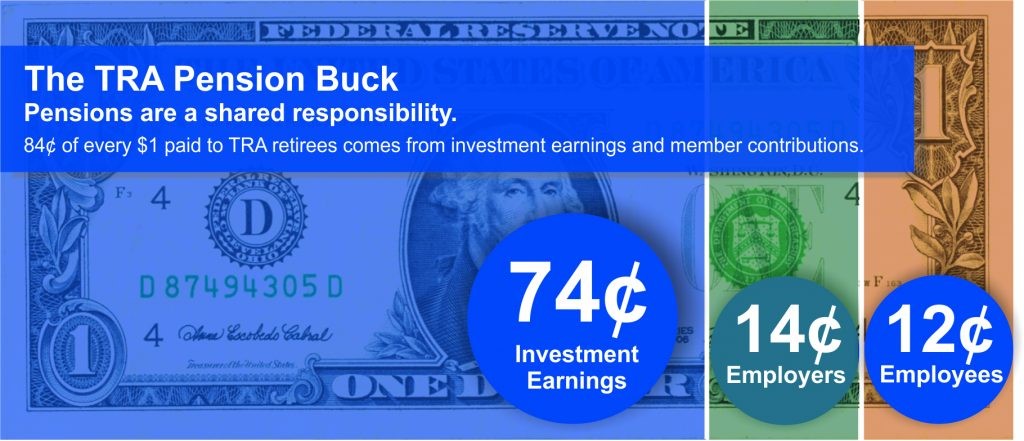
Over time, investment growth provides the majority of the funding needed to pay future benefits. This is true for most public pension systems.
Because investment returns fluctuate, TRA relies on actuarial projections to estimate long-term obligations. When returns fall short of expectations or demographic assumptions shift, the legislature may adjust contribution rates, benefit structures, or actuarial assumptions to maintain long-term stability.
That is why you occasionally see legislative updates affecting contribution percentages, COLA adjustments, or funding timelines.
The key takeaway is this: your pension is not funded from a single source. It is supported by ongoing contributions and long-term investment growth. Monitoring funding ratios and legislative changes is part of responsible retirement planning.
Over time, the majority of pension funding comes from investment growth. Contributions from employees and employers form the base, but long-term returns drive sustainability.
The breakdown below shows how a typical TRA pension dollar is funded.
When Can You Retire Under Minnesota TRA?
One of the first questions teachers ask is simple: When can I retire?
Under Minnesota TRA, eligibility depends on your hire date and your years of service credit.
It is important to separate two ideas: retirement eligibility and full, unreduced retirement. They are not the same.
Minnesota TRA is divided into two eligibility tiers based on hire date. Your tier determines whether you qualify for the Rule of 90, what your full retirement age is, and how early retirement reductions apply. If you are unsure which structure applies to you, read the full breakdown of Minnesota TRA Tier I vs Tier II.
Normal Retirement Age
For teachers hired after June 30, 1989, the normal retirement age, often called NRA, is 65.
This is the age at which you qualify for your full, unreduced pension benefit under the standard formula.
That does not mean you must teach until 65. Early retirement options exist, but they come with permanent reductions.
Rule of 90 (Pre-1989 Hires Only)
If you were hired before July 1, 1989, you may qualify under the Rule of 90.
When your age plus years of service equals 90, you can retire with full benefits and no early retirement penalty.
This rule no longer applies to teachers hired after that date.
If this rule applies to you check out our full breakdown of Rule of 90.
Enhanced 60/30 Provision
Recent legislative changes introduced an enhanced 60/30 option.
If you are age 60 with at least 30 years of service credit, you may qualify for retirement with a reduced early retirement penalty compared to retiring before age 60.
Retiring at 60 does not automatically mean your benefit is unreduced. Your tier status and years of service determine whether an age-based reduction applies.
This provision created more flexibility for long-career teachers who wish to retire before 65.
Age 62 With 30 Years of Service
For many teachers hired after 1989, age 62 with 30 years of service remains an important milestone.
While not fully unreduced retirement, the penalty at 62 with 30 years is significantly smaller than retiring earlier.
Because of this, many Minnesota teachers use 62 as a practical target retirement age.
Early Retirement at 55
Teachers may begin collecting benefits as early as age 55 if vested. Most teachers become vested after three years of service.
However, retiring at 55 results in a substantial reduction to your monthly benefit. In some cases, the reduction can exceed 60 percent compared to full retirement age.
Eligibility does not automatically mean financial readiness. The reduction is permanent and should be evaluated carefully.
Important Note on COLAs
Recent changes also adjusted cost-of-living adjustments, COLAs. For many retirees, COLA eligibility now begins at normal retirement age, generally 65, rather than immediately upon retirement.
This change can affect long-term purchasing power and should be factored into your retirement planning.
Strategic Takeaway
The question is not simply “When can I retire?”
A better question is: When can I retire with the income I want?
Understanding service credit milestones, early retirement penalties, and COLA timing allows you to make that decision intentionally rather than emotionally.
Before choosing a retirement date, log into your TRA account and run multiple scenarios using the official retirement calculator.
So How Is My Benefit Calculated?
Your Minnesota teacher retirement benefit is determined by a defined formula. It is not based on market performance or the balance of an individual investment account.
The formula is:
Years of Service × High-5 Salary × Formula Multiplier
Each component matters, so let’s break them down.
Years of Service
Each academic year you work in a TRA-covered position earns one year of service credit. The more years you accumulate, the larger your benefit becomes. Service credit is one of the most powerful variables in your control.
High-5 Salary
Your High-5 salary is the average of your five highest consecutive years of earnings. For most teachers, those years occur near the end of their career when they are at the top of their salary schedule.
Because your pension is tied directly to salary, late-career earnings have an outsized impact on your final benefit.
Formula Multiplier
The multiplier applied to each year of service depends on when that service was earned.
Service earned before July 1, 2006 is multiplied by 1.7 percent.
Service earned after June 30, 2006 is multiplied by 1.9 percent.
Each year of service is multiplied by its applicable percentage, and the totals are combined to determine your overall benefit percentage.
Example Calculation
Let’s walk through a simplified example.
Assume:
38 years of service
High-5 salary of $72,000
8 years at 1.7 percent
30 years at 1.9 percent
First, calculate the combined multiplier.
(8 × 1.7%) + (30 × 1.9%) = 70.6%
Next, apply that percentage to the High-5 salary.
70.6% × $72,000 = $50,832 per year
If retiring under an early retirement provision such as 62/30 or enhanced 60/30, an early retirement reduction would apply.
For example, if the reduction were 14 percent:
14% of $50,832 = $7,116
That produces an estimated annual benefit of approximately $43,716, or about $3,643 per month.
Your exact benefit will depend on your service history and chosen retirement date. The most accurate way to estimate your pension is to log into your TRA account and use the official retirement calculator to run multiple scenarios.
If you want a detailed step-by-step breakdown of exactly how the Minnesota TRA pension is calculated, including real retirement scenarios, read our full TRA pension calculation guide.
Why This Formula Matters
Unlike a 403(b) or Roth IRA, where retirement income depends on account balance and withdrawal strategy, your TRA pension provides a predictable lifetime payment based on a statutory formula.
Understanding this calculation allows you to estimate future income, identify potential gaps, and determine how much supplemental investing you need to build flexibility into your retirement plan.
The pension provides structure. Your decisions around service years, retirement timing, and additional savings determine the outcome.
Future of TRA
One of the most important metrics to monitor is the funded ratio. This represents the percentage of projected future obligations that are currently backed by assets.
A funded ratio of 100 percent means the plan has enough projected assets to meet long-term obligations under current assumptions.
As of recent actuarial reports, TRA’s funded ratio has been below 100 percent, prompting legislative adjustments to improve long-term sustainability.
Legislative Adjustments
In recent years, Minnesota lawmakers have implemented several changes, including:
• Adjustments to cost-of-living increases
• Changes to contribution rates for employees and employers
• Modifications to actuarial return assumptions
• Extension of amortization timelines
These changes were designed to strengthen the long-term funding trajectory of the system.
What This Means for Teachers
It is important to understand two things at the same time:
First, TRA is not on the verge of disappearing. The pension is backed by statutory obligations and ongoing contribution structures.
Second, pensions are dynamic systems. Contribution rates, assumptions, and benefit structures can change over time to maintain solvency.
That is why understanding your pension formula, monitoring legislative updates, and maintaining supplemental retirement savings is essential.
Your TRA pension provides a powerful foundation. Responsible planning means building on that foundation, not relying on it exclusively.
Planning Beyond the Pension
The Minnesota TRA pension is a significant advantage compared to many private-sector retirement plans. It provides predictable lifetime income and reduces the personal investment risk that many workers face.
However, it was never designed to replace 100 percent of your working income.
Even small changes in assumptions, contribution rates, or cost-of-living adjustments can affect long-term purchasing power. That does not make the pension unstable. It simply means it should be viewed as one part of a broader strategy.
The most resilient retirement plans combine:
• A clear understanding of the TRA formula
• Realistic projections of future income
• Consistent contributions to a 403(b), Roth IRA, or other supplemental accounts
• A disciplined savings rate throughout your career
Teachers who treat their pension as a foundation rather than a finish line tend to retire with far greater flexibility and confidence.
Final Thoughts on Minnesota Teacher Retirement
The Minnesota TRA pension is one of the most valuable financial benefits available to public educators in this state. It provides predictable lifetime income, shifts market risk away from individual teachers, and offers a level of stability that many private-sector workers no longer have.
At the same time, it is not a complete retirement plan by itself.
Understanding how your benefit is calculated, when you qualify for retirement, how early retirement penalties work, and how funding changes affect long-term sustainability allows you to plan with clarity instead of assumption.
The teachers who retire most comfortably are not the ones who simply trust the system to work. They are the ones who understand it, project it, and build around it.
If you want a structured plan for building that broader strategy, start with our Teacher Finances 101 guide. It walks through the full process step by step.
Clarity today builds flexibility tomorrow.
KEEP STACKIN!
 Money at Home, Money Hacks, THE BLOG
A Little Research Can Save You THOUSANDS Of Dollars!
The Story Last week, my Maytag Neptune dryer started making that hideous,
Read More Side Hustle, THE BLOG
Am I DUMB For Creating This Side Business as a Teacher?
In my previous post, I said that I was going to talk

2023 MN Legislative Final Update and How It Impacts Your TRA Pension
Hey everyone. Well, here is the final update from the 2023 MN

2023 MN Legislative Update and How It Impacts your TRA Pension
Hey everyone! It’s been quite a while since I’ve posted anything on

The Big Adventure Into Higher-Ed
This summer I made the leap from public education to a private
Read More Budgeting, Debt, Investing for Teachers, Money at Home, Retirement, THE BLOG
THE PROFESSOR’S END OF Q2 2022 FINANCIAL UPDATE
This is my post showing how we are saving money both in


Leave a Reply
You must be logged in to post a comment.