Tag: Minnesota TRA

  • Minnesota TRA Full Retirement Age: What Age 65 Really Means

    Minnesota TRA Full Retirement Age: What Age 65 Really Means

    Most Minnesota teachers hear terms like Rule of 90 or 60/30 long before they understand a simpler question: what is the standard full retirement age under TRA?

    Full retirement age, formally called normal retirement age or NRA, determines when you can receive your pension without an actuarial reduction. That age is defined under TRA statute and applies to both Tier I and Tier II members. However, how it interacts with early retirement provisions depends on your tier.

    Understanding this baseline age is critical before evaluating early retirement options or milestone provisions.

    What “Full Retirement Age” Means in Minnesota TRA

    Under the Minnesota Teachers Retirement Association, full retirement age refers to the age at which a member may begin collecting pension benefits without a reduction for early commencement.

    This is sometimes referred to in plan documents as normal retirement age.

    Full retirement age determines:

    • Whether your pension is reduced
    • How early retirement penalties are calculated
    • The minimum age required for unreduced benefits if no special provision applies

    It is important to distinguish this from Social Security full retirement age. TRA and Social Security operate under separate systems with different eligibility rules.

    For a full overview of how the pension formula works, see our guide to the Minnesota TRA pension.

    Full Retirement Age for Tier I Members

    Tier I generally includes teachers who first became members before July 1, 1989.

    For Tier I members, the standard full retirement age is 65.

    However, unreduced retirement may be available earlier if service requirements are met.

    When Tier I Can Retire Without a Reduction

    Tier I members may receive an unreduced benefit at:

    • Age 65 with sufficient service, or
    • Earlier if they qualify under specific provisions such as the Rule of 90

    The key point is that full retirement age sets the baseline. Other provisions may allow retirement before 65 without reduction, but those are separate eligibility pathways.

    Those pathways are explained in detail in the Rule of 90 article.

    Full Retirement Age for Tier II Members

    Tier II generally includes teachers who first became members on or after July 1, 1989.

    Although Tier II differs from Tier I in contribution rates and early retirement reduction schedules, normal retirement age is now aligned at 65 for both tiers. This was reduced by legislation passed during the 2024 legislative session.

    What Happens If You Retire Before Full Retirement Age?

    Unless you qualify for an unreduced provision such as the Rule of 90, retiring before 65 will typically result in a permanent actuarial reduction.

    The reduction:

    • Is calculated based on how many months early retirement begins
    • Is permanent
    • Applies for the duration of the pension

    The specific reduction percentages vary and are detailed in the Minnesota TRA Early Retirement Reduction guide. This article focuses only on the age baseline, not the calculation schedule.

    How Full Retirement Age Interacts With Rule of 90 and 60/30

    Rule of 90 and full retirement age

    For certain Tier I members, the Rule of 90 allows retirement with an unreduced pension when age plus years of service equal 90.

    This provision effectively allows retirement before the standard full retirement age of 65, provided eligibility criteria are met.

    The Rule of 90 is a separate eligibility mechanism, not a redefinition of full retirement age.

    60/30 and full retirement age

    The 60/30 rule allows retirement at age 60 with 30 years of service.

    Whether the benefit is reduced depends on tier status and specific statutory provisions.

    The 60/30 rule creates eligibility. Full retirement age determines whether a reduction applies.

    Common Misunderstandings About Minnesota Teacher Retirement Age

    Can I retire at 55 with 30 years?

    Possibly, but early retirement reductions will likely apply unless you meet specific eligibility thresholds. Retirement eligibility and unreduced retirement are not the same.

    Is full retirement age 62 for Minnesota teachers?

    No. For TRA purposes, full retirement age is 65 for both Tier I and Tier II members. Age 62 is often referenced as an early retirement eligibility age, not full retirement age.

    Does 60/30 mean no reduction?

    Not necessarily. It provides eligibility at 60 with 30 years of service, but reduction rules depend on tier and statutory timing.

    Is TRA retirement age the same as Social Security?

    No. TRA retirement rules are independent of Social Security full retirement age.

    Retirement Age by Tier Quick Reference

    Tier I
    Full retirement age: 65
    Earlier unreduced retirement: Possible under Rule of 90

    Tier II
    Full retirement age: 65
    Earlier retirement: Generally subject to actuarial reduction unless specific provisions apply

    Why Knowing Your Full Retirement Age Matters

    Your full retirement age influences:

    • The size of your monthly pension
    • The cost of retiring early
    • Whether bridge savings in a 403(b) are necessary
    • Your long-term financial planning timeline

    Before evaluating Rule of 90 or 60/30 options, every Minnesota teacher should first know their tier and their full retirement age. For a complete financial picture, check out our Teacher Finances 101 page.

  • Minnesota TRA Early Retirement Reduction Explained

    Minnesota TRA Early Retirement Reduction Explained

    Teaching in Minnesota has become more demanding in recent years. Expectations are higher, classrooms are more complex, and many veteran educators are reassessing their retirement timelines.

    Under the rules of the Minnesota Teachers Retirement Association, or TRA, early retirement is possible. But it is not neutral. Retiring before full retirement age may trigger a permanent actuarial reduction to your monthly pension benefit.

    The real question is not whether you can retire early. It is how much it will cost over the course of your lifetime.

    This guide explains the Minnesota TRA early retirement reduction formula, shows how the reduction is calculated, and walks through real examples so you can evaluate the decision with precision.

    What Is the Minnesota TRA Early Retirement Reduction?

    Under the rules of the Minnesota TRA, teachers may begin collecting retirement benefits before reaching full retirement age. However, starting benefits early permanently reduces the monthly amount.

    This reduction is actuarial. It is not a temporary penalty, and it does not disappear once you reach full retirement age. The benefit is adjusted because it is expected to be paid over a longer period of time.

    The reduction percentage is determined by your age at retirement relative to your tier’s full retirement age. The younger you are when benefits begin, the larger the permanent reduction.

    The key variables are:

    • Your tier status, Tier I or Tier II
    • Your full retirement age
    • Your age when benefits begin

    To determine your Tier status, check out our full guide.

    If you are unsure which tier applies to you, clarify that first. Tier status determines your full retirement age and the applicable reduction schedule.

    Where to Find the Official TRA Reduction Factors

    TRA publishes early retirement reduction factors organized by age at retirement. For each year below full retirement age, a specific actuarial reduction percentage applies.

    The schedule is structured around:

    • Your tier
    • Your full retirement age
    • Your age when you begin collecting benefits

    The reduction is permanent. Beginning benefits at age 62 instead of full retirement age will lock in the reduced amount for life.

    Always verify your specific reduction factor using official TRA materials before making a decision.

    How the Reduction Is Applied

    The reduction is applied after your base pension benefit is calculated.

    Step 1: Calculate Your Base Pension Benefit

    Your base benefit is determined by:

    • Your High-5 average salary
    • Years of allowable service
    • The TRA accrual formula

    To determine how to calculate your base benefit, see our Pension Calculation post.

    If you do not understand your base benefit, the reduction percentage will not be meaningful.

    Step 2: Identify Your Full Retirement Age

    Full retirement age differs by tier.

    Tier I and Tier II members both have a normal retirement age of 65. However, Tier I members may qualify for an unreduced benefit under the Rule of 90, while Tier II members do not.

    The reduction schedule measures your retirement age against this benchmark.

    Early retirement reductions apply when benefits begin before normal retirement age.

    Step 3: Apply the Age-Based Reduction Factor

    Once you determine your age at retirement, you locate the corresponding reduction percentage.

    For example:

    • Retiring three years before full retirement age results in a specific actuarial reduction.
    • Retiring ten years before full retirement age results in a much larger reduction.

    The younger you are at retirement, the larger the permanent adjustment.

    Real Minnesota Scenarios

    These examples assume current TRA reduction factors and a full retirement age of 65.

    Example 1: Tier I Teacher Retiring at Age 60

    Assume:

    • 25 years of service
    • A calculated base pension of $3,000 per month at full retirement age

    Since full retirement age is 65 and the teacher retires at 60, the TRA age-based reduction factor applies. Because this person did not fulfill the Rule of 90, their reduction would be 15%. A Tier I teacher retiring at age 60 with 30 years of service would meet the Rule of 90 and receive an unreduced benefit

    This means that their $3,000 benefit now becomes $2,550. That $450 less per month becomes $5,400 per year. Over a 25 year retirement that is $135,000 in lost income.

    Example 2: Tier II Teacher Retiring at 62

    Tier II members typically face larger reductions when retiring before full retirement age.

    Assume:

    • A calculated base benefit of $3,200 per month
    • Retirement at age 62 with 25 years of service
    • Full retirement age at 65

    This member would face a 21% reduction.

    That is a $672 monthly permanent reduction.

    Over decades of retirement, that difference compounds significantly.

    Check out our post on the key early retirement provision for Tier II: The “60-30 enhanced” rule.

    Example 3: Retiring at 55

    Retirement at 55 may be permitted depending on service requirements, but the reduction percentage at that age can exceed 50% depending on your tier!

    For many teachers, retiring at 55 without significant supplemental savings can drastically reduce long-term retirement income.

    For help planning your future retirement under this scenario, check out our Teacher Finance 101 guide.


    For this type of early retirement, you’ll also want to check out our 403b guide.

    This is where planning outside the pension system becomes essential.

    Tier I vs Tier II Differences in Early Retirement

    Tier I members generally have:

    • Lower penalties
    • More favorable early retirement treatment

    Tier II members:

    • Higher full retirement ages
    • Larger age-based reductions when retiring early

    Before making a decision, confirm your tier and your exact full retirement age. Those two variables determine your reduction factor.

    When Early Retirement May Be Reasonable

    Early retirement is not automatically a mistake.

    It may make sense if:

    • You have built substantial 403b or Roth IRA assets
    • You plan to continue working part-time
    • Health or family priorities outweigh maximizing pension income
    • You separate from employment but delay beginning benefits

    The sequence should be:

    1. Calculate the base pension.
    2. Apply the age-based reduction factor.
    3. Measure the permanent income difference.
    4. Evaluate whether other assets can close the gap.

    Retirement timing should be based on mathematics first. Emotion can inform the decision, but it should not override the math.

    Common Misunderstandings

    • The reduction does not disappear when you reach full retirement age.
    • It is not a temporary penalty.
    • Working elsewhere does not restore the unreduced benefit.
    • The Rule of 90 determines eligibility for Tier I members. It does not eliminate age-based reductions unless the Rule of 90 threshold is met.

    Check out our Rule of 90 guide for more information.

    Eligibility and actuarial reduction are separate concepts.

    Bottom Line

    The Minnesota TRA early retirement reduction schedule exists to quantify the cost of beginning benefits before full retirement age.

    Retiring early is allowed. It is not neutral.

    The difference between retiring at full retirement age and retiring several years early can represent hundreds of dollars per month and potentially six figures over a lifetime.

    Before making the decision, confirm:

    • Your tier
    • Your full retirement age
    • Your calculated base benefit
    • The official age-based reduction percentage

    Once those numbers are clear, you can decide whether early retirement aligns with your broader financial plan.

    Frequently Asked Questions About Minnesota TRA Early Retirement

    Can Minnesota teachers retire at age 55?

    Yes, depending on tier and years of service. However, retiring at age 55 typically results in a significant age-based reduction unless a Tier I member qualifies under the Rule of 90. The reduction at age 55 can exceed 50 percent depending on tier.

    Does the Rule of 90 eliminate early retirement reductions?

    For Tier I members who meet the Rule of 90 threshold, the pension is unreduced. If the Rule of 90 is not met, the age-based reduction schedule applies. Tier II members are not eligible for the Rule of 90.

    Is the Minnesota TRA early retirement reduction permanent?

    Yes. The reduction is permanent and does not increase once you reach full retirement age. The benefit amount is locked in at the age payments begin.

    How much does TRA reduce benefits at age 62?

    The reduction percentage depends on your tier and full retirement age. The official TRA reduction schedule lists the actuarial percentage for each retirement age below full retirement age. Always verify your specific factor using current TRA materials.

  • Minnesota TRA Tier I vs Tier II Explained

    Minnesota TRA Tier I vs Tier II Explained

    Minnesota TRA Tier I vs Tier II is not just a technical distinction. Your hire date determines which retirement tier applies to you, and that single detail changes your retirement age, eligibility for the Rule of 90, and how early retirement reductions are calculated.

    If you need a full overview of how the Teachers Retirement Association works, start with the Minnesota TRA overview.

    Minnesota TRA Overview

    Understanding your tier is the first step before running pension projections or planning retirement timing.

    What Determines Minnesota TRA Tier I vs Tier II Status

    Your tier is based entirely on your first date of covered service in Minnesota TRA.

    • Tier I applies to teachers first hired before July 1, 1989.
    • Tier II applies to teachers first hired on or after July 1, 1989.

    There is no election process. You cannot choose your tier. It is determined by statute and permanently attached to your employment start date.

    This distinction affects:

    • Access to the Rule of 90
    • Full retirement age
    • Early retirement reductions
    • Long term retirement planning strategy

    Minnesota TRA Tier I Eligibility and Retirement Rules

    Minnesota TRA Tier I applies to teachers hired before July 1, 1989.

    Rule of 90 Access

    Tier I members are eligible for the Minnesota Rule of 90. This allows retirement with no early reduction when age plus years of service equal 90.

    For example, age 55 with 35 years of service qualifies. So does age 58 with 32 years.

    Minnesota Rule of 90

    This provision creates significant flexibility for long career educators.

    Full Retirement Age

    Tier I members can reach unreduced retirement under the Rule of 90 or at statutory full retirement age. Because of Rule of 90 access, many Tier I teachers retire earlier without penalty.

    Early Retirement

    If a Tier I member retires before meeting Rule of 90 or full retirement age, early retirement reductions apply. However, the reduction structure is generally more favorable compared to Tier II.

    Pension Formula

    Tier status does not change the basic pension formula multiplier.

    Minnesota TRA pension calculation

    What changes is when you can access the full benefit without reduction.

    Minnesota TRA Tier II Eligibility and Retirement Rules

    Minnesota TRA Tier II applies to teachers first hired on or after July 1, 1989.

    No Rule of 90

    Tier II members do not have access to the Rule of 90.

    This is the most important structural difference in Minnesota TRA Tier I vs Tier II.

    Full Retirement Age

    Tier II full retirement age was adjusted during the 2024 legislative session when the full retirement age was reduced from 66 to 65.

    Unreduced retirement generally requires:

    • Reaching full retirement age, or
    • Meeting statutory service thresholds under the 60/30 structure

    Minnesota 60-30 Retirement Option

    Early Retirement Reductions

    Tier II members may retire as early as age 55 with sufficient service credit. However, benefits are permanently reduced for each month before full retirement age.

    These reductions compound over decades. That makes supplemental savings more important for Tier II teachers.

    Side by Side Comparison: Minnesota TRA Tier I vs Tier II

    Although Tier I and Tier II differ in contribution rates and early retirement reductions, both now share the same normal retirement age under TRA.

    Hire Date
    Tier I: Before July 1, 1989
    Tier II: On or after July 1, 1989

    Rule of 90
    Tier I: Yes
    Tier II: No

    Full Retirement Age
    Tier I: Rule of 90 or statutory full retirement age
    Tier II: Social Security aligned full retirement age

    Early Retirement Reduction
    Tier I: Reduced if retiring before Rule of 90 or FRA
    Tier II: Reduced if retiring before FRA, typically more significant

    Minimum Service Requirement
    Both tiers require vesting through statutory service thresholds.

    This captures the structural difference. The financial implications are where planning becomes critical.

    Why Minnesota TRA Tier I vs Tier II Changes Your Retirement Strategy

    Tier I members often have greater timing flexibility. The Rule of 90 creates options to retire earlier without permanent penalty.

    Tier II members face a longer timeline to full retirement age. Because early reductions are permanent and compound over time, Tier II teachers should prioritize:

    • Higher savings rates
    • Consistent 403b contributions
    • Strategic Roth IRA use
    • Bridge income planning before Social Security

    For a broader framework on building financial systems as a Minnesota educator, revisit:

    Teacher Finances 101

    Understanding Minnesota TRA Tier I vs Tier II is not just about eligibility. It is about aligning your savings behavior with your pension structure.

    Common Questions About Minnesota TRA Tier I vs Tier II

    Is Tier I better than Tier II?

    From a retirement age flexibility standpoint, Tier I is more favorable because of Rule of 90 access. However, both tiers retain the defined benefit pension structure.

    Can Tier II teachers retire early?

    Yes, as early as age 55 with sufficient service. However, benefits are permanently reduced if retiring before full retirement age.

    Can you switch tiers?

    No. Minnesota TRA Tier I vs Tier II classification is fixed by first hire date in covered service.

    Does tier status change the pension formula?

    No. The pension formula multiplier remains the same. What changes is retirement timing and reduction structure.

    Final Thoughts on Minnesota TRA Tier I vs Tier II

    Minnesota TRA Tier I vs Tier II is the structural backbone of retirement eligibility for Minnesota teachers.

    Before calculating retirement age or projecting income:

    • Confirm your tier
    • Review Rule of 90 if you are Tier I
    • Understand early reductions if you are Tier II
    • Run your numbers using the pension calculation guide
    • Align your savings accordingly

    Clarity prevents costly timing mistakes. Minnesota teachers who understand their tier plan more effectively.

    Keep Stackin!

  • Minnesota Rule of 90: Complete Guide for TRA Tier I Teachers

    Minnesota Rule of 90: Complete Guide for TRA Tier I Teachers

    Minnesota’s Rule of 90 is one of the most consequential retirement provisions in the history of the Teachers Retirement Association system. It applies only to a shrinking group of educators, yet it continues to shape retirement timelines across the state.

    If you were hired before July 1, 1989, this rule may determine the precise year you can retire without early reduction penalties. The Minnesota Rule of 90 applies only to teachers classified under Tier I of the retirement system. If you are unsure which tier you fall under, review the Minnesota TRA Tier I vs Tier II explanation before planning your retirement timeline.

    This guide explains the Rule of 90 in full detail, including historical context, formula mechanics, reduction math, comparisons to 60 and 30, and strategic planning considerations for Minnesota teachers at every career stage.

    For an overview of how your TRA pension works, check out this detailed post.

    What the Rule of 90 Actually Is

    The Rule of 90 is an eligibility provision within the Minnesota TRA pension structure that applies to Tier I members. Tier I generally includes educators first hired before July 1, 1989. The Rule of 90 allows certain members to retire without reduction even if they have not yet reached normal retirement age.

    The rule states:

    When a member’s age plus allowable years of service credit equals 90 or more, the member may retire with an unreduced pension benefit.

    There is no fixed minimum age. The threshold is based solely on the combined total.

    Examples:

    Age 54 with 36 years of service equals 90.
    Age 56 with 34 years equals 90.
    Age 59 with 31 years equals 90.

    Each qualifies.

    The phrase “unreduced” means that early retirement reduction factors are not applied to the calculated benefit.

    It does not mean your benefit is enhanced or increased. It means it is not reduced.

    Why the Rule Exists

    To understand its importance, it helps to understand pension design.

    Traditional defined benefit pensions assume retirement at a normal retirement age. If a member retires earlier, the system typically applies a reduction to account for longer expected payout duration.

    The Rule of 90 allowed certain long-serving teachers to retire earlier without reduction because their extended service was viewed as offsetting early retirement risk.

    From an actuarial perspective, this increases total lifetime payout. That is why the rule was eventually closed to new members.

    Tier I vs Tier II: Structural Differences

    This section summarizes the differences relevant to Rule of 90. For a full breakdown of retirement age and eligibility rules by tier, see Minnesota TRA Tier I vs Tier II.

    Minnesota divided members into tiers based on hire date.

    Tier I
    First hired before July 1, 1989
    Eligible for Rule of 90
    Different normal retirement age structure
    Legacy benefit multipliers

    Tier II
    First hired after June 30, 1989
    Not eligible for Rule of 90
    Higher normal retirement age
    Modified early reduction factors

    Tier II members must reach normal retirement age or use other provisions such as 60 and 30. They cannot rely on age plus service totaling 90 to eliminate reductions.

    This structural shift significantly changed retirement timing expectations for educators hired after 1989.

    Normal Retirement Age in Minnesota TRA

    Normal retirement age depends on tier.

    For Tier I members, normal retirement age has historically been age 65, with certain provisions for age 62 with sufficient service.

    For Tier II members, reforms have gradually aligned normal retirement age with Social Security standards, now generally age 65 for full benefits.

    If a member retires before normal retirement age and does not qualify under Rule of 90, early reduction factors apply.

    These reductions are permanent.

    Understanding Early Retirement Reduction Factors

    Reduction factors vary based on:

    • Age at retirement
    • Tier
    • Formula selected

    For example, if reduction equals 5 percent per year early and a teacher retires four years early, the benefit is reduced by 20 percent.

    If a pension would otherwise pay $50,000 annually, that reduction brings it down to $40,000 permanently.

    Over 25 years, that difference equals $250,000.

    Rule of 90 eliminates this reduction once eligibility is met.

    If a Tier I member retires before qualifying under the Rule of 90, the TRA age-based reduction schedule applies. See our full breakdown of Minnesota TRA early retirement reductions for examples and percentages.

    Step Formula vs Level Formula

    Minnesota TRA historically offered both Step and Level formulas.

    The Step formula increases multipliers at certain service thresholds. The Level formula applies a consistent multiplier across all years.

    Most Tier I members are associated with the Step formula.

    Rule of 90 interacts most commonly with the Step formula by eliminating reduction penalties once age plus service equals 90.

    It does not alter multiplier percentages.

    Detailed Scenario Modeling

    Scenario One
    Tier I teacher
    Age 55
    35 years of service
    High five average salary $82,000
    Multiplier average 1.7 percent

    Benefit calculation:

    $82,000 × 0.017 × 35 = $48,790 annually

    No reduction applied.

    Scenario Two
    Age 53
    33 years of service
    Total equals 86
    Not eligible.

    Assume reduction equals 4 percent per year early relative to normal retirement age. If four years early, 16 percent reduction.

    $82,000 × 0.017 × 33 = $45,942
    Reduced by 16 percent equals $38,592.

    Difference equals over $10,000 per year.

    Over 30 years, this difference exceeds $300,000.

    Rule of 90 vs 60 and 30

    Minnesota’s 60 and 30 provision allows retirement at age 60 with 30 years of service.

    For Tier II members, early reduction factors may still apply depending on normal retirement age.

    For Tier I members, Rule of 90 may allow earlier retirement than 60 and 30 and eliminate reductions entirely.

    Example comparison:

    Teacher A
    Tier I
    Age 58
    32 years of service
    Eligible under Rule of 90.

    Teacher B
    Tier II
    Same age and service
    Not eligible.

    Teacher B must either wait until 60, accept reduction, or wait until normal retirement age.

    The structural difference may produce six-figure lifetime income variation.

    Retirement Eligibility Comparison

    Rule of 90
    Eligibility: Age plus service equals 90
    Applies to Tier I: Yes
    Applies to Tier II: No
    Minimum Age Required: No fixed age
    Early Reduction Eliminated: Yes

    60 and 30 Provision
    Eligibility: Age 60 with 30 years of service
    Applies to Tier I: Yes
    Applies to Tier II: Yes
    Minimum Age Required: 60
    Early Reduction Eliminated: Depends on tier and timing

    Normal Retirement Age
    Eligibility: Reach normal retirement age based on tier
    Applies to Tier I: Yes
    Applies to Tier II: Yes
    Minimum Age Required: Typically 65
    Early Reduction Eliminated: Yes

    Coordinated vs Basic Members

    Minnesota teachers may be Coordinated or Basic members.

    Coordinated members participate in Social Security. Basic members do not.

    Rule of 90 eligibility does not change Social Security status. However, retirement timing decisions interact with Social Security claiming strategies for Coordinated members.

    A teacher eligible under Rule of 90 at 58 may still delay Social Security until 67 or 70.

    Understanding how these systems integrate is critical. Be sure to visit our TRA pension calculation post to see what your pension may look like.

    Legislative Context

    The Rule of 90 was preserved for Tier I members when reforms created Tier II.

    This approach protected previously promised benefits while reducing long term actuarial liability for future hires.

    Pension systems balance solvency with benefit design.

    Rule of 90 represents a legacy commitment to long-serving educators.

    Strategic Considerations

    Eligibility does not equal optimal retirement.

    Teachers must consider:

    • Health insurance bridge before Medicare
    • Inflation and cost of living adjustments
    • Spousal retirement timing
    • Supplemental savings balances
    • Longevity expectations

    In some cases, working one additional year increases both multiplier accumulation and eliminates reduction.

    In other cases, retiring at eligibility may align best with personal goals.

    If you are building a complete retirement plan, start with our Minnesota Teacher Finances 101 guide to understand how pension eligibility fits into your broader savings strategy.

    Career Stage Guidance

    Early Career Tier II

    Focus on understanding your actual eligibility framework. Rule of 90 does not apply. Supplemental savings becomes more important.

    Mid Career Tier I

    Track age plus service annually. Small timing adjustments may produce large lifetime differences.

    Late Career Tier I

    Run exact benefit estimates. Compare retiring immediately upon reaching 90 versus delaying one or two additional years.

    Common Misunderstandings

    Rule of 90 still applies to everyone.
    It does not.

    Rule of 90 increases pension multipliers.
    It does not.

    Reaching 90 guarantees maximum lifetime payout.
    Not necessarily. Timing matters.

    Why This Matters Now

    Many Tier I members are approaching retirement age.

    Understanding whether age plus service equals 90 may define the difference between retiring at 57 versus 60.

    For Tier II members, understanding the rule clarifies expectations and prevents planning based on outdated assumptions.

    Final Summary

    The Minnesota Rule of 90 applies exclusively to Tier I members hired before July 1, 1989.

    It allows retirement when age plus service equals 90.

    It eliminates early retirement reduction penalties.

    It does not increase formula multipliers.

    It remains one of the most powerful retirement provisions available to long-tenured Minnesota teachers.

    FAQ Section

    What year did Minnesota end the Rule of 90 for new teachers?
    The Rule of 90 applies only to Tier I members, which generally includes educators first hired before July 1, 1989. Teachers hired after June 30, 1989 are Tier II members and do not qualify for Rule of 90 eligibility.

    Does the Rule of 90 apply to Tier II Minnesota teachers?

    No. Tier II members are not eligible for the Rule of 90. They must rely on normal retirement age or other provisions such as the 60 and 30 rule. Early retirement reductions may apply depending on age and service.

    Does reaching 90 increase my pension multiplier?

    No. The Rule of 90 does not increase your pension formula multiplier. It eliminates early retirement reduction penalties once age plus service equals 90. Your benefit is still calculated using the standard TRA formula.

    Is the Rule of 90 better than retiring at age 60 with 30 years of service?

    For Tier I members, the Rule of 90 can allow earlier retirement without reduction compared to 60 and 30. For Tier II members, the 60 and 30 provision may still involve reduction factors. The impact depends on tier and timing.

    How do I confirm if I am Tier I or Tier II?

    Your tier is generally determined by your first date of TRA-covered employment. If you were hired before July 1, 1989, you are typically Tier I. You can confirm your status through your TRA member account or official documentation.

    Keep Stackin!

  • How the Minnesota TRA Pension Is Calculated (Formula, High-5, and Real Examples)

    How the Minnesota TRA Pension Is Calculated (Formula, High-5, and Real Examples)

    Most Minnesota teachers know they will receive a TRA pension through the Teachers Retirement Association, TRA. Fewer understand exactly how that pension is calculated.

    The formula itself is straightforward. The implications are not.

    Your TRA pension is determined by three primary variables: your multiplier, your total years of service credit, and your High-5 average salary. Every retirement decision you make, whether you retire at 60, 62, or 65, flows from this base calculation.

    Before early retirement reductions are applied, before 60/30 adjustments are considered, and before cost-of-living factors come into play, the core formula looks like this:

    Multiplier × Years of Service × High-5 Average Salary

    Understanding how each of those components works is critical. Small changes in years of service or final average salary can shift your lifetime benefit by tens of thousands of dollars.

    This article breaks down the Minnesota TRA pension formula step by step. We will walk through exactly how your benefit is calculated, what counts toward service credit, how High-5 salary is determined, and how early retirement reductions are applied.

    If you are trying to answer the question, “What will my pension actually be?”, this is where the math begins.

    If you are a teacher that qualifies for Rule of 90, make sure to check out our full guide, here.

    The Basic Minnesota TRA Pension Formula

    At its core, the Minnesota TRA pension formula is straightforward.

    Your annual unreduced pension is calculated as:

    Multiplier × Years of Service × High-5 Average Salary

    For Tier II teachers, the multiplier depends on when your service was earned.

    • Service earned before July 1, 2006 uses a 1.7 percent multiplier.
    • Service earned on or after July 1, 2006 uses a 1.9 percent multiplier.

    That means each year of teaching does not necessarily earn the same percentage. Your benefit is calculated by applying the appropriate multiplier to each block of service credit.

    Here is a simplified example.

    Suppose you have:

    • 10 years of service earned before July 1, 2006
    • 20 years of service earned after July 1, 2006
    • A High-5 average salary of $85,000

    First calculate the percentage earned from each service period.

    Pre-2006:
    1.7% × 10 years = 17%

    Post-2006:
    1.9% × 20 years = 38%

    Total earned percentage:
    17% + 38% = 55%

    Now apply that total percentage to your High-5 salary.

    0.55 × $85,000 = $46,750 per year

    That $46,750 is your unreduced annual lifetime pension benefit at normal retirement age before any early retirement reductions are applied.

    This is why service timing matters.

    Two teachers with the same number of total years can have slightly different pension percentages depending on when those years were earned. The multiplier difference may look small, but over 30 years it compounds meaningfully.

    Before discussing early retirement options like the enhanced 60/30 rule, it is essential to understand this base calculation. Every reduction percentage is applied after this number is determined.

    After calculating your base benefit, the next step is understanding how early retirement reductions affect that amount.

    What Counts as Years of Service?

    Your total years of service credit is the second major driver of your pension.

    Under TRA, service credit is generally earned for each year you work in a TRA-covered position. If you work full time for the entire school year, you typically earn one full year of service credit.

    Part-time service is prorated. If you work at 50 percent of a full-time equivalent position, you earn half a year of service credit for that year. The percentage of your contract directly affects how much service credit you accumulate.

    This matters more than many teachers realize.

    Every additional year increases your total earned percentage under the formula. Because post-2006 service earns 1.9 percent per year, each additional year now adds nearly two percent of your High-5 salary to your pension.

    Using the earlier example of an $85,000 High-5 salary:

    One additional post-2006 year adds:

    1.9% × $85,000 = $1,615 per year

    That increase is permanent and paid for life.

    Over a 25-year retirement, that single additional year could produce more than $40,000 in additional lifetime pension payments. That is why retirement timing decisions often come down to small service differences. Retiring one year earlier does not just mean one less paycheck. It can mean a permanently smaller pension.

    Service credit can also include purchased service in certain situations. Teachers may be able to purchase eligible prior service, such as previously refunded Minnesota service or qualifying military time. Once approved by TRA, purchased service increases your total years of credit and is included in the pension formula calculation.

    It is important to verify your official service credit record directly with TRA before making retirement decisions. Small discrepancies can meaningfully change your projected benefit.

    A brief note on vesting. Minnesota TRA has relatively accessible vesting rules compared to many states. Once you are vested, you qualify for a lifetime pension benefit based on your earned service credit.

    If you leave Minnesota teaching after becoming vested, you generally have a decision to make. You can leave your contributions in the system and qualify for a deferred lifetime pension at retirement age, or you can request a refund of your employee contributions. That refund decision has long-term implications and is best evaluated carefully, but it is separate from how the pension formula itself is calculated.

    Service credit is not just a milestone. It is the engine of your defined benefit plan.

    How Your High-5 Average Salary Is Determined

    The third component of the TRA formula is your High-5 average salary.

    Under Minnesota TRA, your pension is based on the average of your five highest consecutive years of salary. “Consecutive” is the key word. The years must follow one another without interruption.

    TRA reviews your salary history and identifies the five consecutive years that produce the highest average. That average becomes the salary base used in the pension formula.

    For example, suppose your final five consecutive salaries were:

    Year 1 – $78,000
    Year 2 – $80,000
    Year 3 – $83,000
    Year 4 – $86,000
    Year 5 – $89,000

    Add those five years together:

    $78,000 + $80,000 + $83,000 + $86,000 + $89,000 = $416,000

    Divide by five:

    $416,000 ÷ 5 = $83,200

    Your High-5 average salary would be $83,200.

    That number, not your final salary alone, is what feeds into the pension formula.

    This is why late-career salary movement matters.

    Lane changes, advanced degrees, and contract increases in your final years can materially shift your High-5 average. Even a $2,000 annual increase sustained over five years can meaningfully change your lifetime pension benefit.

    It is also important to understand that only pensionable earnings count toward your High-5. Not all compensation necessarily qualifies. Supplemental pay and other additional earnings may or may not be included depending on TRA rules and how the compensation is structured.

    Because High-5 must be consecutive, timing matters. A single lower salary year in the middle of an otherwise strong stretch can reduce the overall average.

    This is especially important if you are considering moving to part-time status late in your career. A reduced contract percentage during one of those five consecutive years will lower the High-5 average. That may be acceptable if you are comfortable with where your High-5 already sits, but it should be evaluated before making a schedule change.

    When teachers say, “My pension is based on my last salary,” that is not technically correct. It is based on your highest five consecutive years averaged together.

    Understanding that distinction helps you make informed decisions in your final career years.

    Step-by-Step Pension Calculation Examples

    Now let’s walk through three realistic scenarios to show how the formula works in practice.

    These examples assume Tier II rules and include both pre-2006 and post-2006 service. The age at which you begin collecting benefits relative to TRA’s normal retirement age determines whether your calculated pension is reduced.

    Scenario 1: 40 Years of Service, Retiring at Age 65

    Consider a teacher who began teaching at age 25 and retires at 65 with 40 years of service.

    Assume:

    • 10 years earned before July 1, 2006 at 1.7%
    • 30 years earned after July 1, 2006 at 1.9%
    • High-5 average salary of $95,000
    • Retirement at age 65

    Step 1: Calculate earned percentage.

    Pre-2006:
    1.7% × 10 = 17%

    Post-2006:
    1.9% × 30 = 57%

    Total earned percentage:
    17% + 57% = 74%

    Step 2: Apply percentage to High-5 salary.

    0.74 × $95,000 = $70,300 per year

    This teacher would receive approximately $70,300 annually as an unreduced lifetime pension at age 65.

    That is what a full 40-year career produces under the current multiplier structure.

    Scenario 2: 36 Years of Service, Retiring at Age 60 Under 60/30

    Now consider a teacher who began teaching at age 24 and retires at age 60 with 36 years of service.

    Assume:

    • 10 years pre-2006 at 1.7%
    • 26 years post-2006 at 1.9%
    • High-5 average salary of $90,000
    • Retirement at age 60 under the enhanced 60/30 rule

    Step 1: Calculate earned percentage.

    Pre-2006:
    1.7% × 10 = 17%

    Post-2006:
    1.9% × 26 = 49.4%

    Total earned percentage:
    17% + 49.4% = 66.4%

    Step 2: Apply to High-5 salary.

    0.664 × $90,000 = $59,760 per year (unreduced base)

    Step 3: Apply the 60/30 reduction of 13.05%.

    $59,760 × (1 − 0.1305)
    = $51,961 per year

    Even with the early retirement reduction, this teacher would receive nearly $52,000 annually.

    Compared to Scenario 1, retiring five years earlier reduces the annual benefit by roughly $18,000 per year.

    That is the tradeoff between retiring earlier and allowing the multiplier and service credit to compound longer.

    Scenario 3: 25 Years of Service, Retiring at Age 62 Without 30 Years

    Now consider a mid-career teacher who retires at age 62 with only 25 years of service.

    Assume:

    • 5 years pre-2006 at 1.7%
    • 20 years post-2006 at 1.9%
    • High-5 average salary of $85,000
    • Retirement at age 62
    • Does not meet the 30-year threshold

    Step 1: Calculate earned percentage.

    Pre-2006:
    1.7% × 5 = 8.5%

    Post-2006:
    1.9% × 20 = 38%

    Total earned percentage:
    8.5% + 38% = 46.5%

    Step 2: Apply to High-5 salary.

    0.465 × $85,000 = $39,525 per year (unreduced base)

    Step 3: Apply the Tier II “No Career Rule” reduction at age 62.

    From the reduction schedule, the age 62 reduction without meeting 30 years is 21%.

    $39,525 × (1 − 0.21)
    = $31,225 per year

    That is less than half of the benefit in Scenario 1.

    This example illustrates how both service length and eligibility thresholds dramatically change outcomes.

    Years of service, multiplier timing, retirement age, and the 30-year rule all interact to determine your final pension.

    The formula is straightforward. The decisions are not.

    Comparing Lifetime Payouts and the Break-Even Question

    Now let’s compare Scenario 1 and Scenario 2 more directly.

    Scenario 1
    Retires at 65 with $70,300 per year.

    Scenario 2
    Retires at 60 with $51,961 per year.

    First, consider the five years between age 60 and 65.

    The teacher retiring at 60 collects:

    $51,961 × 5 = $259,805

    The teacher waiting until 65 collects nothing during those five years.

    So by age 65, the early retiree is ahead by approximately $260,000 in pension payments.

    However, beginning at age 65, the teacher who waited is receiving:

    $70,300 − $51,961 = $18,339 more per year.

    Now we can estimate a break-even point.

    To “make up” the $259,805 collected earlier, the higher annual pension must close that gap.

    $259,805 ÷ $18,339 ≈ 14.2 years

    That means the break-even point occurs roughly 14 years after age 65, or around age 79.

    If both teachers live beyond 79, the teacher who waited until 65 will collect more total lifetime pension dollars.

    If both pass away before approximately age 79, the teacher who retired at 60 will have collected more in total pension benefits.

    This does not account for:

    • Investment of early payments
    • Continued salary earned from 60 to 65
    • COLA timing differences
    • Healthcare cost differences

    But it illustrates the core tradeoff.

    Retiring at 60 does not automatically mean you lose money. It changes the timeline of how money is received.

    Waiting until 65 increases your annual benefit permanently. Retiring at 60 gives you five additional years of income and freedom.

    The decision is not purely mathematical. It is personal, financial, and health-dependent.

    How Early Retirement Reductions Are Applied

    The TRA formula determines your base pension first. Early retirement reductions are applied after that base amount is calculated.

    If you retire before normal retirement age, your benefit is permanently reduced based on your age and whether you meet specific eligibility thresholds.

    For Tier II teachers:

    • Meeting the 30-year requirement qualifies you for the enhanced 60/30 reduction schedule.
    • Not meeting 30 years places you under the standard “No Career Rule” reduction schedule.

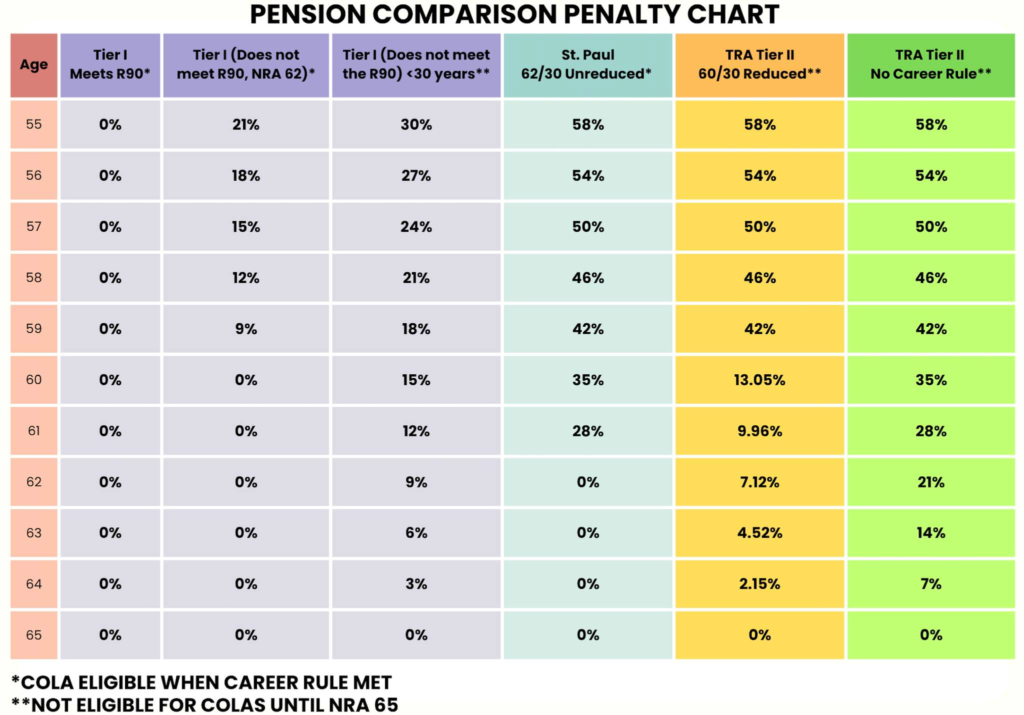
    The difference between those schedules can be significant. At age 60, the reduction is 13.05% if you meet 30 years. Without 30 years, the reduction at age 60 is 35%.

    These reductions are permanent. They do not disappear at age 65.

    For a full breakdown of the enhanced 60/30 schedule and how it compares across ages, see our detailed 60/30 guide.

    Understanding this structure is critical. The base formula determines how much you have earned. The reduction schedule determines how much you actually receive.

    What This Means for Your Retirement Planning

    If you are more than 10 years from retirement, focus on two levers:

    • Growing your High-5 salary
    • Continuing to build service credit

    Those two variables drive the formula more than anything else.

    If you are within five years of retirement, model multiple retirement ages. Compare 60, 62, and 65. Small differences in service and reduction percentages create large lifetime differences.

    If you are approaching 30 years of service, eligibility thresholds matter. Crossing that 30-year mark can significantly change the reduction schedule applied to your pension.

    If you are under 30 years and considering early retirement, run the reduction math carefully. The difference between meeting and not meeting that threshold can be dramatic.

    The TRA pension formula is simple. The decision about when to retire is not.

    Understanding your multiplier, service credit, High-5 average, and reduction schedule gives you the framework to make that decision with clarity.

    If you want a broader overview of how Minnesota teacher retirement works, including eligibility structures and legislative changes, review our complete Minnesota Teacher Retirement guide.

    KEEP STACKIN!

    Frequently Asked Questions About Minnesota TRA Pension Calculations

    Does coaching pay count toward my High-5 salary?

    Only compensation classified as pensionable earnings under TRA rules is included in your High-5 average. Not all supplemental pay automatically qualifies. Review your contract structure or confirm with TRA if you are unsure.

    Can I estimate my pension before I reach 30 years of service?

    Yes. The formula applies at any service level. Multiply your credited years by the appropriate multiplier and apply your High-5 average. Early retirement reductions would apply if you retire before normal retirement age.

    Is the multiplier guaranteed?

    The current multipliers are 1.7% for pre-2006 service and 1.9% for post-2006 service under Tier II. Pension systems are subject to legislative change, but benefits are calculated according to the law in effect at the time of retirement.

    What happens if I leave teaching before reaching 30 years?

    If you are vested, you may leave your contributions in TRA and qualify for a deferred pension at retirement age, or you may request a refund of your employee contributions. Not meeting 30 years primarily affects which early retirement reduction schedule applies.

    Does working part-time near retirement permanently reduce my pension?

    Potentially. Because your High-5 must be five consecutive years, a reduced contract percentage during those years can lower your average salary and therefore your pension. This should be evaluated before changing contract status late in your career.


  • Minnesota Teacher Retirement at 60: Understanding the Enhanced 60/30 Rule

    Minnesota Teacher Retirement at 60: Understanding the Enhanced 60/30 Rule

    For years, Minnesota teacher retirement at age 60 was financially unrealistic for most Tier II educators.

    If you were hired on or after July 1, 1989, you fell under Tier II rules. You could qualify for the 62/30 provision, meaning you were at least age 62 with 30 years of service, and you would receive a more favorable reduction schedule than the standard early retirement penalties.

    But age 60 was not part of that structure. Retiring at 60 meant falling under the harsher “No Career Rule” reduction schedule. For many teachers, that penalty was simply too steep.

    In May 2025, that changed.

    Minnesota enacted an enhanced 60/30 rule within the Teachers Retirement Association, TRA. The 60/30 option primarily applies to Tier II members who do not have access to the Rule of 90. If you are unsure which tier you are in, review the Minnesota TRA Tier I vs Tier II breakdown first.

    This change lowered the career-rule threshold from 62 to 60.

    Who Qualifies for the Enhanced 60/30 Rule?

    The enhanced 60/30 provision applies to:

    • Tier II teachers
    • At least 30 years of TRA service credit
    • Age 60 or older

    If you do not yet have 30 years of service, this rule does not apply.

    If you are Tier I, you are governed primarily by Rule of 90 provisions instead. Check out our full guide on Rule of 90 to see those rules. 

    Service credit generally includes years worked under TRA-covered employment. Purchased service and certain credited time may count, but you should verify your individual record directly with TRA.

    What Existed Before: The 62/30 Structure

    Before the 2025 reform, Tier II teachers with 30 years of service qualified for a more moderate reduction schedule beginning at age 62.

    At age 62, the reduction was significantly smaller than the general early retirement penalty. That made 62 a practical target retirement age for many long-career educators.

    However, retiring at age 60 still triggered the standard Tier II “No Career Rule” reductions.

    Under that prior structure:

    Age 60 carried a 35 percent reduction.
    Age 61 carried a 28 percent reduction.
    Age 62 under the general schedule was 21 percent, though the 62/30 provision improved that for career teachers.

    The gap between 60 and 62 was large enough that most teachers simply waited.

    What Changed Under the Enhanced 60/30 Rule

    The 2025 legislation lowered the career-rule threshold from 62 to 60 for teachers with at least 30 years of service. The 60/30 provision creates eligibility at age 60, but reduction rules are still tied to normal retirement age.

    The new reduction schedule for 30-year career teachers is:

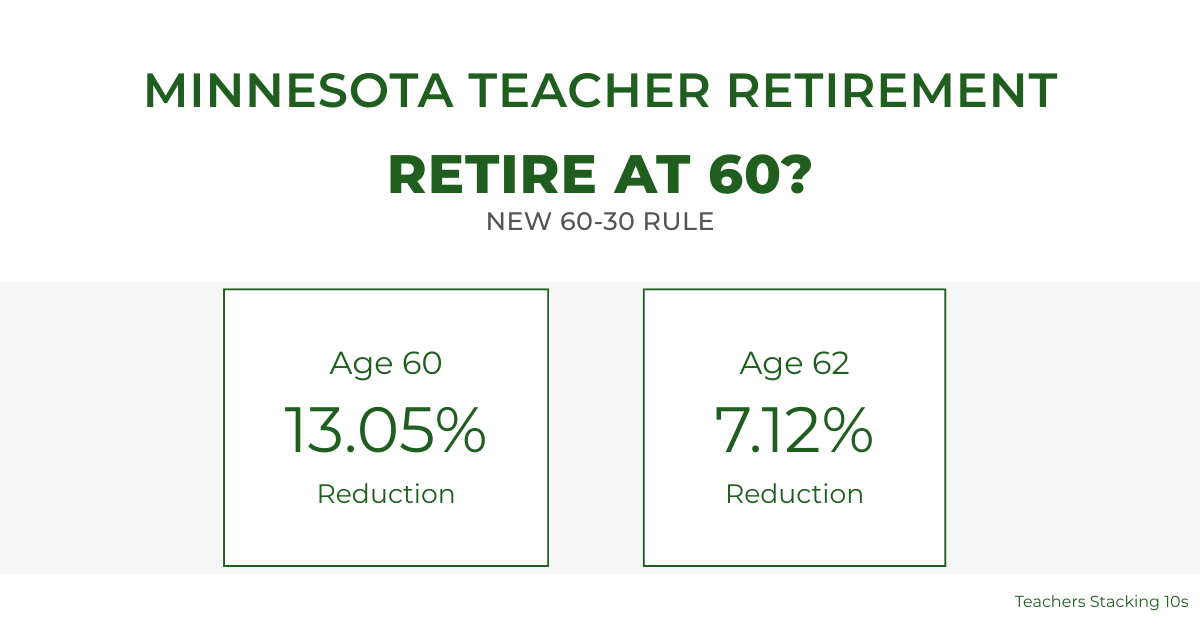
    Age 60 – 13.05 percent reduction
    Age 61 – 9.96 percent reduction
    Age 62 – 7.12 percent reduction
    Age 63 – 4.52 percent reduction
    Age 64 – 2.15 percent reduction
    Age 65 – 0 percent reduction

    This replaces the much steeper early retirement factors that previously applied at ages 60 and 61.

    In practical terms, Minnesota teacher retirement at 60 is now financially realistic in a way it was not before.

    Although the 60/30 provision enhances eligibility for certain members, retiring before full retirement age may still trigger age-based reductions. Review our early retirement reduction guide for full details.

    How the TRA Formula Still Works

    The 60/30 rule does not change the underlying TRA formula. It only changes the reduction factors.

    Your base pension is calculated as:

    Multiplier × Years of Service × High-5 Average Salary

    For Tier II teachers, the multiplier is 1.7 percent for years of service pre-2006 and 1.9 percent for years of service post-2006.

    Example:

    If your High-5 salary average is $80,000
    And you have 30 years of service

    Your unreduced annual pension would be:

    0.017 × 30 × $80,000
    = $40,800 per year

    If you retire at 60 under the enhanced 60/30 rule, that benefit is reduced by 13.05 percent.

    $40,800 × (1 − 0.1305)
    = approximately $35,475 per year

    The reduction is permanent. It does not disappear at 65.

    Before applying early retirement reductions, your base pension is determined by the TRA formula. If you need a full breakdown of how that formula works, including multiplier and High-5 calculations, see our detailed calculation guide.

    What This Means in Dollars

    Suppose your projected unreduced pension at 65 is $60,000 per year.

    Under the old Tier II early retirement schedule, retiring at 60 could have reduced that to approximately $39,000 annually.

    Under the enhanced 60/30 rule, the 13.05 percent reduction would bring it to roughly $52,170.

    That difference fundamentally changes the retirement conversation.

    Instead of asking, “Can I afford to lose 35 percent?” the question becomes, “Is a 13 percent reduction worth gaining two years of time?”

    60 vs 62: The Real Decision

    At age 60, the reduction is 13.05 percent.
    At age 62, it is 7.12 percent.

    That is roughly a 6 percentage point difference.

    Two additional years of salary also increase your High-5 average and your years of service, which increases the base benefit before reductions are applied.

    In many cases, waiting until 62 produces a noticeably higher lifetime benefit.

    However, the flexibility at 60 is now meaningful. For teachers with strong supplemental savings or personal reasons to step away earlier, the financial tradeoff is no longer extreme.

    Important: COLA Eligibility Still Begins at 65

    Even under the enhanced 60/30 rule, cost-of-living adjustments typically do not begin until normal retirement age, generally 65.

    If you retire at 60, you may receive several years without COLA increases. Inflation during that period affects long-term purchasing power.

    The reduction schedule improved. COLA timing did not.

    Health Insurance Between 60 and 65

    One of the most overlooked pieces of retiring at 60 is healthcare.

    Medicare eligibility begins at 65.

    If you retire at 60, you must bridge five years of coverage. That may include:

    • District retiree coverage
    • COBRA
    • Spousal coverage
    • Individual marketplace plans

    Healthcare costs during that window can materially impact whether retiring at 60 makes sense.

    The Bigger Retirement Strategy

    The enhanced 60/30 provision is a meaningful improvement for Tier II educators. It narrows the gap between career teachers hired before and after 1989 and expands retirement flexibility.

    However, your TRA pension is only one part of your plan.

    Your 403(b) balance, Roth IRA contributions, savings rate, and overall retirement readiness determine how much flexibility you truly have.

    Minnesota teacher retirement at 60 is now possible for many educators.

    Whether it is optimal depends entirely on your numbers.

    If you need a full breakdown of how the TRA formula works and how to project your benefit, start with our complete Minnesota Teacher Retirement guide.

    Keep Stackin!

    Frequently Asked Questions About the Minnesota 60/30 Rule

    Can I retire at 60 with less than 30 years of service?

    No. The enhanced 60/30 rule requires at least 30 years of TRA service credit. If you retire at 60 with fewer than 30 years, you will fall under the standard early retirement reduction schedule, which carries significantly larger penalties.

    Is the 13.05 percent reduction permanent?

    Yes. The reduction applied at age 60 is permanent. It does not disappear at age 65. Your pension is reduced for life based on the age at which you begin collecting benefits.

    Does the 60/30 rule apply to Tier I teachers?

    No. Tier I teachers are primarily governed by Rule of 90 provisions and different retirement eligibility rules. The enhanced 60/30 change specifically affects Tier II teachers with at least 30 years of service.

    Does sick leave count toward the 30 years of service?

    Generally, sick leave conversion can increase your service credit at retirement, but eligibility rules and calculations can vary. You should verify your official service credit total with TRA before making a retirement decision.

    Does coaching pay or extra duty pay count toward my High-5 salary?

    Only earnings that are considered pensionable compensation under TRA rules are included in your High-5 average salary calculation. Not all supplemental pay qualifies. It is important to confirm what counts toward your final average salary.

    Can I continue working after retiring at 60?

    There are restrictions on returning to work in a TRA-covered position after retirement. Earnings limits and reemployment rules may apply. Before retiring and returning to work, review TRA guidelines carefully.

    Will the 60/30 rule change again in the future?

    Pension systems are subject to legislative changes. While the enhanced 60/30 rule is currently in effect, future reforms are always possible. Retirement decisions should be based on current law, but awareness of legislative risk is prudent.

  • 2023 MN Legislative Final Update and How It Impacts Your TRA Pension

    2023 MN Legislative Final Update and How It Impacts Your TRA Pension

    Hey everyone. Well, here is the final update from the 2023 MN Legislative session. As I said in my last post, I wish I had better news, but this was NOT a great session for our pensions. The only major change was for the St. Paul Teacher’s Association. They are now able to receive full retirement with no early retirement penalty under the “62-30” rule. TRA has this rule, but there is still a penalty. One positive that did happen for us in the last moments of the session came from the tax committee. The normal retirement age has been reduced from 66 to 65 which means that people will get one less “penalty” year if they qualify for the “62-30” rule. This provision does NOT take effect until July of 2025, so I’m not sure how it will affect people that would like to retire after next year. Hopefully TRA will give us a little more clarity on that in the coming months.

    One massive change that doesn’t help teachers, but does help school staff is now hourly school employees will be able to file for unemployment benefits in the summer. This is HUGE for employees in smaller districts who often-times pay only $13-14/hour to these employees. The biggest question mark for this moving forward is how will it affect school district budgets because their unemployment insurance will definitely see a hit in 2-3 years when these benefit payouts are calculated. The legislature appropriated one-time money for this, but we all know that they aren’t known for full funding any of their mandates.

    This legislative session did not achieve the move towards equalizing the benefits of Tier I and Tier II teachers in Minnesota. Those that qualified under Tier I still receive their benefits 8-10 years before someone in Tier II can receive them and didn’t have to pay in as much in contributions. Hopefully next year’s session can produce another step in the right direction, BUT since it’s an even year, it’s not a bonding year, so money isn’t usually appropriated in those sessions, so it’ll be difficult to see much change.

    Wish I had better news, but as always, KEEP STACKIN!

  • Minnesota Teacher Retirement: How the TRA Pension Really Works

    Minnesota Teacher Retirement: How the TRA Pension Really Works

    If you teach in Minnesota, your Teachers Retirement Association, TRA, pension is one of the most valuable financial benefits you have. It is also one of the least understood.

    Because participation in TRA is mandatory, every public school teacher is automatically enrolled and contributing from their first paycheck. Yet many educators never fully understand how their pension is calculated, when they can retire, or how recent legislative changes affect long-term income.

    Understanding Minnesota teacher retirement is not optional. It directly shapes your future financial flexibility.

    In this guide, we will break down how TRA works, how benefits are calculated, when you can retire, how early retirement penalties apply, and what recent funding changes mean for your long-term plan.

    New to Minnesota teacher retirement planning? Start with our complete Teacher Finances 101 guide, then return here for a deeper dive into TRA.

    What is TRA?

    The Minnesota Teachers Retirement Association, TRA, administers pension benefits for public educators across the state. It provides retirement, disability, and survivor benefits funded through employee contributions, employer contributions, and long-term investment growth.

    TRA is governed by an eight-member board. Five trustees are elected by members, four active teachers and one retiree. The governor appoints the remaining three. Investment management is handled by the Minnesota State Board of Investment, SBI, which also manages assets for PERA and MSRS.

    In plain terms, TRA administers the pension system and the SBI invests the assets.

    Membership begins the day you start employment with a TRA-covered employer. Contributions are deducted automatically from each paycheck.

    So what is a Pension?

    A pension is a defined-benefit retirement plan. That simply means your future retirement income is based on a formula, not on how well your personal investments perform.

    With a defined-contribution plan like a 403(b) or 401(k), your retirement income depends on how much you contribute, how your investments grow, and how you manage withdrawals later. The responsibility and the risk sit largely with you.

    With the Minnesota TRA pension, the benefit is calculated using a formula tied to your years of service, your salary, and a multiplier set in statute. Once you retire, you receive a guaranteed monthly payment for life. Depending on the option you select, that benefit can also provide income for a surviving spouse.

    That guarantee is powerful. It removes many of the uncertainties that come with market-based retirement accounts.

    However, it is important to view your pension as a foundation, not a complete strategy. TRA is designed to replace a portion of your income, not all of it. Understanding how large that portion will be is the key to deciding how much additional investing you need to do.

    How is TRA funded?

    The Minnesota TRA pension is funded through three primary sources:

    • Employee contributions
    • Employer contributions
    • Long-term investment returns

    As a member, a percentage of your salary is automatically deducted from each paycheck. Your employer also contributes on your behalf. Those combined contributions are invested by the Minnesota State Board of Investment.

    Over time, investment growth provides the majority of the funding needed to pay future benefits. This is true for most public pension systems.

    Because investment returns fluctuate, TRA relies on actuarial projections to estimate long-term obligations. When returns fall short of expectations or demographic assumptions shift, the legislature may adjust contribution rates, benefit structures, or actuarial assumptions to maintain long-term stability.

    That is why you occasionally see legislative updates affecting contribution percentages, COLA adjustments, or funding timelines.

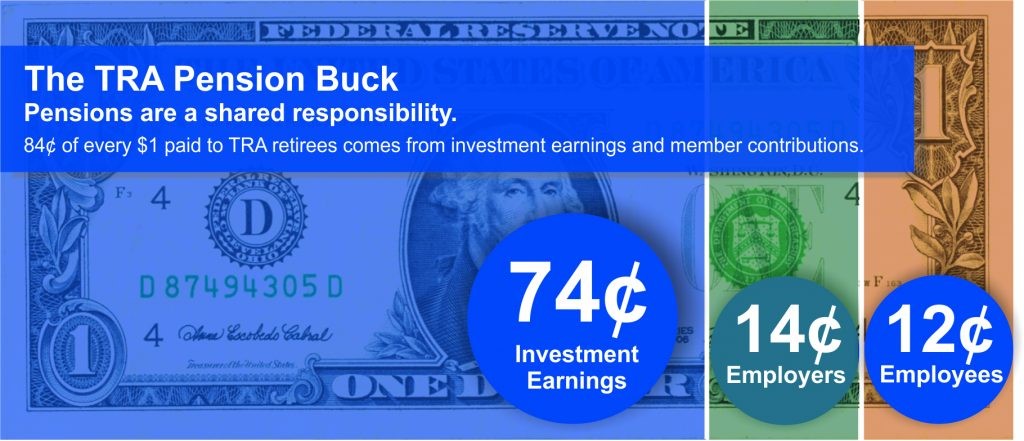
    The key takeaway is this: your pension is not funded from a single source. It is supported by ongoing contributions and long-term investment growth. Monitoring funding ratios and legislative changes is part of responsible retirement planning.

    Over time, the majority of pension funding comes from investment growth. Contributions from employees and employers form the base, but long-term returns drive sustainability.

    The breakdown below shows how a typical TRA pension dollar is funded.

    When Can You Retire Under Minnesota TRA?

    One of the first questions teachers ask is simple: When can I retire?

    Under Minnesota TRA, eligibility depends on your hire date and your years of service credit.

    It is important to separate two ideas: retirement eligibility and full, unreduced retirement. They are not the same.

    Minnesota TRA is divided into two eligibility tiers based on hire date. Your tier determines whether you qualify for the Rule of 90, what your full retirement age is, and how early retirement reductions apply. If you are unsure which structure applies to you, read the full breakdown of Minnesota TRA Tier I vs Tier II.

    Normal Retirement Age

    For teachers hired after June 30, 1989, the normal retirement age, often called NRA, is 65.

    This is the age at which you qualify for your full, unreduced pension benefit under the standard formula.

    That does not mean you must teach until 65. Early retirement options exist, but they come with permanent reductions.

    Rule of 90 (Pre-1989 Hires Only)

    If you were hired before July 1, 1989, you may qualify under the Rule of 90.

    When your age plus years of service equals 90, you can retire with full benefits and no early retirement penalty.

    This rule no longer applies to teachers hired after that date.

    If this rule applies to you check out our full breakdown of Rule of 90.

    Enhanced 60/30 Provision

    Recent legislative changes introduced an enhanced 60/30 option.

    If you are age 60 with at least 30 years of service credit, you may qualify for retirement with a reduced early retirement penalty compared to retiring before age 60.

    Retiring at 60 does not automatically mean your benefit is unreduced. Your tier status and years of service determine whether an age-based reduction applies.

    This provision created more flexibility for long-career teachers who wish to retire before 65.

    Age 62 With 30 Years of Service

    For many teachers hired after 1989, age 62 with 30 years of service remains an important milestone.

    While not fully unreduced retirement, the penalty at 62 with 30 years is significantly smaller than retiring earlier.

    Because of this, many Minnesota teachers use 62 as a practical target retirement age.

    Early Retirement at 55

    Teachers may begin collecting benefits as early as age 55 if vested. Most teachers become vested after three years of service.

    However, retiring at 55 results in a substantial reduction to your monthly benefit. In some cases, the reduction can exceed 60 percent compared to full retirement age.

    Eligibility does not automatically mean financial readiness. The reduction is permanent and should be evaluated carefully.

    Important Note on COLAs

    Recent changes also adjusted cost-of-living adjustments, COLAs. For many retirees, COLA eligibility now begins at normal retirement age, generally 65, rather than immediately upon retirement.

    This change can affect long-term purchasing power and should be factored into your retirement planning.

    Strategic Takeaway

    The question is not simply “When can I retire?”

    A better question is: When can I retire with the income I want?

    Understanding service credit milestones, early retirement penalties, and COLA timing allows you to make that decision intentionally rather than emotionally.

    Before choosing a retirement date, log into your TRA account and run multiple scenarios using the official retirement calculator.

    So How Is My Benefit Calculated?

    Your Minnesota teacher retirement benefit is determined by a defined formula. It is not based on market performance or the balance of an individual investment account.

    The formula is:

    Years of Service × High-5 Salary × Formula Multiplier

    Each component matters, so let’s break them down.

    Years of Service

    Each academic year you work in a TRA-covered position earns one year of service credit. The more years you accumulate, the larger your benefit becomes. Service credit is one of the most powerful variables in your control.

    High-5 Salary

    Your High-5 salary is the average of your five highest consecutive years of earnings. For most teachers, those years occur near the end of their career when they are at the top of their salary schedule.

    Because your pension is tied directly to salary, late-career earnings have an outsized impact on your final benefit.

    Formula Multiplier

    The multiplier applied to each year of service depends on when that service was earned.

    Service earned before July 1, 2006 is multiplied by 1.7 percent.
    Service earned after June 30, 2006 is multiplied by 1.9 percent.

    Each year of service is multiplied by its applicable percentage, and the totals are combined to determine your overall benefit percentage.

    Example Calculation

    Let’s walk through a simplified example.

    Assume:

    38 years of service
    High-5 salary of $72,000
    8 years at 1.7 percent
    30 years at 1.9 percent

    First, calculate the combined multiplier.

    (8 × 1.7%) + (30 × 1.9%) = 70.6%

    Next, apply that percentage to the High-5 salary.

    70.6% × $72,000 = $50,832 per year

    If retiring under an early retirement provision such as 62/30 or enhanced 60/30, an early retirement reduction would apply.

    For example, if the reduction were 14 percent:

    14% of $50,832 = $7,116

    That produces an estimated annual benefit of approximately $43,716, or about $3,643 per month.

    Your exact benefit will depend on your service history and chosen retirement date. The most accurate way to estimate your pension is to log into your TRA account and use the official retirement calculator to run multiple scenarios.

    If you want a detailed step-by-step breakdown of exactly how the Minnesota TRA pension is calculated, including real retirement scenarios, read our full TRA pension calculation guide.

    Why This Formula Matters

    Unlike a 403(b) or Roth IRA, where retirement income depends on account balance and withdrawal strategy, your TRA pension provides a predictable lifetime payment based on a statutory formula.

    Understanding this calculation allows you to estimate future income, identify potential gaps, and determine how much supplemental investing you need to build flexibility into your retirement plan.

    The pension provides structure. Your decisions around service years, retirement timing, and additional savings determine the outcome.

    Future of TRA

    One of the most important metrics to monitor is the funded ratio. This represents the percentage of projected future obligations that are currently backed by assets.

    A funded ratio of 100 percent means the plan has enough projected assets to meet long-term obligations under current assumptions.

    As of recent actuarial reports, TRA’s funded ratio has been below 100 percent, prompting legislative adjustments to improve long-term sustainability.

    Legislative Adjustments

    In recent years, Minnesota lawmakers have implemented several changes, including:

    • Adjustments to cost-of-living increases
    • Changes to contribution rates for employees and employers
    • Modifications to actuarial return assumptions
    • Extension of amortization timelines

    These changes were designed to strengthen the long-term funding trajectory of the system.

    What This Means for Teachers

    It is important to understand two things at the same time:

    First, TRA is not on the verge of disappearing. The pension is backed by statutory obligations and ongoing contribution structures.

    Second, pensions are dynamic systems. Contribution rates, assumptions, and benefit structures can change over time to maintain solvency.

    That is why understanding your pension formula, monitoring legislative updates, and maintaining supplemental retirement savings is essential.

    Your TRA pension provides a powerful foundation. Responsible planning means building on that foundation, not relying on it exclusively.

    Planning Beyond the Pension

    The Minnesota TRA pension is a significant advantage compared to many private-sector retirement plans. It provides predictable lifetime income and reduces the personal investment risk that many workers face.

    However, it was never designed to replace 100 percent of your working income.

    Even small changes in assumptions, contribution rates, or cost-of-living adjustments can affect long-term purchasing power. That does not make the pension unstable. It simply means it should be viewed as one part of a broader strategy.

    The most resilient retirement plans combine:

    • A clear understanding of the TRA formula
    • Realistic projections of future income
    • Consistent contributions to a 403(b), Roth IRA, or other supplemental accounts
    • A disciplined savings rate throughout your career

    Teachers who treat their pension as a foundation rather than a finish line tend to retire with far greater flexibility and confidence.

    Final Thoughts on Minnesota Teacher Retirement

    The Minnesota TRA pension is one of the most valuable financial benefits available to public educators in this state. It provides predictable lifetime income, shifts market risk away from individual teachers, and offers a level of stability that many private-sector workers no longer have.

    At the same time, it is not a complete retirement plan by itself.

    Understanding how your benefit is calculated, when you qualify for retirement, how early retirement penalties work, and how funding changes affect long-term sustainability allows you to plan with clarity instead of assumption.

    The teachers who retire most comfortably are not the ones who simply trust the system to work. They are the ones who understand it, project it, and build around it.

    If you want a structured plan for building that broader strategy, start with our Teacher Finances 101 guide. It walks through the full process step by step.

    Clarity today builds flexibility tomorrow.

    KEEP STACKIN!

    Money at Home, Money Hacks, THE BLOG

    A Little Research Can Save You THOUSANDS Of Dollars!

    The Story Last week, my Maytag Neptune dryer started making that hideous,

    Read MoreSide Hustle, THE BLOG

    Am I DUMB For Creating This Side Business as a Teacher?

    In my previous post, I said that I was going to talk

    Read MoreRetirement, THE BLOG

    2023 MN Legislative Final Update and How It Impacts Your TRA Pension

    Hey everyone. Well, here is the final update from the 2023 MN

    Read Morepexels-photo-3483098.jpegRetirement, THE BLOG

    2023 MN Legislative Update and How It Impacts your TRA Pension

    Hey everyone! It’s been quite a while since I’ve posted anything on

    Read MoreHigher-ED

    The Big Adventure Into Higher-Ed

    This summer I made the leap from public education to a private

    Read MoreBudgeting, Debt, Investing for Teachers, Money at Home, Retirement, THE BLOG

    THE PROFESSOR’S END OF Q2 2022 FINANCIAL UPDATE

    This is my post showing how we are saving money both in

    Read More