Author: The T.A.

  • $0 to $300k Net worth… A 10 year journey

    $0 to $300k Net worth… A 10 year journey

    I mark the beginning of my financial journey as April 2014. I had been teaching for a year and a half and saving more than I earned to the point where I had some extra money in my savings account gaining .5% interest. I was fortunate enough to have a co-worker that was more knowledgeable than me and he talked to me about opening up my first Roth IRA and pointed me towards the legendary Mr. Money Mustache, and the Millionaire Next Door for some light financial readings.

    I can’t say that I was immediately hooked but it did get the wheels turning towards financial independence. Quite a lot has occurred in my life over the past decade. I went back to school to get my master’s degree. I bought and sold a house (even took money out of my Roth to do so). Bought a new car. Changed jobs. And have spent my summers roaming around the country camping, fishing, and hiking. Today, my personal net worth topped $300k for the first time! I write this not to flex but to try to show a real-life long term perspective on our paths to wealth and to illustrate that the snowball effect is real and slow and steady investing does payoff in the long run.

    In the last 10 years I’ve learned a lot about personal finance. Not all of the information came at once and I still learn more about it each day. However, I have gotten to the point that I can put my finances on autopilot. I no longer keep a detailed budget and track every expense. I don’t spend much time researching the markets deciding what stock to pick. I know what to do with the money once I get it at this point so my views have shifted to trying to make more money to put into the system. Here are a few priorities that I had a long the way to get me to the point of having my finances on auto-pilot.

    1. Spend less than you earn.

    I was fortunate to grow up in a household where this was heavily emphasized so I never knew any other way. As I mentioned before, after a year and a half of teaching I had built up a fair amount of savings just by spending less than I was making. It’s a simple concept that can be much more challenging to execute. I was fortunate to start teaching in a small college town so a lot of my expenses were much cheaper than other places in the country. That first year is tough as you’re navigating new terrain and a new way of life. I kept things cheap and my entertainment tended to be exploring nature (Free), happy hour busch lights and dominoes pizza (Cheap). I got the second cheapest one bed-room apartment in town and drove my old Toyota Camry the 12 miles to work each day. All of these things kept my expenses down and allowed me to build up a bit of a cushion in my savings account.

    2. Tracking your budget.

    After grinding that first year or so I loosened up a bit on the budget and started finding things I wanted to spend my money on. I spent the next few years trying a variety of spreadsheets and budgeting apps to help curb that spending (I had graduated from happy hour Busch Lights to craft beers from my local brewery). Keeping spending down as I got raises from my employer meant I had even more money to save and invest each month. I tried mint, personal capital, YNAB and my own personal spreadsheet. All 4 of these had a role in tracking net worth and progress towards my goals. Cutting the extra stuff I didn’t like out of my budget each month lead to even more that I was able to put away. Ramit Sethi puts it better than I do, “Spend extravagantly on things you love, and cut costs mercilessly on things you don’t.” This resonated well with me now that I was a few years into my financial journey. I still wanted to live my life full of things I enjoyed but wanted to cut out those hidden costs of thing I could care less about. I am always the first one to suggest going out to eat, heading down to the brewery, or packing up and planning a 2 week vacation. However, I could really care less about what phone I have, what clothes I wear, or how expensive my home is. Tracking my budget for those years really helped establish spending patterns in my life to the point where I don’t have to think about it much anymore. I don’t use any budgeting software at this time because the years of using it established my routine, now I just stick with it.

    3. Investing the Extra

    With my budget habits solidified the next step is to put those extra dollars to work. Life-style creep is real. With each years raise it’s so easy to subtly spend more and more, I know I do. Now, with every raise, I adjust the amount of money that is auto-invested from my check. This means that roughly the same amount is being deposited into my bank account each month of every year even though I get a raise every year. When I never see the money I never think about spending it. So not only is my money growing with my low cost index funds but I am actively contributing more to it every year. This has been a huge step in the journey. Automate that and free up some brain space for yourself.

    4. Increase Income

    This has been my latest quest. Now with moving to Higher-Ed and having a more complicated source of income I am constantly looking for new duties to add and more places to invest my time that will help bring in more income. At the public school level this takes the form of extracurricular activities. Maybe you don’t want to be a coach or an advisor but every event that happens needs workers and for a lot of schools that’s a paid position. It can be getting your masters to get a pay bump. It can be a job with a different district or a new role within yours. It can be a summer or weekend job if you’re one of those crazy teachers that looks for work in the summer-time! It can be a challenge in public education to find ways to increase your income but it is definitely still possible.

    It seems straightforward but that’s my simplified path these past 10 years

    1. Spend less than your earn
    2. Track your expenses
    3. Invest the rest
    4. Increase income

    Put the extra money in some low-cost index funds and let the market do it’s work for you. For some insight. In the last 10 years my rate of return is 14.6% and the vast majority of my holdings are in total market index funds. Set it and forget it. My favorite kind of investing.

    Hopefully this is motivation for you to set out on your own financial journey or some motivation to keep stacking away!

  • A Perfect Time to Set up Your Emergency Savings Account

    With high interest savings accounts paying out at 4.5% currently, it is a great time to establish those emergency savings accounts!

    Here at Teachers Stacking 10’s, like many other financial gurus, we recommend having a few months income built up in a savings account that is easy to access. Experts vary in how much is the ideal amount and it is different person to person but you can find amounts that range from 3 to 12 months! Starting off this is a daunting task as your just trying make ends meet. Do not feel bad if you don’t have this part of your finances locked in! We are a bit unique as teachers in that our jobs are far more secure than other jobs in the private sector. The threat of teacher lay-off (while not zero) is very low, and even so it’s a market saturated with jobs now…

    But I digress, many of us don’t have 3 months of savings built up for those big and sometimes unplanned purchases in life. A costly car repair, braces for your teenager or replacing appliances, life has a way of throwing those things at us when we aren’t necessarily prepared for it. So take the leap now to get prepared!

    With the increase in interest rates we are finally seeing some savings accounts getting some decent returns. Not as much as what you’d expect in a high yield index fund but 4 – 5% is still very solid growth for your emergency cash flow.

    Check out Nerd Wallet’s list of the best online savings accounts right now

    That’s a great list, personally I’ve been enjoying my capital one 360 savings account that I’ve had for years. Mobile check deposit is great and 4.3% interest rate is even better! I took the initiative this summer to build up that emergency fund to have some more security in life and to take advantage of some high interest rates! What interest rates is your savings account getting right now? Could it be doing better? Is it time to research some online options? It’s a great time to do some research and check things out!

    If you’re still a bit cautious about getting into the market and investing, now’s a great time to set up that savings account!

    Keep Stacking!

  • The Big Adventure Into Higher-Ed

    The Big Adventure Into Higher-Ed

    This summer I made the leap from public education to a private Midwest college. I hope to highlight and document the differences in finances and benefits as the year goes on.

    Like so many teachers this past year I have also chosen to leave the traditional high school classroom (mainly). Many factors lead to this change. Struggling infrastructure, lack of respect from students and adults, a corroding benefits package, and uncertainty of being able to keep grinding for 30 more years as a public school teacher pushed me to switch gears into higher-ed. Higher-ed still has it’s problems and in many ways is also not currently sustainable but it was time to see what that world is like. I just wish I could bring my colleagues and students with me.

    Things I did when I left my public education job

    1. DO NOT TOUCH THAT PENSION!
    2. Left my 403b account alone
    3. Monitor my Spending

    PENSION – Don’t touch it. It might be tempting to withdraw your contributions for some short term cash. Don’t do it. With 10 years of service I am vested in my state’s retirement and if I never contribute again I’ll be eligible for $4,000+ a year. Might not seem like a lot but with COLA once I start collecting that will be a decent little chunk of money coming in each year. And that’s guaranteed income.

    403b – My new employer uses a difference group for 403b (Thankfully they still offer vanguard funds) so I’ll be opening a new 403b account. That’ll be my 3rd 403b… It seems like a lot but after listening to everything the professor went through I’m not too eager to try to roll one into another.

    Monitor Spending – My days of building intricate full blown budgets might be over but with an impending paycut I am paying attention to where I’m spending my money. I’ll have to cut back in some areas I’m sure, I am just trying to identify these areas before they become a problem.

    Those have been my immediate steps as I anticipate a career change. There have been others, including selling my house! I’ll be covering some of those more directly as the year goes on.

    I am hoping to provide all of you some insight into the benefits and costs of the world of higher-ed to see if that’s a viable career path for you to consider. Best of luck and god-speed to teachers at the start of this upcoming school year. I hope there are positive changes on the way.

    Keep Stackin!

  • 403b – What Should You Know

    403b – What Should You Know

    Your 403b is a tool that we talk about frequently on the site. Let’s get into the details of what exactly your 403b is and how it can work for you

    403b – The Basics

    A 403b account is tax sheltered annuity account available to public school teachers and a few other careers in the public sector. It is tax sheltered, which means this money comes out of your check pre-taxes, which is a nice tool to lower your taxable income. At the time of writing this in 2022, the maximum contribution to your 403b is $20,500, which is a substantial amount. This means that you can invest up to $20,500 annually into this account. If you are able to max this amount out, that is very impressive! For most of us this isn’t a realistic goal. Heck for some of our staff that would be over half their salary! 

    So you can contribute $20,500 pre tax into this account, but what can you do with it? 403b is essentially the public sector version of a 401k. You really shouldn’t touch it until you’re at retirement age (59.5 years). There is a significant penalty if you do. So think of it as another investment tool at your disposal.  Something to one day supplement your pension. You can begin drawing money out of that account once you hit age 59 and a half. Ideally, you would wait until you hit 72 and are legally required to start withdrawing from it. That’s another 12 years of growth in the market. Like we’ve mentioned before, there’s potential for your investment to nearly double in that time period, even when you aren’t investing in it!

    How to set up your 403b

    A 403b is an account that you must set up through your place of work. You’ll have to go through your business office or HR department in order to set yours up. Because of this, it is also going to be restricted to what firms you can go through. In my current district, we recently made a push to have vanguard available as our provider. We like them due to their transparent fee structure. Once you get yours setup, you’ll have to consider how much you are comfortable with contributing each check. Once you’ve set that up with your HR department, login to your investment firm and allocate what series of index funds you’d like you money to go into. Then you are all set for years of passive investing and growth. 

    Pro’s

    Some pro’s of using your 403b for investing.

    1. It’s tax-sheltered. That means you’re not going to pay taxes on that income until you start withdrawing from that investment account. That can be nice to lower your current taxable income. 

    2. There might be some matching money. Many school districts have some kind of incentive program for investing into your 403b. For schools in our area, it comes in the form of the district matching up to a certain percent or dollar amount. Districts like doing this because they also have to pay less tax on your income so contributing $1,000 to your 403b is cheaper for them than increasing your salary $1,000. Please, if your district has a matching program take advantage of it. It’s free money you are missing out on!

    3. It’s passive. You really don’t have to do anything once you get things set up. You can always modify and change what or how much you invest but typically its very hands off. 

    Con’s

    1. You can’t touch it early. Let me rephrase that. You shouldn’t touch it early. Pulling money out of your 403b before age 59.5 comes with a penalty. You’ll have to pay 10% penalty on the money, and you’ll have to claim it as income on your taxes. Honestly, I think of this as a positive because it forces me to not touch that money until I am much older. 

    2. Limited investment options. You are definitely limited to what companies you can invest with. When I started my job, we had to go through a local financial group. They were fine, but their fees were astronomical compared to what I currently have with Vanguard. There is potential to work around this. Typically your district will be open to adding Vanguard or others to your investment groups.


    So all in all, Your 403b should be a tool in your investment tool box if you qualify for it. When you retire you will thank your younger self for putting away what money you were able to. If you want a deeper dive into all thing’s 403b check out Dan’s website at – 403bwise.org. It is a fantastic resource for 403b info. 


    Keep Stacking!

  • Don’t Touch this account when you decide to leave teaching!

    Don’t Touch this account when you decide to leave teaching!

    Teacher job boards seem to be filling up left and right as more and more people are leaving the profession early, some even mid-year. As this becomes a grim reality for many of us we still need to make the right financial decisions when we leave. The biggest thing to do is DO NOT WITHDRAW YOUR PENSION CONTRIBUTIONS

    When you leave teaching you have the right to withdraw your contributions to your pension fund. Notice how I say “Your” contributions. You can only take out the amount that was deducted from your paychecks over your years of teaching. The districts contributions stay in the pension fund. This is a terrible financial move. It depends on the state on how long it takes to be “vested” in the states pension plan. Typically, after 3-5 years you are vested, meaning you get access to a pension. This is true regardless how long I teach. Let’s look at my current set-up

    9 years of teaching – $41,000 in TRA contributions

    Lets say I walk away tomorrow. What happens to that $41k? I have the option to withdraw that amount. Reminder that I never paid taxes on that amount so I’d get hit with an income tax on that amount. To make it easy, let’s say it end up being $30k. So I would have the option to have that $30k now after taxes etc. Sounds okay but isn’t spectacular. 

    What happens if I stay vested. I let that money sit in my TRA account. I am then going to be eligible for a pension from the state. It won’t be enough to live off of but it will be significant. The TRA estimate for my wage and 9 years of service, so long as I didn’t withdraw until age 62 would be $678 a month… For life. After only 4 years I’ve already gotten that $30k back and I’ll continue to get $678 a month. This is true even if you leave to take a teaching job in another state. Many teachers take advantage of this and actually receive a double pension. 

    Changing careers or switching jobs comes with a lot of financial stress. Make sure to save yourself some future stress by leaving your pension contributions where they are at and staying vested in your state’s plan. You’ll be thankful you did when you get to retirement age


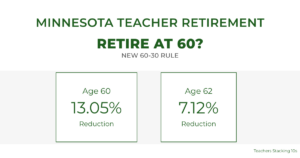
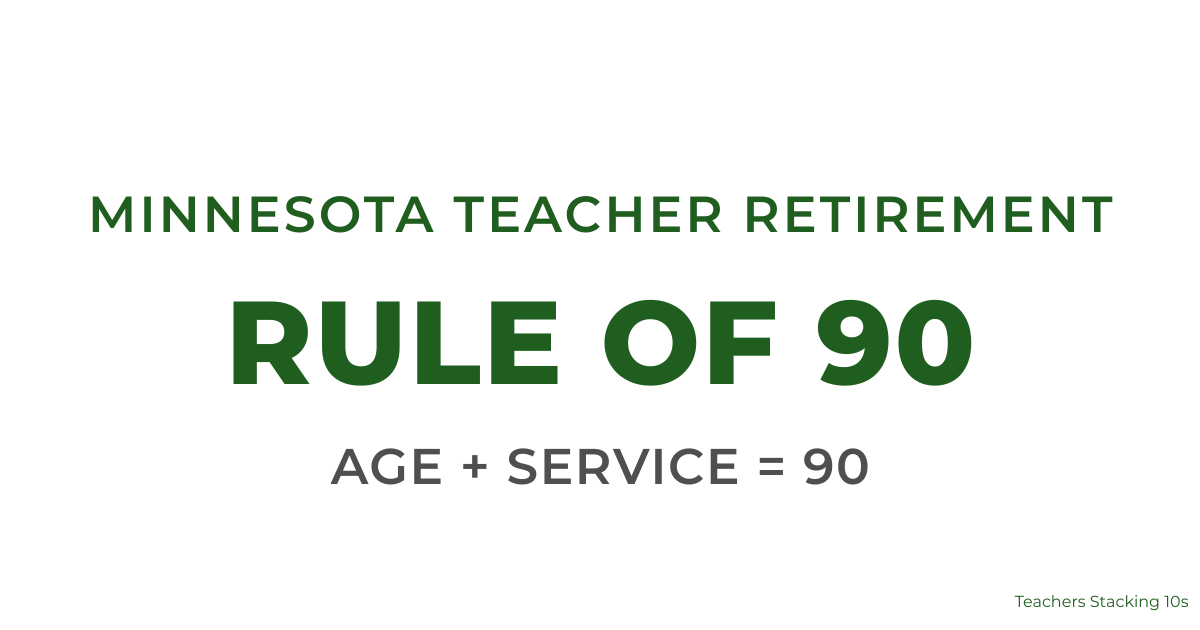
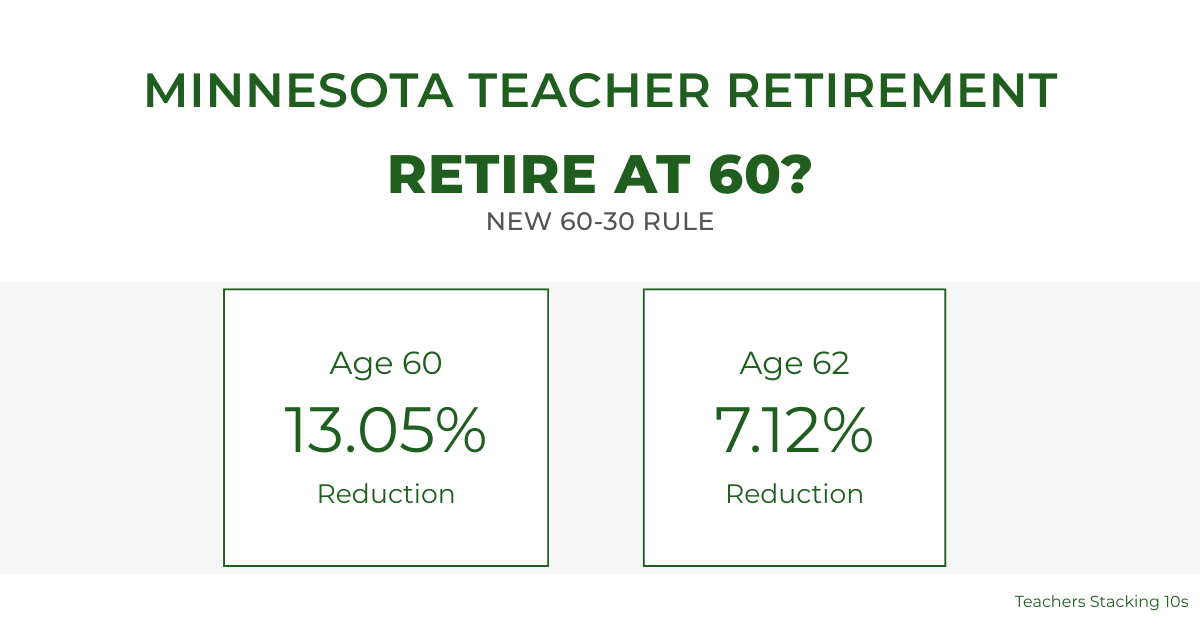
    Minnesota teacher retirement at 60 reduction comparison under enhanced 60-30 rule

    Minnesota Teacher Retirement at 60: Understanding the Enhanced 60/30 Rule

    For years, Minnesota teacher retirement at age 60 was financially unrealistic for


    Read More

  • 3 accounts you need to be auto-investing in

    3 accounts you need to be auto-investing in

    As the new year starts it’s time again to evaluate how much of your paycheck you are saving and investing. For most of us a new school year means moving to a new step on the pay scale. I always think this is the best time to increase your contributions to your saving and investing. Personally, I always try to adjust my savings so that my take home amount stays close to the same each year. I find that is the best way for me to avoid the life style creep that comes with increases in pay. But as you adjust your auto-investing and savings where should that money go? Here are the 3 types of accounts I have found work the best for myself.

    1. 403b or 457 plan.

    We have covered both of these types of plans before but both are plans you have set up through your employer and your contributions to these accounts come out pre-tax, lowering your taxable income. It is a great idea to increase your monthly contributions to a 403(b) or 457 plan each year. It doesn’t have to be by much, sometimes mine is only a $20 increase a month but that is still slowly stacking those tens into an investment account putting more of those dollars to work for you creating more assets. Typically, to increase your contributions you must contact payroll at your school so they can take that money out pre-tax. It’s a pretty painless process, I do it annually. 

    2. HSA

    HSA is a strange one but can be an unorthodox investing tool. Building up your cash reserves in an HSA account can be a wise investment strategy. It is money that is never taxed and will be useful down the road as medical expenses can potentially increase. Your HSA might be throug your bank collecting a small amount of interest, however it is also possible to transfer that money into an investment account to put it to work for you. Once again this is money that is never taxed however the current annual max contribution is $3650 for single and $7300 for family. Once again this will be a conversation or an email to payroll at your school to get the changes made. 

    3. Roth IRA

    I’ve always been a fan of Roth IRA’s, probably because it was my first experience in investing. A reminder, Roth IRA contributions are post tax and you most likely manage these yourselves. Roth IRA’s differ from 403(b) type plans in that they are taxed up front then you can get that money tax free once you turn 59.5. 403(b) plans are the opposite, taxed at the end not upfront. I also enjoy Roth IRA’s because you have more control and more access to your money in that account typically. Once again there is an annual max contribution of $6,000 currently. 

    I would highly recommend increasing your contributions to each of these three types of accounts. They all serve a unique purpose and are all good investment strategies. There are many different opinions on the order in which you should invest in these. Many suggest the order that I have listed above however I find it comes down to personal preference. There are also other directions you can choose to go to invest your new income. 

    4. Brokerage account

    You can increase your contributions to your brokerage account. I also do this annually but it make up a small fraction of my total money in the market (10%). You have a ton of freedom in your brokerage account and it can be fun and exciting to invest in one and get into buying and selling stocks. This comes with a caveat. All of your gains in this account are taxable. That’s one thing all of the amatuer day traders in the world need to understand is you have to pay capital gains tax on earnings from that account. It’s a fine place to add your new investments but you should feel confident about your understanding of the market before you dive into it. 

    5. Traditional savings account

    There’s nothing wrong with having a traditional savings account and increasing your monthly contributions to it. You might have some big purchases coming up and want to have the cash on hand ahead of time to afford them, a very wise move. It’s also very wise to have a small cash reserve in a savings account that you can easily access. However, I do challenge you to have a goal in mind when you are contributing to a savings account. Set a number you want to have in there. Then once you have hit that number think about moving future investments into the market. in the year 2021, the average savings account interest rate was .06%. Think about that. $10,000 would earn you $6 annually. Meanwhile a low cost index fund has a rate of return of 15.9% over the past decade. Keep the cash reserves that you need to have to feel comfortable, then think about put the left over money to work for you. 

    Those are 5 places that you can put your new raise to work for you. Which one fits you best? And I challenge you to save and invest as much of your pay bump as possible. 

    KEEP STACKIN!


    Minnesota teacher retirement at 60 reduction comparison under enhanced 60-30 rule

    Minnesota Teacher Retirement at 60: Understanding the Enhanced 60/30 Rule

    For years, Minnesota teacher retirement at age 60 was financially unrealistic for


    Read More

  • FOMO – What is it? And why you need to fight it

    FOMO – What is it? And why you need to fight it

    FOMO in all aspects of life could be destroying your mental health while providing zero benefits. 

    FOMO is the Fear of Missing Out. It exists in all aspects of human life and is magnified in the financial sector. You see and hear it all of the time. People that want to quickly get in on a new fad or a new profitable company while it’s still on the way up. We have recently lived through this experience so that you didn’t have to… Enter the meme stock craze! 

    So many of us desperately want to pick a winner in life. You see it all of the time. I think immediately to sports. Whether it is bandwagon fans or coaches that change their entire playbook every year hoping to get lucky and pick a winner. This fear of missing out is detrimental to our health. Rather than looking forward we spend all of this time looking backwards at all of the things that could’ve been, “If I had only bought amazon stock 10 years ago it would be worth 18x that value now!”…”If only I had gotten into this housing market a little early I could’ve made a fortune reselling this house.” Here is what that kind of thinking is doing to your brain

    Coincidentally, I just returned from Las Vegas, which is the perfect lead-off for the fear of missing out. We so desperately want to pick a winner that we are convinced just one more hand, one more pic, one more stock and we’ll hit it big. This just isn’t the case. Casinos capitalize on this phenomenon in our brains. We know going in that the house always wins but we are convinced that it’ll be different for us. Not a black jack player? Replace that with lotteries and scratch offs, same principle, we know what the odds are but we convince ourselves that we may be different. Someone is going to win it, it could be me! Or, you can’t win if you don’t play! We’ve heard these before, they are clever sayings that feed into our fears of missing out. 

    Fear of missing out isn’t just confined to sports and gambling however. I heard it from my father just the other day. My father is definitely one of THE MOST financially conservative people I know (I feel like that’s a lot of dads out there) yet here he was clearly worried about missing out on big earnings. What earnings was he talking about? He was talking about getting in on this current housing market. 

    What to do instead? – Stay the course. Responsible investing isn’t sexy. It’s spending less money than you earn month in and month out and investing the difference into reliable index funds. If you are looking for get rich quick ideas, this isn’t the site for you. And if you have the time, effort and skill to try your hand at day trading then you probably aren’t looking at teaching and most of our information isn’t for you. 

    Don’t believe in slow and steady wins the race investing? Just look at the professor’s quarterly reports, check out the growth from one year to the next. Slow and steady wins the financial race almost every single time. So that’s where you should always put your serious money. You can still partake in the speculative side of the market, just put less money there. I’ve always treated those speculative pics like gambling money. I have to personal be okay if I lose all of that money. That’s why most of my speculative pics (AMC and GME) I’ve only put a couple of hundred dollars into. Extra money that I had in my budget but enough investment that I feel like I am part of the craze. 

    Stay the course and KEEP STACKIN!


    Minnesota teacher retirement at 60 reduction comparison under enhanced 60-30 rule

    Minnesota Teacher Retirement at 60: Understanding the Enhanced 60/30 Rule

    For years, Minnesota teacher retirement at age 60 was financially unrealistic for


    Read More

  • Dividend Stacking – Passive, Exponential Growth for your Portfolio

    Dividend Stacking – Passive, Exponential Growth for your Portfolio

    We have talked at length about dividends in the investing world. What we haven’t mentioned is how we use dividends to grow our net worth exponentially through the art of dividend stacking. Dividend Stacking, much like our namesake of Teachers Stacking Tens, is a slow and patient investment strategy that starts with small quarterly and annual growth, and can balloon out to a substantial source of passive income. Like the name suggests, it is not a get rich quick scheme (Those don’t really exist). We aren’t over here trying to time the market buying low and selling high or anticipating the next crash. We are here, buying stable long term dividend growth stocks to increase our net worth. 

    How does dividend stacking work?

    Remember, stocks that pay a dividend will provide you a small pay out per share you own. Many stocks that do this pay out quarterly, some pay out annually and some pay out monthly. Index funds fall into this category. Since index funds are a slice of many stocks, they pay dividends based on those companies as well. So nothing new here, you own a share of a company that pays dividends. Then you’ll get a small deposit each time they post a dividend. It’s what you do with the deposit that matters. 

    Enter the DRIP – The Dividend ReInvesting Plan. Rather than have those small amounts added into our accounts we have them selected to get REINVESTED back into the company. So each time a particular stock pays a dividend, I am automatically using that money to buy more shares of that company. This embodies that Teachers Stacking Tens philosophy, constantly adding those dividend earning back into more stock which will, in turn, produce more dividends in which you will buy even more stock which will produce even more dividends! You get the idea. 

    So how do I do this? 

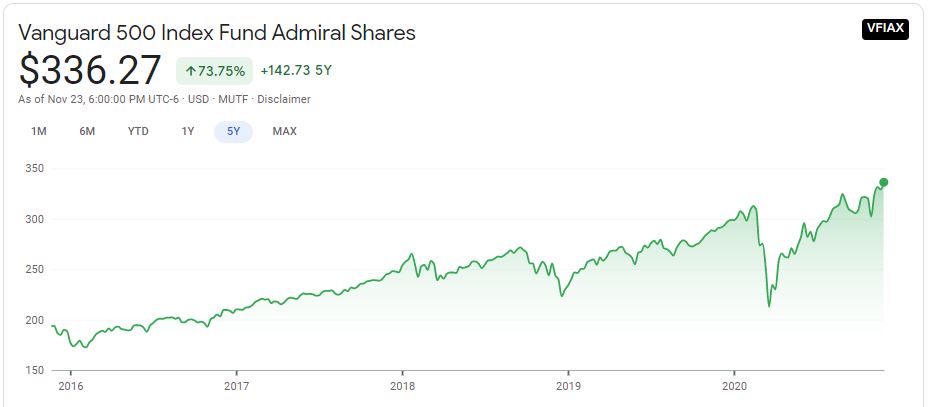
    Well, chances are your financial institution might be doing this for you already. When you are looking at your 403b or Roth IRA or 401K those accounts will have the dividends automatically reinvested… Nothing you have to do or worry about. For example, in the last 3 years my Roth IRA account has generated $950 in dividends. Those dividends in turn have purchased 3.558 shares of VFIAX. As of Today, that is worth $1,196. So in the last 3 years not only have I used those dividends to purchase more index funds, the value of those index funds have gone up as well. And to be honest I don’t have all that much money in my Roth IRA. Thanks to my need to continue to pay off my new car I haven’t been able to max out my Roth IRA like I would prefer. However, you can still see by being patient and letting our money work for us it has the power to grow exponentially. 

    So what are we doing with this now?

    Like I said, this is something you shouldn’t have to worry about in your retirement accounts. You shouldn’t have the option to cash out your dividends because, you know, taxes… Where this needs to be applied is in your taxable or brokerage account. 

    Brokerage accounts are a subject that we haven’t discussed in great detail on here for a few reasons. One, there are many financial needs that one needs to understand before getting a brokerage account and two. Brokerage accounts have only recently been redone to be more user friendly. Up until just a few years ago many institutions had a trading fee. Something like $7 a trade seemed to be pretty typical. It didn’t make as much sense to invest small amounts if you were going to get hit with a $7 fee every time. Now many institutions, such a Vanguard, have waived trading fees. There is no fee to purchase most domestic stocks. And many places now don’t have a minimum purchase requirement either. Just that you order in complete shares, and even that rule is changing. More on our Brokerage account set-ups at a later date. 

    What this has enabled us to do is invest in the market and take advantage of its growth in an account that we can access before retirement age. The Professor is in the second half of his career and is seeing the end in sight (Even if its a long ways down the road). I however am still in the first 1/3rd of my career, retirement benefits 30 years from now are not as clear as benefits that are only 15 years away. I have seen the benefits of investing in an account that I can access should I chose to leave teaching before the typical retirement age. Even though it is taxed, I enjoy this sense of freedom. 

    It also lets me pick individual stocks not just Vanguard funds. WARNING! – Do not start purchasing individual stocks unless you know what you are doing! This is what we call a pro-gamer move. We’ll have more info to come as we are getting data back from a year of investing in dividend growth stocks. But the short hand is it lets me pick individual companies, collect their dividends, and reinvest them into that company. After a year of experience, I’ve enjoyed it and thanks to dividend stacking, I have some decent returns to show for it and future growth ahead. 


    – KEEP STACKING!


    Minnesota teacher retirement at 60 reduction comparison under enhanced 60-30 rule

    Minnesota Teacher Retirement at 60: Understanding the Enhanced 60/30 Rule

    For years, Minnesota teacher retirement at age 60 was financially unrealistic for


    Read More

  • Selling TESLA and the Slow Grind of Investing

    Selling TESLA and the Slow Grind of Investing

    Yep, you read that correctly I bought TESLA stock way back in 2016 for under $200! I believe a lot in the future of electric cars and bought the stock to support the vision (boy was I naive back then). Two years later I sold it for $315. A sweet 57% turnaround after two years and a few hundred bucks in profit. I’m sure I used it to pay some bills or to buy some other stock. As sweet as that was, TSLA is currently trading for over $2,000 a share and is about to go through a 5-way split. Boy do I feel like a moron whenever I look at this. And yet, here you are, looking to me for personal finance advice! 

     What Selling TESLA has Taught me

    As painful as it has been watching that stock climb and realizing I could have made several paychecks worth of money on it, I have actually learned a bigger lesson in the personal finance/casual investor world. There are no get rich quick options, it is a slow decades long grind. That’s it, that’s the secret for all of us non-day traders out there, we need to invest for the long haul. When I was first buying and selling stocks I was under the impression of buy low and sell high, then use the profits to buy your next batch of stocks etc. Yeah, that doesn’t really work, not with any kind of sustainability for those of us that earn a median income. Buying and selling stocks short term turns quickly into an expensive gambling habit, and really to be successful at it you need to be paying close attention to the markets daily and to have a little bit of luck on your side. 

    Buy Stable Stocks with Consistent Payouts

    Here at Teachers Stacking Tens, we are clearly big fans of index funds. We seem to hit on them in every post we make about investing. They are extremely safe and the ultimate slow and steady hands off pay-out. However… They are kind of boring. Index funds make up over 90% of my portfolio for a reason, they work, but I like to have a little more diversity in my investments and I enjoy looking at the markets frequently. What made TSLA a frustrating stock for me was the fact that it never paid a dividend. It just sat in my portfolio not doing anything for years. The only way it had any real value to me was if I sold it. So I did for a profit and moved on to focus on Dividend Growth Investing. With dividend growth investing I’ve been able to invest in stable companies that kick out a quarterly or monthly dividend and I can reinvest that dividend back into the company giving me more shares! Using this I can set some more realistic goals for myself. Currently, I receive roughly $1,000 in dividend annually, it’s easy for me to work towards increasing that number and I can get some tangible results. Sitting on stocks that don’t pay out is tougher, at that point you are banking solely on their performance in the market which is much less predictable. 

    Investing for Teachers is a GRIND!

    Much like the grueling months of February and March, teacher’s investment plans are a very dreary. You aren’t going to receive a big flashy payday but consistent auto investing will begin to pay off in the long run. Heck even looking back at the past 5 years, it’s unbelievable the progress I have been able to make. The professor and I were just talking about our frustrations in not being able to invest more into the market and feeling how slow it has been, only to look back and realize that all of our accounts are quite a bit positive for the year 2020, and 2020 had the biggest drop since I’ve been investing. Another good reminder that discipline and consistency will win out every time. Don’t chase after miracle stocks like TESLA. Come up with an investment plan and stick to it. Now every time I see TESLA skyrocketing I am reminded to trust the process and keep grinding. 

    So keep those monthly contributions flowing, keep slowly raising them each year, and keep socking that money away into the market in stable long terms funds.

    Keep Stackin!


    Minnesota teacher retirement at 60 reduction comparison under enhanced 60-30 rule

    Minnesota Teacher Retirement at 60: Understanding the Enhanced 60/30 Rule

    For years, Minnesota teacher retirement at age 60 was financially unrealistic for


    Read More

  • 6 ways to Intelligently Spend Your Coronavirus Stimulus Check

    6 ways to Intelligently Spend Your Coronavirus Stimulus Check

    So… You are about to get some of your tax money back… What exactly should you spend it on? Unfortunately, many casinos don’t abide by the social distances rules so we can’t go and put it all on black. With that option taken out of the equation… Here are a few things you can do with that government hand back. 

    Quickly I’d like to point out that this is not free money, it’s your tax money that they have “Given back to you”. They’ll take it again next tax season don’t worry about that. So not technically free money but whatever, Let’s talk about how you can put it to work for you in order of importance. 

    1. Survive – If your family has been financial impacted by the Covid-19 quarantine of 2020, use that hand out in whatever way you need to to insure food, shelter and security. Thankfully, states are paying their teachers their salaries still, but perhaps a loved one is impacted. If you need to put that money to work for you in these next couple of weeks, make sure you take care of that first. 

    2. Pay down Debt – Have an outstanding balance on that credit card that’s been hanging over your head? Use that stimulus pay to pay down that debt. Remember credit card debt has an astronomical interest fee. It might not feel like that much but it is quickly adding up behind the scenes. Pay that credit card debt down and climb out from some of that debt. Break that pay-check to pay-check cycle.

    3. Stock up that emergency fund – This time has been a great reminder to keep a little cash cushion in your accounts for when times might get tough. We had all of about 5 days to prepare for society shutting down. The next great event that challenges the financial system will probably hit equally fast. Always a great reminder to have some of your money in liquid accounts (meaning you can easily cash out and use that money). Personally, I keep a small checking account and a chunk of money in the Vanguard Money Market in my brokerage account. Vanguard Money Market earns around 2% and I can easily use that money to cash out or buy stocks. 

    4. Put that money to work for you – No major debts? Still collecting your salary and haven’t had to dip into that emergency fund? You get a chance to put that stimulus check to work for you. The stock market is extremely volatile right now and will likely drop again and climb again and drop again and climb again etc. etc. Remember, no one can time the markets. Invest in low cost index funds and those index funds will continue to grow for you for years to come. They might drop over the short term, but remember our goal is to build long term wealth here. 

    5. Check out other sources to invest in – Have you always wanted to get into real estate investing? Interested in starting a side hustle? Thinking about making some renovations to your home that will increase it’s value? This stimulus check could be the perfect excuse to start seriously looking at these alternatives ways to increase your net worth. 

    6. Treat Yo’self (sort of) – I’ve always believed that the most important thing to invest in is yourself. This can be just the push you have needed to start investing in yourself. Maybe it is in the form of taking online classes, maybe it’s purchasing higher quality food to cook in your time at home, maybe it’s something as simple as purchasing a more supportive office chair so your back doesn’t ache every day. I don’t know that you should spend all of your stimulus check on treating yourself, but it’s okay if you spend some of it on you. I would challenge you to spend it on something that will genuinely enrich and add value to your life, not just feel good in the moment. Personally I am spending some time and money purchasing supplies and building a DIY modest home gym. That way I won’t have any excuses as to why I can’t exercise.

    However you choose to spend your check, please do so wisely, it’s likely that there won’t be another stimulus like this and this situation we are finding ourselves in is likely to last more than the next few weeks. Go through this list in order and make sure you feel good about each option before you advance to the next. Use your newfound time and money to grow your skill set and increase your knowledge. Look for new resources and tools to enhance your understanding of your financial situation. And as always… 

    KEEP STACKIN!