Author: The T.A.

  • How much should a teacher be saving each month?

    How much should a teacher be saving each month?

    So you know you should be budgeting and saving money. The question is what is a realistic savings rate for you and your family? And where should that money be going?

    What is a “Savings Rate”?

    First, to define a term – Savings Rate – a percentage of your income that you are able to tuck into long term storage. Don’t think of your savings as an amount each month but instead think of it as a percent. In reality, the precise number you save each month means much less than the percentage of your check you stash away.

    Take the following example into consideration. This is a famous example used in the book that first put me on the path to financial freedom, The Millionaire Next Door.

    Mike earns $50,000 a year. He is able to save $10,000 into his retirement accounts, a savings rate of 20%. Mike’s lifestyle has adjusted to live comfortably on the $40,000 a year the he currently budgets.

    Joe earns $500,000 a year. He is able to save $100,000 into his retirement accounts and live off the $400,000 he has left to budget. Also a savings rate of 20%.

    On the surface joe will have far more money in his retirement account than Mike does. This can be deceiving. Since Joe is used to the $400,000 a year lifestyle both men will reach financial independence at the same time. Reaching that 4% rule and being able to live off their accounts. So you see your savings rate is more important than the amount you put away.

    What should my savings rate be?

    So what is an ideal rate? Well… For sure it is more than 0%. Life throws situations at us where at times we don’t have the luxury of saving up. The key is during those moments is to buckle down and fix the problems or make the changes necessary to get above the 0% savings rate. Don’t feel bad or embarrassed if this is where you are currently at. It’s normal. People just don’t like talking about it. The key is to keep moving and keep working in the right direction. Choose and work towards a positive savings rate. It won’t happen overnight, but slowly you will become more financially savvy and you’ll be in the black. Once you are in the positives, automate some of those savings so that you no longer have to mentally focus on them. So how much should be going there…

    Your first step should be to get a savings rate that is equal to your school’s 403b match. This is an automatic 100% guaranteed return because your school is putting in that same amount you are putting in. For most teachers, we do NOT get a “robust” match from our schools. It’s usually not the same as the private sector.  Most private sector jobs will match a percentage of an employee’s salary. The standard match is usually 3%, and in some cases, even up to 8%! Most schools do not match a percentage of salary, but usually have a flat dollar amount that they will contribute. As an example, our district will match up to $750 to our 403b. For me, that’s 1.2% of my salary, so my first goal is to save 1.2% of my salary into my 403b.

    From there, it’s all about increasing that rate over time. A very easy way to increase this rate as a teacher is to take a portion of your salary increase each year and budget that directly towards your savings rate. Ideally, you would allocate 100% of any yearly salary increase to your savings rate, but that’s just not realistic. Inflation, especially in today’s economic environment, is a real thing. A realistic goal might be to allocate 25% or even 50% of any salary increase to savings. If you do this each year, your savings rate will grow a an incredible rate. Let’s look at an example of a teacher just starting out.

    You just signed on to teach high school science at a starting salary of $45,000. Your district will match up to $1,000 of your 403b contributions. You decide to make that your savings for the year. Your savings rate your first year is 2.22%. Not great, but hey, it’s a start. Let’s fast forward 5 years. Your salary is now $53,000. You started your career contributing $1,000, but you’ve decided to allocate 25% of any raises towards your savings rate. Your salary grew by $8,000, so you have added $2,000 more to your contributions giving you $3,000 going towards your savings. In five years your savings rate has climbed from 2.22% up to 5.66%! Let’s go ahead another 5 years. During this time, you were able to get your master’s degree, so your salary has jumped up to $65,000. You continued to allocate 25% of any raises to your savings. This adds another $3,000 to your savings giving leading to a total savings of $6,000. Your savings rate has now grown to 9.23%! By year 15, your salary has climbed up to $73,000, and you are at the top of your district’s salary schedule. You have added another $2,000 to your yearly savings. Your total savings is now $8,000 a year. Your savings rate is a very solid 10.96%. If you would have allocated 50% of your raises, your savings rate by year 15 would have climbed to over 20%! Take it one step further. By year 5, you have gotten your expenses in line and you have no reason to grow them. You decide to allocate 100% of any future raises to savings. In year 15, your savings rate is a whopping 31.51%!!!

    25% Allocation of All Raises
    YearSalarySavingsSavings Rate
    1 $  45,000.00 $    1,000.002.22%
    5 $  53,000.00 $    3,000.005.66%
    10 $  65,000.00 $    6,000.009.23%
    15 $  73,000.00 $    8,000.0010.96%
    50% Allocation of All Raises
    YearSalarySavingsSavings Rate
    1 $  45,000.00 $    1,000.002.22%
    5 $  53,000.00 $    5,000.009.43%
    10 $  65,000.00 $  11,000.0016.92%
    15 $  73,000.00 $  15,000.0020.55%
    100% Allocation of Raises after Year 5
    YearSalarySavingsSavings Rate
    1 $  45,000.00 $    1,000.002.22%
    5 $  53,000.00 $    3,000.005.66%
    10 $  65,000.00 $  15,000.0023.08%
    15 $  73,000.00 $  23,000.0031.51%

    Where should I put these savings?

    Everything that we have talked about to this point has focused on saving money in your 403b. This is a great option because it is a pre-tax option. Is it always the best option? That is for you to decide. One thing that is important to point out is that your 403b is not easily accessible until you reach retirement age. A portion of your savings should go into after-tax saving’s accounts, or you will run into a problem called “liquidity”. Liquidity is a term that means your ability to quickly access your money. As was pointed out earlier in the post, there are times when you will need access to cash. It could be to purchase a home, pay for kid’s college, replace a water heater, or buy a vehicle. These are events that happen in every person’s life, and you will need to be prepared for them. Too many Americans have good-looking retirement accounts, but they have no access to money so they can’t afford to pay for that new water heater when theirs breaks. This is why part of these savings should be put into an emergency fund in a savings account or a brokerage account. 

    Why is savings rate so important?

    If you are planning on teaching to your full pension age, you are going to be using your savings to help float the gap that is left over between your pension and your typical spending rate. Remember your pension will only be about 60% of the salary you have been used to. So if you have been spending your entire paycheck for your entire life, you will be in for a rude awakening.

    Some people believe that social security will be able to make up for that 40% “gap” between your full salary and your teaching pension. This might be a possibility, but social security funding and payouts will need to be changed in the coming years to make up for budgetary shortfalls. Some people believe that social security could become “means-tested”. The government will see how much money you are bringing in during retirement and determine if you will qualify for social security benefits. Well… The sad news is that if you have a pension, you may end up having your social security benefits reduced.

    Now, this is definitely us doing some speculating, but we would rather let you know the “worst-case scenario” and have you plan for that than bury our heads in the sand and “hope” everything works out. That’s what too many people are doing for their retirement “planning” these days!
    In Closing

    Saving money is not something that comes natural to most people. The thrill of spending money and buying that next shiny toy is designed to give you that shot of dopamine that most people crave! It takes planning, patience, and vision to see the big picture and build toward the future you want. Hopefully by following the information we’ve shared with you, you are able to build your own vision for your future and make it become a reality, and as always….

    KEEP STACKIN!

  • The Millenial’s Guide to YOUR Teacher Pension

    The Millenial’s Guide to YOUR Teacher Pension

    Or, more accurately… What the Hell is a pension?

    If you are like me, you’ve always thought that a pension is some kind of retirement plan the government gives you after your service. It is one of those things that you hear a lot about but it can quickly become overwhelming trying to figure out exactly what a pension is and what the government is going to be paying you after you retire.

    New to Minnesota teacher retirement planning? Start with our complete Teacher Finances 101 guide.

    (A QUICK DISCLAIMER. Pension plans vary greatly state to state and generation to generation. they are frequently changing to meet the demands of their retirees and contributors.)

    While complex and confusing, you NEED to take that time to sit down and truly understand what your state’s requirements and policies are. For most, this will end up being the biggest chunk of your retirement (AKA your future) so do not just assume everything is going the way that it should be. Even if you are young, make sure you understand what your pension will look like. It might be a driving factor in where you decide to work and small changes while you’re young will amplify in the future!

    We work in Minnesota and have an excellent step by step description of how MN TRA works HERE

    1. Where does your pension come from?

    The common misconception from the private sector is that pensions are gifts from the state as a token of your service… WRONG. You and the district you work for contribute to your pension with every check. Check out your pay stubs. You and your employer both contribute a percentage of each check into the states pension fund. This is typically between 5-10%. For the 2018-19 school year, my contribution was 7.5% of my salary, and my school contributed 7.71% as well. You don’t get a choice in this. This is a number that your state’s government comes up with in order to make sure the fund is healthy, growing, and sustainable. This percentage also changes slightly through the years in order to, once again, make sure the fund is healthy and growing. In Minnesota for example, the school contribution is scheduled to continue to rise to 8.50% by 2023. My rate will rise to 7.75% that same year. This is to help cover the shortcomings of the fund. This will continue to change as numbers come in from future years in the stock market.

    2. When do I get my pension?

    When you get access to your pension once again varies state by state and generation by generation. The date is typically derived by some type of a formula using your AGE and your NUMBER OF YEARS OF SERVICE. So, for example, in the state of Iowa you can start collecting your full pension once you have hit the RULE OF 88. Meaning once, years teaching + age = 88 then you are eligible for your full pension. For example, if you started teaching at age 22, and taught every year. Then you would be eligible for your full pension on your 55th birthday. That is a great retirement system if that is currently offered in your state. Many are not so lucky. As the rising cost of baby-boomers is increasing they need more of us working paying into the pension. Many states have adopted older retirement ages and gotten rid of age + service rules. In the state of Minnesota there is no longer a rule of 88 or a rule of 90. Retirement is now more directly linked to a person’s age (62-66 years) than service. Thus, for us young teachers, the age for receiving your full pension keeps getting pushed back. I would like to not be working into my 60’s in life that is why I am working hard towards financial independence so I can be in control of my own retirement date. It sounds like a simple idea but pension systems do not like that concept.

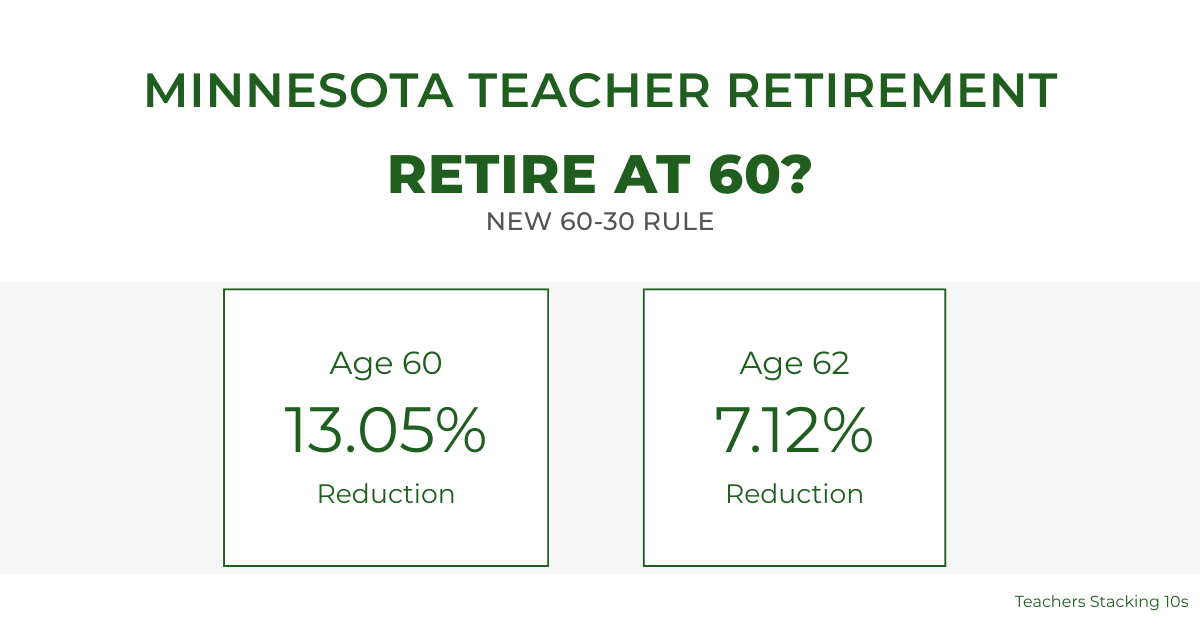
    Pension plans do not offer ANY wiggle room as far as age and requirements are concerned. You want to retire early? That’s fine but you will only receive a FRACTION of your potential retirement. So what are all the options and percentages…?

    3. How much money will I get from my pension?

    Guess what… It varies! But here are the basics. A pension is not a one-time lump-sum amount of money that you get on your last day of work. It is a monthly check that you will be getting from the government until the day you die. Is that check going to be enough to live off of?? Probably not by itself. Let’s talk about what that typically is. Before diving in, one important concept for pensions is the idea of your high 5. When calculating how much to pay out many states will look at an average of sorts of your highest paid years of employment. For the sake of our math let’s say they take the average of your highest paying 5 years of teaching. For our math let’s say that average works out to $65,000

    Full Pension – If you meet all of the requirements set by your state to receive your full pension then you can expect a monthly check from the government for roughly 55 – 65% of your high 5 depending on your state’s formula. ​

    Let’s look at an example from our state of Minnesota.

    Let’s say I made that $65,000 from my High-5. I started at age 24 and taught until full retirement age of 66. That’s 42 years of service. Minnesota’s multiplier is 1.7% for each year of service.

    So the math says 42 X 1.7% = 71.4% of my High-5 salary. 71.4% of 65,000 = $46,410. That’s what I would make every year. This number could vary slightly depending on what kind of survivor benefits you would choose, but my Minnesota teaching retirement would pay me $3,867.50/month for the rest of my life. Not a bad benefit, but be sure to check out #4 before jumping up and down….

    Partial Pensions – Let’s say you DON’T meet all of the retirement conditions. DANGER! Retiring early from teaching dramatically reduces your pension. This is why you don’t seem to hear about too many teachers in the FIRE movement. Even something as simple as trying to access your money a month early could reduce your monthly income by 50%… Forever. So that $3,000 a month just turned into $1,500 a month because you have an October birthday and you wanted to start drawing your pension in September. Here are some general rules.

    • At any point you can retire and withdraw YOUR half of the pension contribution, but NOT the state’s contribution. This will be viewed as new income so you will have to pay taxes on it. That’s an immediate 50% loss of your money so it’s a big NO!
    • You can retire early AND withdraw early but expect a significantly reduced monthly pay out.
    • There is potential with many current systems to quit teaching early and elect not to withdraw from your pension until you have reached the correct age. This can result in earning your full pension but it may require you to spend several years not getting paid from working and not earning your pension.

    It is an interesting dilemma if you’d like to retire early as a teacher. For example, if you decide teaching isn’t for you and retire after teaching for 6 years. In my state, I’d have 2 options. Option A – take my half of my pension (roughly $25K) pay taxes on it then that money is mine free and clear. Option B – Wait on the pension until age of 55. Then I can collect $250 a month. That is $3,000 a year until I die. Say I live to 75, that pension will have earned me… $60K… Not bad. Worth a lot more than taking your initial cut.

    4. The Golden Handcuffs

    As you can see, the teacher pension is a great safety net for you when you near retirement age. Some people outside of education will say that it’s a “gold-plated” retirement package, but we view it is a set of golden handcuffs. You are tied to teaching and don’t have the luxury of taking that pension money with you if you decide to change careers like someone in the private sector would. Sure, you are guaranteed an income when you retire, but with more and more people leaving the teaching profession after 5 or 10 or 15 years of work, it is definitely something that will weigh on you if you decide that 20 years of teaching is enough. Grumpus Maximus has a fantastic in-depth series all about pensions and financial independence that is definitely worth checking out.

    Closing Thoughts

    Remember this is intended as an initial introduction as to what a pension is. If you are in the position where you are considering retiring or walking away from teaching, you should consult an adviser through your states pension department, they will know what options you qualify for.

    This all sounds like a lot right now. You are thinking that you are years from retirement and that’s okay. But it’s important to have an idea of how your pension works. It’s an important part of your financial freedom and it’s important to have an understanding of how it all fits into the puzzle. So take some time this week to do the following

    • Log into your state retirement account
    • Check your current contribution balance
    • Look at your pay stub and figure out what percentage you and your school are contributing
    • Start a conversation about roughly when you’d like to retire

    Keep Stacking!

  • Best Investment Accounts Available for Teachers

    Best Investment Accounts Available for Teachers

    So Where Do I Buy Stocks and Bonds?

    Now that we’ve convinced you that you need to put your money to work, and you’ve decided that you need to use stocks (and bonds) to grow your wealth and improve your financial future, the question is where?

    We will be looking at 5 different types of accounts that you can purchase these things.

    Retirement Accounts

    The first group of accounts are all various types of retirement accounts. EVERYONE should have at least one of these accounts RIGHT NOW! My 16-year-old daughter already has a retirement account! The longer your money is in the market, the more time it has to grow….

    “But Professor, I have a teacher pension. I don’t need a retirement account.”

    Actually, yes you do. Many public pensions in the U.S. are currently under attack due to underfunding by state governments. It’s also the American way to take away things from others that you have lost or never had. Private sector workers have seen their pensions dropped over the last 20 years and instead of fighting to get them back, politicians have them focused on making sure that public sector employees lose theirs too! Idiots….

    But I digress.. Your pension right now might look wonderful, but it definitely could change by the time you are of retirement age. And let’s be honest, full retirement age in Minnesota is 66. There is no way in hell that I am still going to be working with kids at that age. I want the ability to retire when I am ready to retire, and retirement accounts will allow you to do that!

    Now most people’s biggest gripe with retirement accounts is that you CANNOT withdraw funds from some of them before age 59 ½ without incurring a 10% penalty. There are some exceptions to this rule that we will cover below.

    In all seriousness, as a teacher, you have access to more retirement accounts than most other professions.

    Retirement Accounts

    403(b)

    The 403(b) is the public employee equivalent of the 401(k) that you’ve probably heard about. This account is a “tax-deferred” account. It means that you are putting money into this account before current taxes are removed. Your money then grows TAX-FREE for the next 25 years! When you “retire” and begin to withdraw money from this account, it will be counted as income and taxed accordingly.

    One of the most important aspects of the 403(b) is that many districts will “match” money that you put into your 403(b). For example in our district, they will match 100% of your contributions up to $700/year. That’s a 100% return on your $700 investment!! You can’t get that kind of guaranteed return anywhere else!

    The combined contribution limit for all 403(b) accounts for 2019 is $19,000. This does not include any monies that your district includes.

    The biggest con of the 403(b) account is that you are limited in your investment choices to the ones that the servicer your school uses provides. You don’t get to just pick and choose what you are buying.

    Roth 403(b)

    This account might sound like a regular 403(b), but it is very different. Whereas a 403(b) is funded with pre-tax money, a Roth is funded with after tax money. So you pay Roth taxes up front, your money grows tax-free, and then you pay NO taxes when you withdraw the money. Later in the article, we will analyze which accounts you should be contributing to.

    The combined contribution limit for all 403(b) accounts for 2019 is $19,000. This does not include any monies that your district includes. The same rules about investment products apply to the Roth as the traditional 403(b).

    457(b) and Roth 457(b)

    The 457(b) plans are very similar to 403(b) plans. They have the same contribution limits as the 403(b), but they separate from those limits. This means that an employee may contribute $19,000 to a 403(b) AND $19,000 to a 457(b). So this means that you could contribute $38,000/year to your retirement. Let’s be honest, ain’t a damn one of us teachers able to afford that. Hell, $38,000 is more than you can make in our district for the first couple of years of teaching. Now, if you are lucky and married a “sugar daddy/momma” then you could definitely go for it, but then why do you even need us?

    Let’s get to the biggest advantage of the 457(b) plans. Whereas you will be hit with a 10% early withdrawal penalty if you take out funds before age 59 ½ from your 403(b) plans, you may withdraw your 457(b) funds at any time after you retire without early withdrawal penalties! Yahtzee!!! This is your golden ticket if you hope to retire early!

    Traditional and Roth IRA

    These accounts are NOT associated with your school. These are accounts that you would open on your own with a brokerage of your choosing. The nice thing about these accounts is that YOU have total control on deciding where to put your money. You are not limited to the investments that your 403(b) servicer provides. You just need to choose a brokerage to open your IRA in. Our personal recommendation is Vanguard, but there are plenty of other good brokerages out there. Since these are so nice to have, of course the government limits how much you can contribute. The max combined contribution is $6,000 for 2019. This is much below the $19,000 contribution limit for your 403(b). Remember, the financial industry has a lot (of money) to lose if you are in charge of your own money!

    Final Word

    The majority of people we talk with are scared and nervous about investing their own money. The financial industry has PURPOSELY made investing seem difficult. That way you feel like you need them to invest your money, and they can charge you fees to invest that money for you. You might like your 403(b) rep. He or she might be a great person, but remember, their JOB is to make money off of you whether your money grows or not! Investing might seem difficult, but if the TA and I can do it, anyone can.

    Keep Stackin!

  • The Secret to Starting a Budget

    “Don’t buy shit you don’t need.”

    Truer words have never been spoken.

    During my first few years of teaching, Minnesota would administer 6th graders a statewide writing test. The students were required to write an essay choosing a topic from a predetermined list. After the papers were finished, the teachers had to gather all pre-writing notes and make sure that the students had included their names on the forms. Going through one of the tests, we found one that was written beautifully. It was organized. It had a thesis and strong supporting details. The student explained how their neighbors had lots of “junk” in their yard that they never used and it looked terrible. He mentioned how they never had money to buy things they needed.

    His closing statement was the truest thing that I’ve ever read. “Don’t buy shit you don’t need.”

    Budgeting 101.

    As you begin your teaching career, there are three rules that you have to establish. I have these three rules on my board for my 6th grade social studies students.

    Rule #1 – Earn money

    This rule should seem easy enough. You make money. The key to this step is that your income should grow over time. As you progress in your career, you should get steps each year. You should also examine how your district handles lane changes. This is something you should look into doing as soon as you are set in your position. Hopefully within the first 5 years of your career. If you don’t, you are leaving a lot of money on the table. You may add to your income by coaching sports, supervising groups, etc.. You may also pick up some work in the summer, BUT be sure to read this post(backlink) before you do.

    Rule #2 – Spend less than you earn

    This is the rule that seems to elude most people. It sounds really easy to do, but trying to keep up with everyone else is the most American thing you can do. It’s also the dumbest thing to do when it comes to trying to become financially free! By trying to keep up with others, you could end up spending more than you earn by using credit cards. Credit card debt in America has reached all-time highs. And your debt is definitely an emergency according to Mr. Money Mustache, the guru of Financial Independence. Read about proper credit card use in this post.

    Start this process of spending by laying out your necessities such as housing, vehicle, and food. These are necessities and usually your biggest monthly expenses. If you can lower these bills, you will be starting out ahead.

    An especially dangerous area for many people is vehicle payments. Monthly payments to debt obligations are the devil. Literally… They will drag down your budget to the point of causing you great stress. Ask yourself if you really NEED that new vehicle. What value will it add to your life? Many in the “Financial Independence” community believe that you don’t even need a vehicle and you should just bike everywhere. The T.A. and I don’t believe that idea is reality for most people. If it is, great! You are way ahead of the game. But think about the purpose of your vehicle. A newer vehicle will cost you more in monthly payments and insurance. We will talk about the impact of a new car in a future post.

    The next step is to examine your insurance, cable/internet, and phone bills. These bills fall in between the need/want areas. They can balloon in cost very quickly. The big key to this is to shop around for a better deal when possible. I was able to lower my auto insurance by $100/month and double my amount of coverage by switching companies last summer.

    The final step is to examine your wants to see if you they are costing you your financial freedom. Restaurants, fast food, chicken wings, etc.. All of these things can derail your future. An easy way to track this spending and budgeting is to use a software program or app. There are many of these things available today. I used Microsoft Money and Quicken in the past. The T.A. and I both use You Need a Budget (YNAB) to track our spending and set budgeting goals. An important step that you will need to do each year will be to analyze your spending to make sure you are not succumbing to lifestyle creep. We also use Personal Capital to keep an overview of all of our accounts. It does a great job of giving a snapshot of your overall net worth and progress.

    Rule #3 – Save the rest

    This is where automating your paycheck is important. There are many different accounts you can put your extra money into. Retirement, savings, taxable. All have their pros and cons. The key is that you are putting your extra money into these accounts on a monthly basis. Have portions of your check directly deposited into these accounts so you aren’t tempted to spend them.

    As I mentioned in a previous post, I have $200/month sent into a savings account that takes some work to withdraw money from. I’ll admit. I’m like most Americans. I like the dopamine rush you get when buying something new. Buying new things actually gives off a chemical in your brain! Automating that savings makes it much easier and much more effective!

    The goal of budgeting is to give yourself financial security. This means you are no longer in that paycheck to paycheck cycle of just making the minimum payments on your debt obligations. Once you break that cycle and get your finances in order, you will be able to build your savings and create that financial security. Then you can move on to working on that next step, which is financial freedom and financial independence!

    But remember that lesson taught to me by a 6th grader, budgeting can be very simple.

    “Don’t buy shit you don’t need!”

    KEEP STACKIN!

  • Why this Teacher Finance Blog?

    Why this Teacher Finance Blog?

    So how do a couple of small-town teachers start their own personal finance blog?

    Well, it’s been quite a process. It started a couple of years ago at age 42 when I, The Professor, realized my finances weren’t good. I had just checked out Rich Dad, Poor Dad by Robert Kiyosaki. We contributed to my wife’s 401(k) and my 403(b). I had my teacher pension growing in size,

    but I was always worried about bills.

    We had hardly any money in savings outside of these retirement accounts. Any time an unexpected bill would arise, on the credit card it would go. We were like most typical Americans living paycheck to paycheck and constantly making minimum payments to loans and credit cards. The credit card debts just never seemed to get any smaller.

    I realized that other than our retirement accounts, we had accumulated very few assets. Get a little extra money in, “Oh, we need a new kitchen floor!” Done. “Oh, our range is old and inefficient. Let’s replace it!” Done! And on and on… I knew very little of real personal finance.

    Self-installed Hardwood Floors. Saved some money, my back regrets it.

    After that book, I became a financial sponge. I’ve read books, articles, magazines, forums, websites… and I mentioned all of these things to one of my colleagues and assistant coaches, The T.A. (teacher’s assistant). Being only 26, he was impressionable and relished the idea of learning all this information. Since that time, we have bounced investment information, websites, articles, and ideas back and forth about the best way to financial stability, security, and independence as a teacher. He also decided that we needed to take all of this information to the people through this blog.

    At first, I was hesitant. I am fairly computer-savvy, but this whole blog thing is a little intimidating. The T.A., on the other hand, knows technology. He’s already got his own science teaching blog, and he convinced me that we could do it, so here we are. We decided on Teachersstacking10s because you always hear about people stacking Benjamins, but as teachers, we don’t see too many Benjamins. We see $10’s, so it just felt right.

    Keep Stackin!

  • About us

    2 teachers, stacking 10’s, 1 day at a time.

    The Professor

    The Professor graduated from college in 1998 with a degree in education and athletic coaching and no knowledge of personal finance. He has spent the last 20+ years teaching middle school kids how to become critical readers and about the history of the great state of Minnesota. During his teaching career, he has spent time coaching football, track, and basketball. He currently coaches football along with The T.A.

    The professor has made many poor financial decisions during his years of teaching. He realized there were no lessons in personal finance during his college years. In his conversations with teaching colleagues, The Professor recognized an incredible lack of knowledge in money issues that deeply troubled him. With the help of The T.A., he began researching, learning, reading, and listening in hopes of helping other teachers to avoid the same pitfalls that plagued his early career.

    The Professor has been married to his beautiful wife since 2001.  They have two teenage daughters who will soon be going off to college.

    The T.A.

    The TA graduated from college in 2012 with a degree in high school science. He has spent the last 7 years teaching a variety of high school science classes and coaching 2 sports.

    Currently living the bachelor lifestyle in a mid-sized Midwestern city (pop. = 100,000) the T.A. brings a different financial perspective to the table. He spends most of his free time enjoying the outdoors, at the local brewery or trying to find the best hot wings in town.

    While being slightly frugal most of his life, the T.A. has only recently started to fully commit to his finances with the goal of achieving F.I.R.E. sometime before his official retirement date without sacrificing mass amounts of his lifestyle.