Author: The Professor

  • Choosing a Real Estate Investing Strategy.

    Choosing a Real Estate Investing Strategy.

    One of the best things about real estate investing is that there are multiple strategies that you can implement to make money. Each strategy has it’s own pros and cons. Most importantly, is that you can switch strategies depending on the property that you are looking at. 

    The first two strategies are the ones that most people have heard of, but the other strategies can be just as successful. In fact, being able to move from one strategy to another can turn a bad deal into a great one.

    Strategy #1 – Flipping

    This strategy has become extremely popular over the last 15 years due to the abundance of flipping shows on networks like HGTV. People have seen the success of these shows and how “easy” they seem to make it look. Flipping involves buying a run-down property, rehabbing it, and then selling at a profit. Sounds simple, doesn’t it? Well, slow your roll! Before you jump into your first flip, you’re going to need to have some knowledge. First, you are going to have to find a property that you can add value to. And like I said, flipping is very popular, so you’re probably going to have some competition. Then you need to understand the cost of the rehab AND what the ARV (after repair value) will be. You may need the help of a contractor for the rehab portion and a real estate agent for the ARV portion. This is especially true if it is your first flip. The two biggest mistakes that first-time flippers make is that they underestimate the cost of the rehab and overestimate the ARV of the property. Another cost to keep in mind is the holding cost that you will have during the repair. You will have utilities, any loan costs, property taxes, etc., during the time you are holding the property. Now, I don’t want to make flipping sound like an impossible mission. In fact, the reason flipping is such an attractive strategy is that a successful flip can earn a smart investor large amounts of money in a short amount of time. A successful flip could get you $20,000 or more in 6 months or less. Some flippers that specialize in high-end properties can even bring in $100,000 or more in profit in under a year. These successful investors understand successful flips require knowledge and planning and also some risk.

    Strategy #2 – Buy and Hold

    This strategy might be the one that most people associate with real estate investing. This is the landlord strategy. You buy a property, hold it, and rent it out. This strategy requires an investor to understand property values and rents for an area. It will also require you to understand your income and expenses for a property. The monthly rent for the property is the first income people think of, but are there other incomes like coin operated laundry or garage rent as well? And then you must also understand your expenses. Mistakes that investors make in this strategy include underestimating expenses and overestimating rents. Another big mistake is some investors do not hold enough cash reserves to cover unexpected expenses that come with owning a property. For every property you plan on holding, you should have $10-15,000 in reserves for any large, unexpected expenses. Of course this amount can vary depending on the age of your property. If you have a brand new property, your reserves can be less. A 100-year old property will definitely require more reserves. As you acquire more properties, you could also bring that amount down per property. For example, if you have 10 properties, you probably don’t need $100,000 in reserves. Not every furnace or roof on all of your properties will go out at the same time, but as you use up some of those reserves, you’ll want to make sure you build them back up.

    This strategy might not pay out the large sums of money upfront like we see with the flipping strategy, BUT this strategy can produce many streams of income that would make George Clason proud! We will go into more depth on this strategy in a later post.

    Strategy #3 – Wholesaling

    Wholesaling is not actually “buying” real estate. This strategy involves you finding good deals and then getting them under a contract. You then sell that contract with your assignment fee. This fee varies by the size of the deal. This strategy is great for someone who doesn’t have the capital to purchase deals themselves but is good at finding and sourcing deals. It requires a lot of hustle and willingness. It can also dry up pretty quickly if you don’t build a good marketing funnel to constantly bring in new deals. Just be careful of the real estate “gurus” out there who are more than willing to “sell” you their wholesaling course for the modest sum of a few thousand dollars. If wholesaling was as easy as they make it seem to be, wouldn’t every real estate investor be doing it? Don’t get me wrong, it’s a great strategy for a person with the right mindset and hustle.

    Strategy #4 – House Hacking

    House hacking is a very popular strategy for first time real estate investors. This strategy is when an investor buys a property and then rents out one part of the property. It is a great strategy for a first-time investor because it can give an investor a place to live with little or no mortgage payment and gives you practice as a landlord. The negative is that you are right next door to your tenant. This strategy can also be a little easier to work if you don’t have a family because if you by a single family property, you would be renting a room to someone else. If you have a family, you’ll probably want to find at least a duplex so you don’t have someone living in your house with you and your spouse.

    This can also be a great strategy if you have a kid heading off to college. Once they are able to live off-campus, you purchase a property near campus and have your child live there and have their friends live with them paying you rent! It saves your college kid money in cost of living, and you are getting the mortgage on your property paid off by their friends! Once they are finished with college, you can continue to rent it out, or you can sell the property to another investor. Just make sure that you check into the city’s rental requirements before you jump at this option. Many college towns have specific zoning ordinances for rentals. 

    Conclusion

    Real estate can be a fantastic wealth generator for the smart investor. Any of these four strategies taken alone or in any combination can grow your money tremendously. There are also numerous other ways to get into real estate but before you jump into any of these investments, be sure to do your research! Read books, watch videos, read blogs, visit forums. Investing used to be controlled by those that controlled the knowledge. With the explosion of the Internet, that knowledge is out there for anyone willing to do the work. Now get out there and…

    KEEP STACKIN!

  • The Greatest Wealth Generator in History.

    The Greatest Wealth Generator in History.

    Here at Teachers Stacking 10s, we have talked in depth about saving and investing your money into stocks and index funds. We have spent a lot of time in this area because almost all of us as teachers have a 403(b) account in which we invest. It’s also a very simple method for growing your money, but is it the “best” way to grow your money? If you want to be a passive, hands-off investor, yes, stocks, especially index funds, are going to be your best bet. But as we have seen these last couple of weeks, the stock market can drop precipitously and without warning.

    This brings us then to the idea of real estate. As the title of the post states, real estate has created more millionaires over time than any other. So why is real estate such a powerful driver of wealth? To answer this question, we have to look at the four different ways that real estate can grow your wealth faster than most other investments.

    Wealth Generator #1 – Cash Flow

    This is the area that attracts most people to real estate investing. People hear of someone who is making an extra $300+/per month on this rental property that they purchased. This is the passive income stream that we have talked about in previous posts. Now, like index funds, this cash flow can go up and down. Factors such as capital expenses, vacancy, repairs can significantly impact your monthly cash flow. This is why real estate has a steep learning curve. You have to understand cap ex, taxes, vacancy rates, property management, etc.. All of these things can affect your bottom line. We could compare this to dividends in an index fund except real estate cash on cash returns can easily exceed 10% compared to 2-3% in a dividend fund.

    Wealth Generator #2 – Appreciation

    Appreciation is when the house you buy goes up in value over time. This is similar to buying an index fund and having it the price increase. The average house in America appreciates on average 3% each year. Of course, this can vary greatly from location to location so it is important to make sure you understand the area that you are purchasing in to guarantee yourself the best chance of appreciation. Unlike stocks, you have the opportunity of “forced appreciation” in real estate by improving your property through repairs or additions. But like stocks, the price of your home could drop in a housing market downturn like we saw in 2008.

    Wealth Generator #3 – Mortgage Pay Down

    This is where real estate starts to really show its true wealth building ability. Mortgage pay-down is the paying down of the loan that you took out when you purchased the property. Very few people in real estate pay all cash on a property. The most common method or purchasing real estate is to pay 20-25% down and then “leverage” other people’s money for the rest of the property. This is similar to buying stock on “margin”, BUT in real estate, your tenants are the ones paying down that loan. So if you purchased a $100,000 property for $20,000, after 30 years your tenants would pay off that $80,000 loan for you! When you buy stocks on “margin”, or borrowed money, nobody is paying that loan but you!

    Wealth Generator #4 – Tax Benefits

    This final area is the one that shows how real estate investing is the “favored” method of growing wealth in America.  Each year that you own the property, the government allows you to “depreciate” your asset. This means that the government feels that the house is going down in value by a certain amount each year due to wear and tear, and you can deduct that amount from your taxes. You cannot “depreciate” stock. Now, the government of course wants to recapture that depreciation that you have deducted when you go and sell that house, BUT there is something called a 1031 exchange that allows you to sell that property and purchase another, hopefully larger property, WITHOUT paying those taxes. With this 1031 exchange, you are able to delay these taxes forever. This enables an intelligent real estate investor to “trade up” properties every few years to improve their cash flow. So you could realistically start out with a single-family home. A few years later move up to a duplex. Maybe 5 years later exchange up to a four-plex, etc.. Continuing to do this could allow you to to upgrade from that SFH to a 16-unit apartment complex over the course of 20 years!

    As with all types of investing, there are risks. Successful real estate investing requires time, effort, and knowledge. You will not be able to jump right in to real estate investing without doing your homework. Fortunately, there are numerous sources out there for you to study. One of my favorites is the Bigger Pockets website. I have used this site for the past couple of years as I build my knowledge in real estate. I have also started attending our local real estate investor meetings. Real estate is huge “relationship” business. You have to be willing to meet people and connect with others in the industry. Through these relationships, I am hoping within the next year to make my first purchase of a rental property. In my next post on real estate, I will discuss the different strategies when entering real estate. In the meantime, everybody….

    KEEP STACKIN!

  • Book Summary and Review: The Richest Man in Babylon

    Book Summary and Review: The Richest Man in Babylon

    One of the most important aspects of improving your personal financial habits is to learn as much as you can. One of the best ways to learn is to read great books on personal finance. “The Richest Man in Babylon” by George S. Clason is one of the books most often mentioned by those who have pursued financial freedom. Even though it was written in 1920, it’s 7 rules of money acquisition still hold true today. In fact, Mr. Clason sets his story in Ancient Babylon, and the rules of money back then still hold true today! I will include a summary of each chapter in regular print and then my thoughts and review in italics.

    Get your own copy today! (Affiliate Link) 

    This book is a must have for the personal finance community.

    Chapter 1 – The Man Who Desired Gold

    Mr. Clason’s style of writing does take a little getting used to at first. It is written in the perspective of a shield maker in Ancient Babylon named Bansir. The story starts with Bansir discussing how to get gold (their currency) with his good musician friend Kobbi. Bansir complains of having to toil every day to earn his money and then it is all soon spent and he has to go back to work to earn more. He has dreams of his purse full of gold coins that replenish themselves without him slaving at his task each day. Bansir thinks of his old friend, Arkad, who has become the richest man in all of Babylon. So rich, in fact, that Bansir thinks out loud that if he were to meet him in a dark alley, that might steal his wallet and the gold inside. Kobbi rebukes him with an important lesson, “Nonsense, a man’s wealth is not in the purse he carries. A fat purse quickly empties if there be no golden stream to refill it. Arkad has an income that constantly keeps his purse full, no matter how liberally he spends.” Bansir decides that he will bring a group of men who work an honest living but no riches to seek the counsel of Arkad to learn how they can also attain these income streams.

    Doesn’t this sound like many of us? We go to our jobs day after day to earn money, but after we pay our bills, there is not much money left, so back to work to continue earning income. Don’t we all wish for other streams of income that do not require us to put time and effort into, passive income streams!

    Chapter 2 – The Richest Man in Babylon

    Bansir gathers a group of friends and visits with Arkad asking how he has been able accumulate such wealth. They had all shared the same teachers and played the same games as children and yet none of these other men had been able to do so. Arkad explains that these riches are there for every man to enjoy. The difference is that he learned the laws that govern the building of wealth while Bansir and his friends did not. This was something that Arkad learned from the moneylender, Algamish. Arkad tells the others of his years of learning from Algamish and how he was able to accumulate great wealth. He shares with them the 7 rules of gaining wealth. Some of the men question and doubt that it could be this easy to gain wealth.

    Herein lies one of the most difficult things for many people to do; ask others for help. If you know someone else that is successful in an area you are not, ask them how they were able to achieve that success. The answer may be easy, or it may be difficult, but realize that it will probably take work on your part. If it didn’t, everyone would do it. This is one thing that I have really taken to heart. I’ve spoken to a couple of good friends that I consider much more successful in accumulating money than I have. They have been great in teaching me the principles that they have used to grow their wealth. My path may not rise as rapidly as theirs due to their main source of income being much higher than my teaching salary, but I can apply their principles on a smaller scale.

    Chapter 3 – Seven Cures for a Lean Purse

    Babylon became the wealthiest city in the world. Babylon conquered its enemies, but the Royal Chancellor explained to King Sargon that the people seemed unable to support themselves. All of the gold in the city had found its way to a handful of men. Not through any treachery or deceit, but because most men didn’t know the rules of accumulating gold. The king asked the richest man in the city, Arkad, to hold a class to teach the men of Babylon the ways of gold. Arkad explained to all the men in the class that he started out with very little and was able to accumulate much by following these rules of wealth. 

    The First Cure – Start thy purse to fattening

    Arkad explained that the first step to building wealth was to keep 1/10th of what you earn for yourself. He instructed them to set aside this money before paying any bills or buying any items. Arkad explained that it might seem simple, but the truth is always simple.

    The Second Cure – Control thy expenditures

    Arkad explained that men are burdened with more desires than they can satisfy. He showed how some of the men in the class earned more than others but their purses were as lean as those that earned far less. Arkad told them a very true fact of life, “That what each of us calls our ‘necessary expenses’ will always grow equal to our incomes unless we protest to the contrary.” He challenged them to all list the things that they wanted to spend on and only select those that fit into their 9/10s of their income. They were NOT to touch the 1/10th that they were to keep in their purse.

    The Third Cure – Make they gold multiply

    As class went on, Arkad proceeded to the third cure. By this time, the men had started to “fatten their purses” by saving 1/10th of what they earned and not spending more than 9/10ths of their income. Now it was time to make that gold they had saved start to earn more money. Each of these gold coins was put to use in investments to earn more gold coins. This was done to ensure a stream of wealth coming in without work.

    The Fourth Cure – Guard they treasures from loss

    Arkad continued with his fourth cure by explaining that a man must learn to protect the small amount of gold in their purses before the Gods will entrust them with more. Men with gold are often tempted by investing in extravagant opportunities that will grow their wealth. Arkad explained that his first investment was foolish as he trusted a brick maker with his savings to buy rare jewels that they would share the profits in. The brick maker knew nothing of jewels and his treasure was lost. Your treasure should only be invested where you have knowledge or have sought the knowledge of those with experience. Protect your treasure from unsafe investments.

    The Fifth Cure – Make of thy dwelling a profitable investment

    Arkad’s fifth cure was to explain to the men that they should own their own homes instead of paying a landlord high rents for a home that is not their own. Owning your home grows your wealth.

    The Sixth Cure – Insure a future income

    Arkad explained that all men age and that a man should prepare for those days when he will no longer be able to perform the physical work of earning income. A man should secure investments that will provide for his family an income in his older years.

    The Seventh Cure – Increase thy ability to earn

    Arkad concludes his cures with one of the most vital cures of a lean purse. This lesson is not about gold but about each man themselves. Each man should improve their skills and abilities to increase their income.

    This chapter is where the “meat” of this book lies. It is in these “cures” for a lean purse that show us what we need to do to improve our financial situation. All of these cures can apply to our way of earning and spending today. The only cure that some may argue against today might be owning your own home. Some people today believe that renting can be cheaper than owning a home simply because you don’t have the unexpected costs of home ownership like a broken furnace or water heater as a renter. This money is then invested into other profitable ventures. Outside of that, I believe that all of these cures, however simple or generic they may seem, can put you on a path to financial success.

    Chapter 4 – Meet the Goddess of Good Luck

    Arkad completes his class with the men of Babylon and continues to teach his knowledge to the people of Babylon in the Temple of Learning. One day a man comes to him to tell of a very lucky circumstance of finding a purse containing gold. He wishes to continue to be this lucky to find gold and asks Arkad how this can be so. Arkad poses the question of good luck as it applies to the gaming (gambling) tables. Surely this is where most men claim good luck to be found, yet none of the men, including Arkad, could claim to ever having found luck at these places. Arkad claimed that none of the wealthy men of Babylon could credit their success with the gaming tables. Their success came from honorable skills and trades by which they earned their gold. Arkad posed a question of how many had seen good luck within their grasp only to see it escape. Many of the men offered that they had. One man explained that when he was young his father had implored him to enter into an investment of barren land above the city which water could not reach. A friend had devised a plan to build waterwheels that would raise waters to the soil. The man being of young age instead spent his money on beautiful new robes from the East. The venture proved most profitable and the man regretted many years not joining the enterprise allowing good luck to escape him. Arkad explained that “good luck waits to come to that man who accepts opportunity.” Another man arose to speak of a disappointing return to the city after a journey in search of camels. The gates of the city were closed and the man was frustrated. An elderly farmer approached the city with a flock of sheep eager to sell and return to his wife who was sick with fever. The buyer eagerly struck a bargain with the old man but they could not count the sheep easily in the dark and the buyer refused to pay. The elderly man was desperate and asked for only two-thirds the price. The buyer was stubborn and would not pay. The next morning the gates opened and four buyers rushed out and purchased the flock at three times the price at which the elderly man had offered the buyer. Thus the buyer had good luck escape him. Arkad explained “Good luck fled from procrastination.” Arkad took both of these tales and explained to the rest that “Men of action are favored by the goddess of good luck.”

    This chapter seems to fit perfectly with what I’ve seen in the world. We all know people who we believe are “lucky”, but do we really notice the action that they took that we were not willing to take? The people I know who seem to have all the “luck” in the world are those who have taken some risks and took action to make their dreams reality. All of us can probably look back at some opportunity that was there for the taking, but for some reason, many times fear, we hesistated and the opportunity was gone. Be a person of action!

    Chapter 5 – The Five Laws of Gold

    Kalabab tells a story on the laws of gold by posing a question of which you would choose, a bag heavy with gold or a tablet carved with words of wisdom. All of the men of course choose the bag of gold. Arkad says it is true of most men. They ignore the wisdom and take the gold, and in a matter of time the gold is gone and they is no wisdom. “Gold is reserved for those who know it’s laws and abide by them.” He tells of Arkad, the richest man of Babylon, whom Kalabab knew through his son Nomasir, who had also earned his own riches in the city of Nineveh. Arkad did not believe in the custom of passing your estate to your sons. Arkad explained to Nomasir that he would have to show his father that he was capable of handling his estate and not wasting it. He gave Nomasir a bag of gold and a tablet with the five laws of gold. Nomasir was to leave and return in 10 years to prove that he was worthy of his father’s estate. Ten years passed and Nomasir returned to his father. Nomasir explained that he learned a difficult lesson soon after he was leaving his father as he was cheated in a bet on a horse race. His next lesson was when he went into business with a man from Babylon who proved to be a foolish buyer and lost their money. It was at this point that Nomasir read the five laws of gold and put them to heart. The laws were as follows:

    The Five Laws of Gold

    1. Gold cometh gladly and in increasing quantity to any man who will put by not less than one-tenth of his earnings to create an estate for his future and that of his family.

    2. Gold laboreth diligently and contentedly for the wise owner who finds for it profitable employment, multiplying even as the flocks of the field.

    3. Gold clingeth to the protection of the cautious owner who invests it under the advice of men wise in its handling.

    4. Gold slippeth away from the man who invests it in businesses or purposes with which he is not familiar or which are not approved by those skills in its keep.

    5. Gold flees the man who would force it to impossible earnings or who followeth the alluring advice of trickster and schemers or who trusts it to his own inexperience and romantic desires in investment.


    Nomasir then got a job managing a crew of slaves at the city walls. He diligently saved one-tenth of his income and this came to the attention of one of the master. The master made an offer of a business opportunity to Nomasir that could prove profitable. Nomasir jumped at the investment and was able to become of a part of this group of men in their investments. This led to Nomasir increasing his wealth and opportunities and he was able to show his father his ability to manage his father’s estate wisely. Thus, Nomasir received his father’s estate.

    This chapter gives us an the early beginnings of the 7 cures. They started as the 5 rules of gold and progressed into the cures. Nomasir’s example is a good one of someone who ignored the rules at first and lost everything and once they learned and respected the rules, they were able to turn their fortunes around.

    Chapter 6 – The Gold Lender of Babylon

    Rodan was a spear maker of Babylon who had just come into some money. The king had been pleased with his new design for spear tips for the Royal Guard. The king rewarded him with 50 gold pieces, but Rodan had no idea what to do with his newfound wealth. He went to the gold lender not to borrow money, but to ask for his advice on lending his gold. Mathon, the money lender, was quite pleased. Usually, men came to him only when they were in need of money. Nobody had come to him for advice. Rodan’s sister’s husband had asked Rodan to borrow money to start a business to become a rich merchant. Mathon asked if her husband had any knowledge of items or trade. Rodan said he did not. Mathon gave him strong advice that he should not lend money to anyone that does not appear to have the ability to repay. Rodan fretted as to how he should tell his sister that he would not lend her husband the gold. Mathon asked Rodan how many pieces of gold he had saved during his three years of spear making. Rodan answered three pieces. Mathon said surely his sister would not expect Rodan to give away 50 years of his savings to her husband, which is what the 50 gold pieces represented. Rodan had learned to be cautious with his hard earned gold.

    This chapter goes back to the idea of only investing your money into investments that you are familiar with or with people who are knowledgeable in such areas. I have experienced this firsthand. Once I had a couple thousand dollars saved away, I decided I was going to invest in the next up-and-coming business, pot stocks. I took that $2,000 and invested in a Canadian company that seemed to be the one that was going to come out on top. That stock today is worth about $300. A tough first lesson…

    Chapter 7 – The Walls of Babylon

    Banzar was an old guard of the Walls of Babylon. An army had besieged Babylon and was trying with all their might to get in. Each day, people would stop and ask if the walls of the city would hold. To each, Banzar would tell them that the Walls of Babylon would protect them. Finally after three weeks, the attacking army realized that victory was impossible and retreated from the battlefield. The citizens of Babylon celebrated in the streets rejoicing in their victory.

    The lesson from this chapter was to show that we need adequate protection from people that would try to take what is ours. There is nobody in life that will care more about your money than you!

    Chapter 8 – The Camel Trader of Babylon

    Tarkad was a starving. Food was everywhere, yet he had no gold to purchase any. He came across Dabasir, a friend of his fathers that had loaned him money. Dabasir asked for repayment of the loan, but Tarkad claimed that ill fortune had prevented him from being able to repay. Dabasir rebuked him but told Tarkad to come with him so he could tell Tarkad a tale. Dabasir proceeded to tell a tale of being a young man that saw the world through a different color. As a young man, Dabasir had borrowed much money and could not repay it, so he fled Babylon, but he was captured and taken as a slave some time later. During his time as a slave, he learned the value of hard work and was able to convince the daughter of his master that he was a good man. She believed him and allowed him to flee across the desert. For many days he rode in the direction of Babylon until he was on the brink of dehydration. He realized at this time that he had viewed the world in the wrong color. He vowed from that point on that he would repay every person that he had borrowed money from. With this new determination, he continued on with renewed vigor to change his life. Tarkad learned as Dabasir ordered the inn keeper to bring food for his young friend, that “where there is determination, the way can be found.”

    Too many times in life, people give up at the first sign of adversity. Living life this way prevents us from living our best life. It’s up to us to stay focused and determined to work for what we want in life.

    Chapter 9 – The Clay Tablets from Babylon

    Alfred Shrewsbury was an archaeologist studying some clay tablets that had been found in Mesopotamia. The tablets spoke of a man named Dabasir who learned the lessons of money accumulation that used these lessons to pay off all his debts and amass a great amount of wealth. Alfred, who had much debt, took these lessons and applied them to his own life. Over a period of time, he was able to repay his debt and accumulate enough wealth to live a comfortable life. The lessons that applied in Ancient Babylon still apply today.

    This chapter really stresses the idea of debt being the barrier to growing your wealth. This especially applies today with all of our easy credit that is available to everyone. The majority of Americans today have some form of consumer debt; car loans, lines of credit, credit cards. Ask anybody with this kind of debt, and it can seem insurmountable.

    Chapter 10 – The Luckiest Man in Babylon

    Sharru Nada was the merchant prince of Babylon who was travelling with the grandson of his long-time business partner, Arad Gula. Sharru felt that he owed a great debt to Arad and wanted to help his grandson, Hadan, but he was disturbed by the young man’s attitude toward work. Hadan believed that all manual labor was reserved for slaves, not for someone of his place in life. Sharru decided on a plan to show the young man the value of hard work. Sharru recounted to Hadan his beginnings as a slave who learned that the better a slave worked, the better the master treated them. Sharru worked hard enough that he became friends with another hard-working slave, none other than Hadan’s grandfather, Arad. Arad had earned enough money through his hard work that he was able to buy his freedom. Some years later, Arad purchased Sharru and freed him to make him his partner. Hadan was shocked at his grandfather’s beginnings and realized that he earned his high status through his hard work.

    This chapter shows us that no matter where you start in life, you must respect the value of hard work. Work is what gives life meaning and earns the respect of others.

    Mr. Clason’s book gives us an outline of how each of us can accumulate wealth. The rules are simple, but they are difficult to follow. Our society has stressed the importance of consumer spending, and we fall into the trap. The key is to take the first step. Try to pay yourself first. That first step could be the first step on a path to financial freedom! And as always…

    KEEP STACKIN!

    Minnesota teacher retirement at 60 reduction comparison under enhanced 60-30 rule

    Minnesota Teacher Retirement at 60: Understanding the Enhanced 60/30 Rule

    For years, Minnesota teacher retirement at age 60 was financially unrealistic for

    Read More
  • What Should I Be Teaching My Kids About Money?

    What Should I Be Teaching My Kids About Money?

    Money is definitely something that you need to be teaching your kids about. The problem is that most people don’t know where to start. Heck, most of us here are teachers. We teach for a living, but we don’t know what or how to teach our children about money.

    The sad fact is that less than half of parents in America talk with their kids about saving and investing for retirement. Unfortunately, too many parents are themselves uneducated when it comes to managing their personal finances. This whole blog is designed to give you enough background knowledge and confidence to take charge of your own finances so that you can pass this knowledge on to other teachers, but more importantly, your own children.

    So where do I start?

    The Basics

    The first conversations about money with your child should focus on what money is, how you earn it, and where it goes. Start with talking to them about your check and how you earned that money. It’s very important that your child understands that the money you earn comes from you giving your time to your employer. It isn’t just “given”. After they see your paycheck, they will probably think that you are rich! The next step is to explain to them where the money goes. This money allows them to have a place to live, lights, food, etc… Explain to them that all of these items need to fit in your budget. A budget is an important part that many people skip and even fewer follow. They need to understand that without a budget, you can’t move into the next step of financial literacy.

    Savings

    Now that your child understands the basics. You can dive deeper into budgeting with them and show them that you should NOT be spending every dollar you earn. Start with a simple idea of a savings account. This is an important step for children. We live in an instant gratification society where people get what they want when they want it. Kids must learn the concept of delayed gratification and teaching this at a young age is paramount. Try to keep it very simple. Have them think of a reasonably priced item that they really want. Now it is up to them to save enough money to buy it. If your child is 8 or older, you could give them a small allowance for doing chores around the house. This is a golden opportunity for them to learn the concept of work for pay. Just like if mommy and daddy don’t go to their job, if you don’t do your chores, you don’t get your allowance. An important step of this is to make sure that you give them the money that they’ve earned. They need to have the ability to spend it when you go places. They need to see all of the temptations in everyday life. We’ve all made impulse purchases before. Your child needs to see that there are going to be things out there in the real world that are going to try and “persuade” you to give up your hard earned money. Whenever your child wants to spend on something that isn’t their “goal”, remind them of what they really want to get, but don’t stop them. If they do decide to spend on something else, keep talking up that “goal” that they have to create a little buyer’s remorse. They need to feel that at a young age. Better to feel some buyer’s remorse now on a $10 toy than 20 years from now on a $20,000 one! Once they’ve learned that lesson, it’s time to move on to the next step.

    Investing

    Now the real fun begins. Remember when you talked with your child that the way you earn money is by working? Now they need to learn that real wealth is made when your money makes money for you! To me, the best way to teach this lesson is to actually open an investing account for your child. I believe that a Roth IRA account is the best vehicle to do this. We talked about Roth IRA’s in this post. A Roth is a great choice because the money grows tax free and is NOT taxed when money is withdrawn. Your child can also withdraw any principal invested at any age. The con is that they may NOT withdraw any growth on the money until they are age 59.5. This investment also gives you a chance to talk with your child about retirement. Wouldn’t we all like to retire at age 59.5 with enough money to live our best life? Starting a Roth at an early age will allow your child to do that. Now this is the ultimate in delayed gratification! One caveat with a Roth is that your child can ONLY invest $6,000 or what they claim in earned income during a calendar year, so your child will need to have a documented job to invest in a Roth. Sorry, their allowance doesn’t count. Oh, your child has a mowing “business” that they are paid to mow your yard and a neighbors. Hmm. We may have something. Consult your personal CPA before committing to that. The Professor is NOT a certified CPA. 

    Conclusion

    Every parent wants their child to have a great life. Teaching them about money at an early age is a vital role for you as a parent. As a teacher, you KNOW that your children are NOT being taught these types of lessons in school. Ironically, high schools and colleges will teach students how to manage money in a business, but not your own personal finances! So, take the steps necessary to put your child on the right path here in Money 2020! Nobody will care about THEIR money more than THEM!

    Keep Stackin!

  • The Professor’s End of 2019 Financial Update

    The Professor’s End of 2019 Financial Update

    This will be my first post showing how I am saving money both in and out of retirement accounts. I always like to read blogs that give real-life examples of those people practicing what they preach. Going forward, I will try and give a quarterly update of our financial position and the thoughts that go into it. I will warn you, I don’t have huge amounts of money socked away anywhere, but I think we have done a solid job in putting money aside. 

    *Always keep in mind, these numbers DO NOT include my teacher pension. My goal is to make that money just a part of our financial future and NOT the entire amount we will have.

    Assets

    December

    Cash – All checking and savings accounts

     $      4,648.50

    Stock Account (TD Ameritrade)

     $      1,160.41

    Index Fund (Vanguard)

     $      2,435.15

    My 403(b)

     $    74,563.08

    My IRA

     $         269.75

    Wife 401(k)

     $  143,699.19

    My HCSP

     $    19,834.26

    Total Assets

     $  246,610.34

    Liabilities

    Current Debt (Credit Cards, Etc.)

     $                 –  

    Clinic

     $      1,238.88

    Corolla Loan

     $                 –  

    RAV4 Loan

     $    18,549.07

    Student Loan

     $      5,764.82

    Property #1 Mortgage (Primary)

     $  107,469.98

    Total Liabilities

     $  133,022.75

    Total Net Worth

     $  113,587.59

    Assets:

    Cash – $4,648

    This includes all of our checking and savings account balances. I’m not a big believer in carrying 3-6 month emergency fund. We have enough room on credit cards to put any emergency purchases on and then pay them off with our other accounts before those bills are due. These types of accounts just don’t return enough in interest to provide any value to me.

    TD Ameritrade (taxable) – $1,160

    This is an account that I started so I could buy individual dividend growth stocks.

    Vanguard (taxable) – $2,435

    This is an account that I use to purchase Vanguard index funds.This is where I prefer to keep my “emergency” fund. I know that I need to grow this out more in case of any significant emergency expense. My plan is to get between $10-15,000 in this account and let it grow and replenish as needed.

    My 403(b) – $74,563

    This is my main retirement account. I have been paying into this since I started teaching. Our district currently matches $800 each year into this account. It is kind of small for having taught for 20 years, but my early years of putting money into this account robbed me of many gains. I was invested in annuities with heavy fees and surrender penalties. It’s just been in the last 8-10 years that I have really become more knowledgeable about these accounts. They also say that your first $100,000 is the hardest to save. Once you hit that mark, your accounts grow much more quickly because you are getting that compounding snowball rolling. I’m almost there…

    My IRA – $274

    I opened this account because I was going to drop my contribution in my 403(b) down to the match. I will be contributing more to this as I go forward. The key reason is that I don’t have to pay ANY fees in my IRA like I do in my 403(b). This is also where I will rollover my 403(b) money to when I retire.

    Wife 401(k) – $143,699

    My wife has a good job as a nurse and the organization that she works for contributes 9% of her salary each year into this account. She’s also contributing 11% of her salary so about 20% of her salary goes here each year. This is the account that I learned first-hand the power of compounding.

    My Health Care Savings Plan (HCSP) – $19,834

    This is an account through our school that we both contribute to each month. It can only be used for medical expenses AFTER I retire. It has grown nicely the last 5 years.

    Liabilities:

    Clinic – $1,238

    It sucks to have low-back pain.  I get a procedure done each spring that costs about $3,000 out of pocket. This is the paydown for that.

    RAV4 Loan – $18,549

    We had to add another vehicle to our “fleet” last spring due to another driver in the household. We also needed a little bit larger one with two teenage girls.

    My Student Loan – $5,696

    This is what’s left of my loan for my Master’s degree.

    Mortgage – $107,469

    This is the mortgage that we have on our home. The house currently appraises for about $160,000 so we do have some equity in it. I opened a $30,000 line of credit on it last spring just in case I found an investment property to purchase. I don’t plan on touching that line of credit for anything but an investment.

    Net worth (assets-liabilities) – $113,587

    Key Points:

    You’ll notice that I don’t have assets linked for our major liabilities. I do NOT believe that you should include the value of your house or vehicles as assets for your net worth. You only realize those assets if you sell them, and I don’t plan on ever selling those things, but I DO have to pay off those loans. I think it gives a clearer picture of how much money you actually have.

    Goals for 2020:

    My biggest goal for 2020 is to pay off the clinic bill. Another big event that happened since the New Year was that we had to get a vehicle to replace my old 2010 Dodge Avenger that was totaled in an accident. Fortunately everyone involved was OK, but the insurance company didn’t feel that spending $6,000 to repair a 9 year old vehicle with 210,000 miles on it was a good investment. We ended up purchasing a 2016 Toyota Corolla. We made a $3,000 down payment and I am planning on paying off the $11,000 loan within the year. Once that is completed, my goal is to fully fund ($6,000) my IRA for the year and increase contributions to my 403(b).

    So how’s your financial situation? Throw some thoughts down in the comments and as always….

    KEEP STACKIN!

  • Mind YOUR Money!

    Mind YOUR Money!

    Well, you wouldn’t think that we would need to put out a post like this since we are dealing with teachers that are supposedly responsible people, but….. People! Check your pay stubs EVERY time you get paid and check on your accounts at least once per month!

    If you have followed our advice, much of your paycheck is automatically sent to the proper accounts. Everything “should” be correct and getting to the right places. I mean, those are adults working in the business office, aren’t they? They are, but they are also human, so sometimes mistakes do happen.

    The T.A. and I have been dealing with some major issues in our district regarding our paychecks. We are a small district, so our business office consists of one person. Unfortunately, our business manager took a different job in October. Our district hired an agency to handle the finances until the new business manager was hired. Let’s just say that things haven’t transitioned very well. Pay amounts were wrong for certain extra-curricular activities, insurance premiums were not deducted, and 403b, HSA, and other various monies were never sent to the proper accounts. At first, we thought it was just due to the transition. It was, but it happened a second pay period and then even into a third! The T.A. and I contacted our superintendent after the first pay period. By the second pay period, we were bugged, but we stayed understanding. I mean, nobody wins if we go in guns blazing, but we had to make sure the right people were aware of what was going on.

    The part that really opened our eyes was that many of our colleagues had no idea that their money wasn’t getting into their accounts! As long as the money in their checking account made it, they didn’t seem to mind that the rest didn’t make it! We talked and encouraged them to check their accounts and make sure that their money was there and accurate. It wasn’t until we informed them that their insurance premiums might not have been paid that they REALLY perked up. It was as if their 403b money didn’t matter. UGH!!!

    Now, there was no nefarious activity behind our problems. There was nobody misusing funds or sending them to the wrong place. Apparently codes and passwords needed to be updated with the new company we had hired, but if nobody would have pointed it out, that money might still not be in our accounts earning interest and dividends. Even worse, people might have lapsed on their insurance!

    Teachers, we can do better! We have to pay attention to and care about our money. Nobody else is going to care about it for us. If they do, they are trying to get their hands on it!

    KEEP STACKIN!

  • Vanguard is our new best friend.

    Vanguard is our new best friend.

    It’s happening! The TA and I are going to be getting Vanguard as a 403(b) vendor in the New Year! Wait, you aren’t as thrilled as we are? You should be. This is great news!

    What’s the big deal Professor?

    Well, everybody loves saving money! This is what Vanguard is going to do for us. Most teachers don’t realize that a 403(b) vendor charges fees to “advise” you on how to invest your money. Depending on your vendor, these fees can range from $100’s to even $1,000’s of dollars per year. This can cost you MASSIVE amounts of money over the course of your teaching career. Our current vendor charges a fee of 1% to manage our money. I have about $70,000 in my account, so they charge me $700/year! Vanguard charges a $5/month record keeping fee, so my yearly cost will be $60! That’s a savings of $640/year! No matter how much money I add into my account, I will still only be paying $60/year!

    There has to be a catch? 

    Yes. The “catch” is that you can only purchase Vanguard funds. This is fine with the TA and me since we are big fans of Vanguard’s low expense ratio funds. We both actually hold them outside of our 403(b) in personal IRA and taxable accounts.

    Friend with benefits

    Not only will we save money with Vanguard as our provider, but we will also have more control of where our money goes. With our current vendor, we have to talk with our adviser about where we want our money. We have to tell them the percentages and then we have to listen to them try to “persuade” us to invest in high expense ratio funds. We can log in to see our accounts, but we have ZERO direct control over anything that happens in the account. We have to contact our adviser to make changes. With Vanguard, we will be able to log in and set our investment profile directly. 

    A typical conversation with my 403(b) rep.

    Don’t get me wrong. My adviser is a nice guy and I know he means well, but I’m an intelligent investor and the person I trust most with my money is me. I hope that doesn’t come off as arrogant, but I have put the time in to learn about good investing strategies. You can do it too! Just go back and read our post on understanding stocks, ETFs, and funds.

    Remember, an adviser makes his money by telling you what to do with your money. Even if you aren’t confident in making your own money decisions, there are three key questions that need asking.

    • What is your company’s expense ratio?
    • What is the expense ratio of the funds you are recommending?
    • Is there a penalty for moving money from one fund to another?

    The first two questions will give you an idea of how much of your money you are losing. If the answer to either of these questions is over 0.50%, then you are being charged too much.

    If the answer to the third question is yes, RUN! This will mean your money is in some kind of annuity. These are bad! You should NEVER be penalized or required to keep your money in a fund for a certain amount of time.

    The Hurdle

    The one hurdle that you have to get past is having limited options when it comes to 403(b) vendors. Every school district has a list of approved vendors. You cannot choose anyone outside of this list to administer your 403(b). The TA and I did not have a great list of vendors available to us, so we decided to ask our school if Vanguard could be added. We were lucky, for us it was simple. We are a small school district, so we don’t use a 3rd party administrator to oversee our 403(b). Our school board quickly approved adding Vanguard. You can try the same thing with your district. Show them the comparisons between a company like Vanguard and your current choices. It can be a powerful influence to show them the amount of money that their employees could be saving.

    I just wish I would have learned this 20 years ago!

    Keep Stackin!

  • Minnesota Teacher Retirement: How the TRA Pension Really Works

    Minnesota Teacher Retirement: How the TRA Pension Really Works

    If you teach in Minnesota, your Teachers Retirement Association, TRA, pension is one of the most valuable financial benefits you have. It is also one of the least understood.

    Because participation in TRA is mandatory, every public school teacher is automatically enrolled and contributing from their first paycheck. Yet many educators never fully understand how their pension is calculated, when they can retire, or how recent legislative changes affect long-term income.

    Understanding Minnesota teacher retirement is not optional. It directly shapes your future financial flexibility.

    In this guide, we will break down how TRA works, how benefits are calculated, when you can retire, how early retirement penalties apply, and what recent funding changes mean for your long-term plan.

    New to Minnesota teacher retirement planning? Start with our complete Teacher Finances 101 guide, then return here for a deeper dive into TRA.

    What is TRA?

    The Minnesota Teachers Retirement Association, TRA, administers pension benefits for public educators across the state. It provides retirement, disability, and survivor benefits funded through employee contributions, employer contributions, and long-term investment growth.

    TRA is governed by an eight-member board. Five trustees are elected by members, four active teachers and one retiree. The governor appoints the remaining three. Investment management is handled by the Minnesota State Board of Investment, SBI, which also manages assets for PERA and MSRS.

    In plain terms, TRA administers the pension system and the SBI invests the assets.

    Membership begins the day you start employment with a TRA-covered employer. Contributions are deducted automatically from each paycheck.

    So what is a Pension?

    A pension is a defined-benefit retirement plan. That simply means your future retirement income is based on a formula, not on how well your personal investments perform.

    With a defined-contribution plan like a 403(b) or 401(k), your retirement income depends on how much you contribute, how your investments grow, and how you manage withdrawals later. The responsibility and the risk sit largely with you.

    With the Minnesota TRA pension, the benefit is calculated using a formula tied to your years of service, your salary, and a multiplier set in statute. Once you retire, you receive a guaranteed monthly payment for life. Depending on the option you select, that benefit can also provide income for a surviving spouse.

    That guarantee is powerful. It removes many of the uncertainties that come with market-based retirement accounts.

    However, it is important to view your pension as a foundation, not a complete strategy. TRA is designed to replace a portion of your income, not all of it. Understanding how large that portion will be is the key to deciding how much additional investing you need to do.

    How is TRA funded?

    The Minnesota TRA pension is funded through three primary sources:

    • Employee contributions
    • Employer contributions
    • Long-term investment returns

    As a member, a percentage of your salary is automatically deducted from each paycheck. Your employer also contributes on your behalf. Those combined contributions are invested by the Minnesota State Board of Investment.

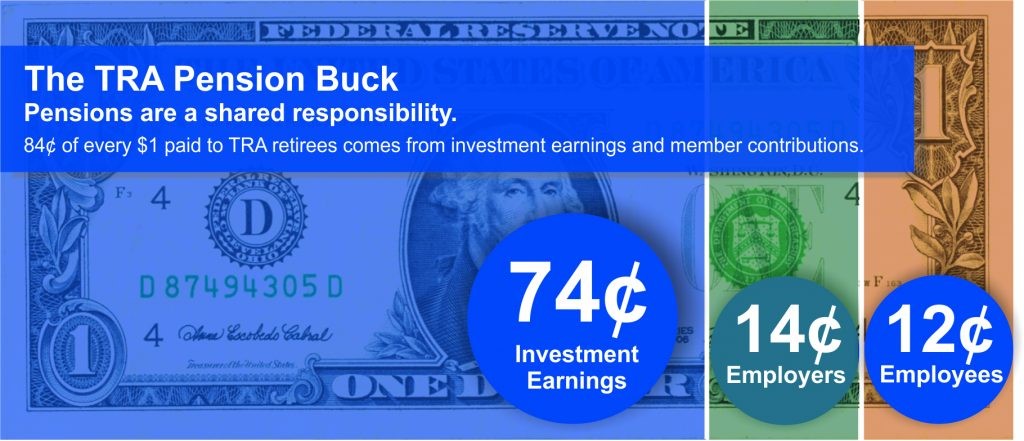
    Over time, investment growth provides the majority of the funding needed to pay future benefits. This is true for most public pension systems.

    Because investment returns fluctuate, TRA relies on actuarial projections to estimate long-term obligations. When returns fall short of expectations or demographic assumptions shift, the legislature may adjust contribution rates, benefit structures, or actuarial assumptions to maintain long-term stability.

    That is why you occasionally see legislative updates affecting contribution percentages, COLA adjustments, or funding timelines.

    The key takeaway is this: your pension is not funded from a single source. It is supported by ongoing contributions and long-term investment growth. Monitoring funding ratios and legislative changes is part of responsible retirement planning.

    Over time, the majority of pension funding comes from investment growth. Contributions from employees and employers form the base, but long-term returns drive sustainability.

    The breakdown below shows how a typical TRA pension dollar is funded.
    When Can You Retire Under Minnesota TRA?

    One of the first questions teachers ask is simple: When can I retire?

    Under Minnesota TRA, eligibility depends on your hire date and your years of service credit.

    It is important to separate two ideas: retirement eligibility and full, unreduced retirement. They are not the same.

    Minnesota TRA is divided into two eligibility tiers based on hire date. Your tier determines whether you qualify for the Rule of 90, what your full retirement age is, and how early retirement reductions apply. If you are unsure which structure applies to you, read the full breakdown of Minnesota TRA Tier I vs Tier II.

    Normal Retirement Age

    For teachers hired after June 30, 1989, the normal retirement age, often called NRA, is 65.

    This is the age at which you qualify for your full, unreduced pension benefit under the standard formula.

    That does not mean you must teach until 65. Early retirement options exist, but they come with permanent reductions.

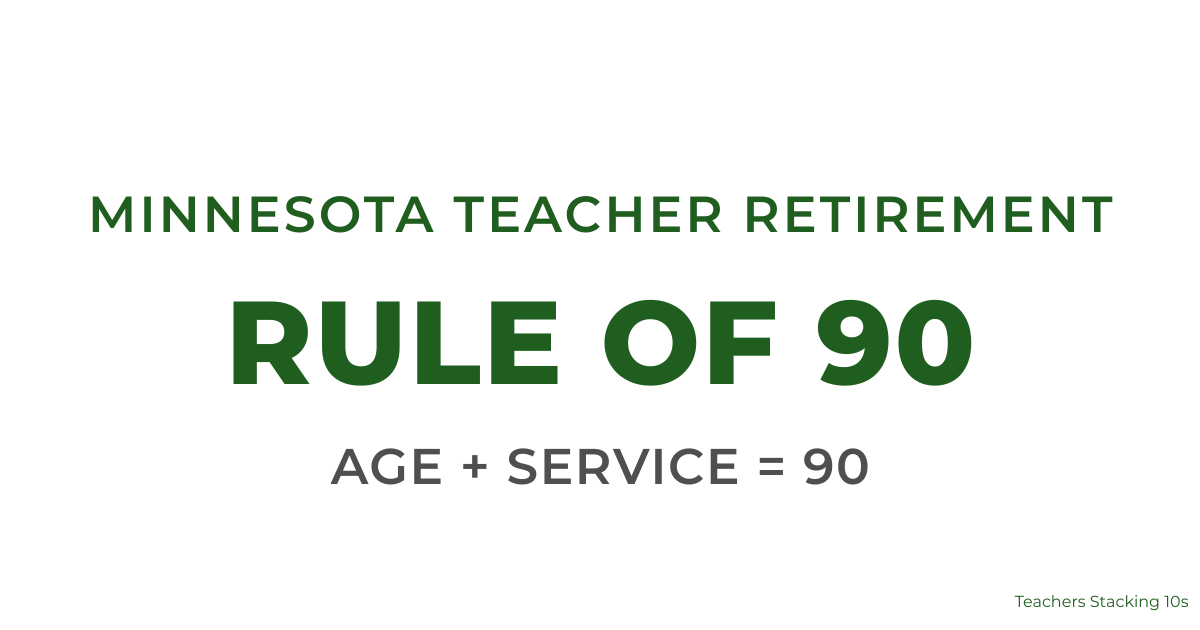
    Rule of 90 (Pre-1989 Hires Only)

    If you were hired before July 1, 1989, you may qualify under the Rule of 90.

    When your age plus years of service equals 90, you can retire with full benefits and no early retirement penalty.

    This rule no longer applies to teachers hired after that date.

    If this rule applies to you check out our full breakdown of Rule of 90.

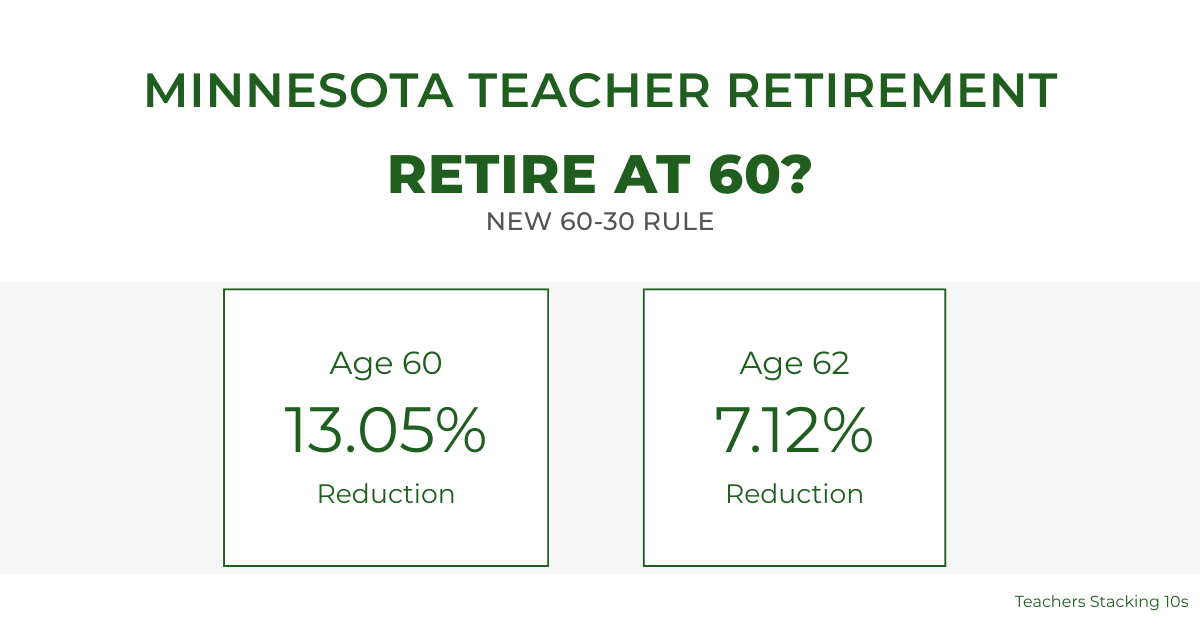
    Enhanced 60/30 Provision

    Recent legislative changes introduced an enhanced 60/30 option.

    If you are age 60 with at least 30 years of service credit, you may qualify for retirement with a reduced early retirement penalty compared to retiring before age 60.

    Retiring at 60 does not automatically mean your benefit is unreduced. Your tier status and years of service determine whether an age-based reduction applies.

    This provision created more flexibility for long-career teachers who wish to retire before 65.

    Age 62 With 30 Years of Service

    For many teachers hired after 1989, age 62 with 30 years of service remains an important milestone.

    While not fully unreduced retirement, the penalty at 62 with 30 years is significantly smaller than retiring earlier.

    Because of this, many Minnesota teachers use 62 as a practical target retirement age.

    Early Retirement at 55

    Teachers may begin collecting benefits as early as age 55 if vested. Most teachers become vested after three years of service.

    However, retiring at 55 results in a substantial reduction to your monthly benefit. In some cases, the reduction can exceed 60 percent compared to full retirement age.

    Eligibility does not automatically mean financial readiness. The reduction is permanent and should be evaluated carefully.

    Important Note on COLAs

    Recent changes also adjusted cost-of-living adjustments, COLAs. For many retirees, COLA eligibility now begins at normal retirement age, generally 65, rather than immediately upon retirement.

    This change can affect long-term purchasing power and should be factored into your retirement planning.

    Strategic Takeaway

    The question is not simply “When can I retire?”

    A better question is: When can I retire with the income I want?

    Understanding service credit milestones, early retirement penalties, and COLA timing allows you to make that decision intentionally rather than emotionally.

    Before choosing a retirement date, log into your TRA account and run multiple scenarios using the official retirement calculator.

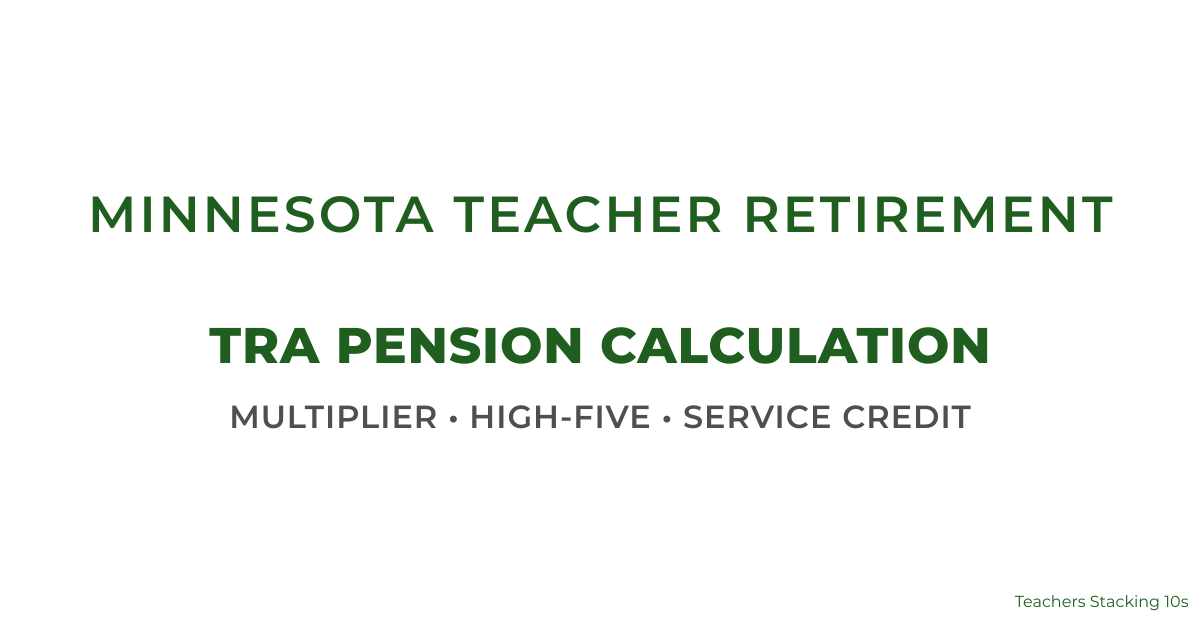
    So How Is My Benefit Calculated?

    Your Minnesota teacher retirement benefit is determined by a defined formula. It is not based on market performance or the balance of an individual investment account.

    The formula is:

    Years of Service × High-5 Salary × Formula Multiplier

    Each component matters, so let’s break them down.

    Years of Service

    Each academic year you work in a TRA-covered position earns one year of service credit. The more years you accumulate, the larger your benefit becomes. Service credit is one of the most powerful variables in your control.

    High-5 Salary

    Your High-5 salary is the average of your five highest consecutive years of earnings. For most teachers, those years occur near the end of their career when they are at the top of their salary schedule.

    Because your pension is tied directly to salary, late-career earnings have an outsized impact on your final benefit.

    Formula Multiplier

    The multiplier applied to each year of service depends on when that service was earned.

    Service earned before July 1, 2006 is multiplied by 1.7 percent.
    Service earned after June 30, 2006 is multiplied by 1.9 percent.

    Each year of service is multiplied by its applicable percentage, and the totals are combined to determine your overall benefit percentage.

    Example Calculation

    Let’s walk through a simplified example.

    Assume:

    38 years of service
    High-5 salary of $72,000
    8 years at 1.7 percent
    30 years at 1.9 percent

    First, calculate the combined multiplier.

    (8 × 1.7%) + (30 × 1.9%) = 70.6%

    Next, apply that percentage to the High-5 salary.

    70.6% × $72,000 = $50,832 per year

    If retiring under an early retirement provision such as 62/30 or enhanced 60/30, an early retirement reduction would apply.

    For example, if the reduction were 14 percent:

    14% of $50,832 = $7,116

    That produces an estimated annual benefit of approximately $43,716, or about $3,643 per month.

    Your exact benefit will depend on your service history and chosen retirement date. The most accurate way to estimate your pension is to log into your TRA account and use the official retirement calculator to run multiple scenarios.

    If you want a detailed step-by-step breakdown of exactly how the Minnesota TRA pension is calculated, including real retirement scenarios, read our full TRA pension calculation guide.

    Why This Formula Matters

    Unlike a 403(b) or Roth IRA, where retirement income depends on account balance and withdrawal strategy, your TRA pension provides a predictable lifetime payment based on a statutory formula.

    Understanding this calculation allows you to estimate future income, identify potential gaps, and determine how much supplemental investing you need to build flexibility into your retirement plan.

    The pension provides structure. Your decisions around service years, retirement timing, and additional savings determine the outcome.

    Future of TRA

    One of the most important metrics to monitor is the funded ratio. This represents the percentage of projected future obligations that are currently backed by assets.

    A funded ratio of 100 percent means the plan has enough projected assets to meet long-term obligations under current assumptions.

    As of recent actuarial reports, TRA’s funded ratio has been below 100 percent, prompting legislative adjustments to improve long-term sustainability.

    Legislative Adjustments

    In recent years, Minnesota lawmakers have implemented several changes, including:

    • Adjustments to cost-of-living increases
    • Changes to contribution rates for employees and employers
    • Modifications to actuarial return assumptions
    • Extension of amortization timelines

    These changes were designed to strengthen the long-term funding trajectory of the system.

    What This Means for Teachers

    It is important to understand two things at the same time:

    First, TRA is not on the verge of disappearing. The pension is backed by statutory obligations and ongoing contribution structures.

    Second, pensions are dynamic systems. Contribution rates, assumptions, and benefit structures can change over time to maintain solvency.

    That is why understanding your pension formula, monitoring legislative updates, and maintaining supplemental retirement savings is essential.

    Your TRA pension provides a powerful foundation. Responsible planning means building on that foundation, not relying on it exclusively.

    Planning Beyond the Pension

    The Minnesota TRA pension is a significant advantage compared to many private-sector retirement plans. It provides predictable lifetime income and reduces the personal investment risk that many workers face.

    However, it was never designed to replace 100 percent of your working income.

    Even small changes in assumptions, contribution rates, or cost-of-living adjustments can affect long-term purchasing power. That does not make the pension unstable. It simply means it should be viewed as one part of a broader strategy.

    The most resilient retirement plans combine:

    • A clear understanding of the TRA formula
    • Realistic projections of future income
    • Consistent contributions to a 403(b), Roth IRA, or other supplemental accounts
    • A disciplined savings rate throughout your career

    Teachers who treat their pension as a foundation rather than a finish line tend to retire with far greater flexibility and confidence.

    Final Thoughts on Minnesota Teacher Retirement

    The Minnesota TRA pension is one of the most valuable financial benefits available to public educators in this state. It provides predictable lifetime income, shifts market risk away from individual teachers, and offers a level of stability that many private-sector workers no longer have.

    At the same time, it is not a complete retirement plan by itself.

    Understanding how your benefit is calculated, when you qualify for retirement, how early retirement penalties work, and how funding changes affect long-term sustainability allows you to plan with clarity instead of assumption.

    The teachers who retire most comfortably are not the ones who simply trust the system to work. They are the ones who understand it, project it, and build around it.

    If you want a structured plan for building that broader strategy, start with our Teacher Finances 101 guide. It walks through the full process step by step.

    Clarity today builds flexibility tomorrow.

    KEEP STACKIN!

    Money at Home, Money Hacks, THE BLOG

    A Little Research Can Save You THOUSANDS Of Dollars!

    The Story Last week, my Maytag Neptune dryer started making that hideous,

    Read MoreSide Hustle, THE BLOG

    Am I DUMB For Creating This Side Business as a Teacher?

    In my previous post, I said that I was going to talk

    Read MoreRetirement, THE BLOG

    2023 MN Legislative Final Update and How It Impacts Your TRA Pension

    Hey everyone. Well, here is the final update from the 2023 MN

    Read Morepexels-photo-3483098.jpegRetirement, THE BLOG

    2023 MN Legislative Update and How It Impacts your TRA Pension

    Hey everyone! It’s been quite a while since I’ve posted anything on

    Read MoreHigher-ED

    The Big Adventure Into Higher-Ed

    This summer I made the leap from public education to a private

    Read MoreBudgeting, Debt, Investing for Teachers, Money at Home, Retirement, THE BLOG

    THE PROFESSOR’S END OF Q2 2022 FINANCIAL UPDATE

    This is my post showing how we are saving money both in

    Read More
  • Debt is a four letter word!

    Debt is a four letter word!

    The T.A. and I were talking the other day about the fact that we have talked a lot about what to do once you have money, but many people live paycheck to paycheck. It’s time we talk about the biggest problem facing Americans today…. Debt….

    One of the first posts that I read when I started down this path was the classic Mr. Money Mustache post on debt being an emergency. I highly suggest reading that post as Mr. Money has a way with words that I still am learning. He is the man!

    When it comes to debt, Americans are in love! According to a 2018 study by Nerdwallet, the average American household has $6,829 of revolving balances each month. Add in your monthly mortgage/rent, car payment, student loan payment, etc… It’s no wonder that your average American looks at you like you have a third arm when you ask them how much they are saving each month for retirement.

    If debt is so bad, then why do so many people put themselves in this situation? Most people don’t venture out to bury themselves with debt. It’s more like a death through a thousand paper cuts type of situation. They get that first job and see how much money they are going to be making. They decide to purchase a house to start their family. So starts their life of mortgage payments. They realize they need a new/newer vehicle because they “deserve” it. So they take out a vehicle loan with a monthly payment they can afford. They pick up a few things to go into their house to make it look nicer. They go out to eat a few times a month. All of these small charges go on their credit card because they will have enough money at the end of the month when they get paid. Uh oh, the water heater goes out. $1,200. Damn house. They pay that bill because they have to have hot water, but that means they don’t have enough to pay that $500 credit card bill. It’s ok they think because the minimum payment is only $25. They make that minimum payment and carry over that $475 plus another $15 for a total of $490. Here’s where it all starts to go wrong. They don’t change their habits. They rack up another $500 in credit card charges the next month and now have a $990 bill staring them down. Get the picture?!?

    So how do we handle this debt problem? Well, if you’re like most Americans, you ignore it and try not to think about it. You DEFINITELY don’t talk about it. The typical American sticks their head in the sand and hopes the debt will go away. THAT WON’T WORK! So what do they do? They run out and get a consolidation loan or even a home equity loan and pay all them cards off! Problem solved! Wrong. Wrong.

    Because here’s what happens. All of their debt is gone, but their habits don’t change. They continue to put those little charges on their credit cards and now, not only do they have that new loan payment, but their credit card debt starts to climb again. It’s an all-too common theme in America. People NOT taking responsibility.

    So professor, what’s the answer then? How do I fix this situation? 

    First, you must face up to your debt and NOT ignore it! Immediately stop spending money on those credit cards. Put every penny you can spare into paying them off. You can start on the card with the smallest balance or the highest interest rate. Hard-core budgeters will tell you it has to be the highest interest rate card, but you need to do whatever works for you! It won’t be easy. It will probably suck, but YOU put yourself into this situation and only YOU can get yourself out.

    The key is that you MUST take action.

    KEEP STACKIN!

  • What is a Dividend?

    What is a Dividend?

    Investing can be complicated. Through this website, the T.A. and I have tried to simplify it into terms that the average teacher can understand. The focus of this post will be on dividends.

    So far, we have talked about saving your money and investing it into primarily index funds to make things as simple as possible. Now that you are starting to get a better understanding of what stocks and index funds can do, I want to explain the importance of dividends in your portfolio.

    In it’s simplest terms, a dividend is in the interest that a company pays you for you “borrowing” them your money. By purchasing a company’s stock, you are “loaning” them your money. They use that money to improve their business and grow profits. If you have purchased stock in a good company, they will have a profit each quarter, and they may pay their stockholders a percentage of those profits. A key point is that NOT ALL COMPANIES pay dividends. This does NOT mean those are bad companies. Maybe it’s a company that is still growing and is investing their profits into growing and are not yet ready to pay out dividends. The stock price is climbing because their company is growing and your money is still growing. Index funds, ETFs, and mutual funds may also pay dividends out to their shareholders.

    Dividends can be paid at different times during the year. Some companies will distribute a yearly dividend at the end of their fiscal year. Others will distribute them semi-annually, quarterly, or even monthly. There really is no set rule as to when companies will distribute them. Some companies will even announce a “special” dividend if they have an extra profitable fiscal quarter or year.

    Dividends are measured in their annual yield. This yield is figured by dividing the total yearly dividend paid by their stock divided by the stock’s price. Let’s take a common ETF that we have discussed in previous posts, Vanguard Total Stock Market Index Fund (VTI).

    VTI’s share price as of this post is $155.83. The dividend paid over the last 12 months is $2.74. If you divide $2.74 by $155.83, you get 0.176. Multiply by 100 and you get 1.76%. So currently, VTI has a yield of 1.76%. It’s really not that difficult to calculate.

    So the quick decision people make is, oh, just find the stocks with the best yield and buy all of them! Not so fast… You need to make sure that the dividend for that stock is sustainable. Maybe their share price has plummeted due to a poor quarterly report. Their yield will jump, but they may have to cut their dividend because they didn’t make enough money to pay the previous dividend amount. It is important to keep an eye on a company’s earnings per share (EPS) each quarter. If a company only profited $1.32/share for the previous year, paying $1.40/share dividend isn’t going to be sustainable.

    So how can we use dividends to grow our wealth?

    A popular way of dividend investing is to invest in strong companies that have a history of raising their dividends over time. This is a great way of increasing your yield. It is commonly referred to as Dividend Growth Investing or DGI. Let’s take a look at an example of how your yield can grow over time.

    You decide to buy Company A. They are a solid energy company that has continually raised their dividends over the last 10 years. You decide to purchase 100 shares at $100/share. At the time of your purchase, the company had a yield of 1.5%, so for your $10,000 investment, you were paid $150/year in dividends.

    Fast forward 10 years. You’ve held those 100 shares in Company A over the last 10 years. Each year, you have received your dividend. Also, the stock price has steadily climbed and is now $140/share. During this time, the dividend continued to increase each year as well. Now they have an annual yield of 1.75%, so based off of that $140 share price, the yearly dividend in now $2.45/share. So if we look at your original purchase of $100/share, your yield on cost (YOC) is now 2.45%! This is how dividend growth works. It’s not unheard of for people that have held their stocks for 20-30 years to be receiving 10% yields or more on that money they originally invested.

    The negative of dividends is that if they are in your taxable accounts, you will have to pay taxes on them depending on your tax bracket. If you have held the stock for under a year, any dividends you receive will be “unqualified” and you will have to treat them like income and pay taxes on them according to your tax rate. If you have held them for longer than a year, they are considered “qualified” dividends and are subject to a different tax rate that will depend on your income level.

    This is why many people hold their dividend stocks in their tax-sheltered accounts like your 403b, IRA, or Roth.

    While index funds are still our #1 recommendation for investing dividends can be a great way to provide yourself passive income and add some diversity to your account.Your money making money for you, and that will help you to…..

    KEEP STACKIN!