Category: Budgeting & Cash Flow

Practical strategies for managing income, eliminating debt, building emergency funds, and creating financial stability on a teacher salary.

  • Saving Money By Doing My Own Basement Remodel!

    Saving Money By Doing My Own Basement Remodel!

    I feel like I need to start this post off by saying that I know that this won’t be for everyone. I have always been a handy person. I’m not saying this to toot my own horn because much of the work that I did, can be done by most people with a little bit of research. With YouTube, you can learn how to do almost anything. One YouTuber that I got a TON of information from was Basement Finishing Guy. His videos were extremely helpful and gave me tons of insight into how to do things correctly.

    I’m also very lucky that I have access to most of the equipment that I used. Even if you can’t do all of the work that I did, you could definitely choose parts to tackle yourself and save some money.

    This whole project was always something that I always wanted to do, but it took a heavy rainfall last March to push me over the edge. We had gotten some water in the finished side of our basement in the past, but this time it really flooded one corner. If I would have done a little investigating, I would have found that the reason it flooded was because the small window well had filled with water and flooded in through the window. But I was convinced that we had a crack in the cement wall so I just started tearing down the paneling and drywall and framing. Lo and behold, no crack! Well, the carpet still had to come out, so I just went with it. I still wanted to make a larger window in that room and also put a larger window in my daughter’s basement bedroom to make it legal. She’s been in that bedroom for a couple years, and I knew that I would feel more comfortable having a large, legal egress window there, so away I went.

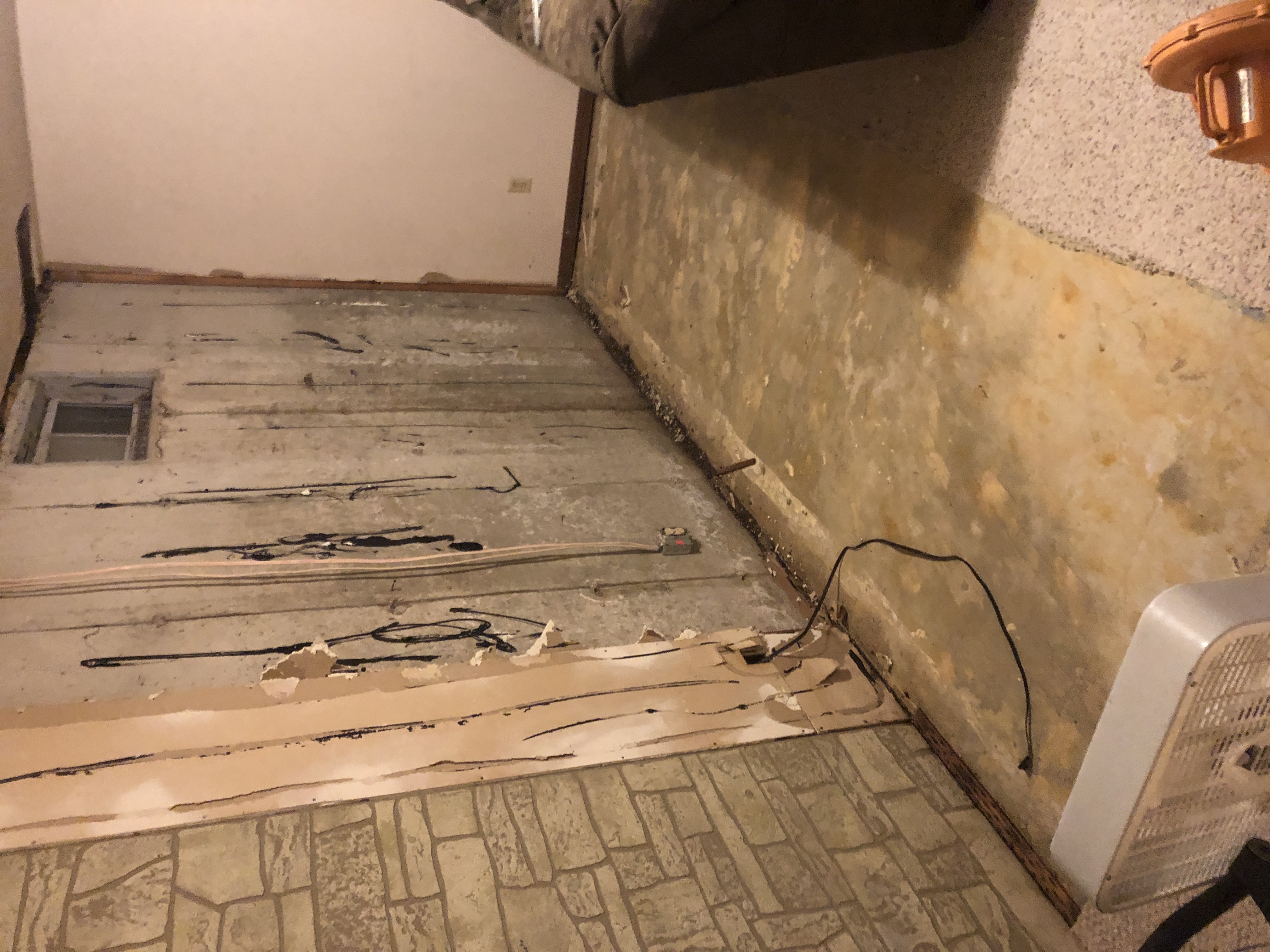
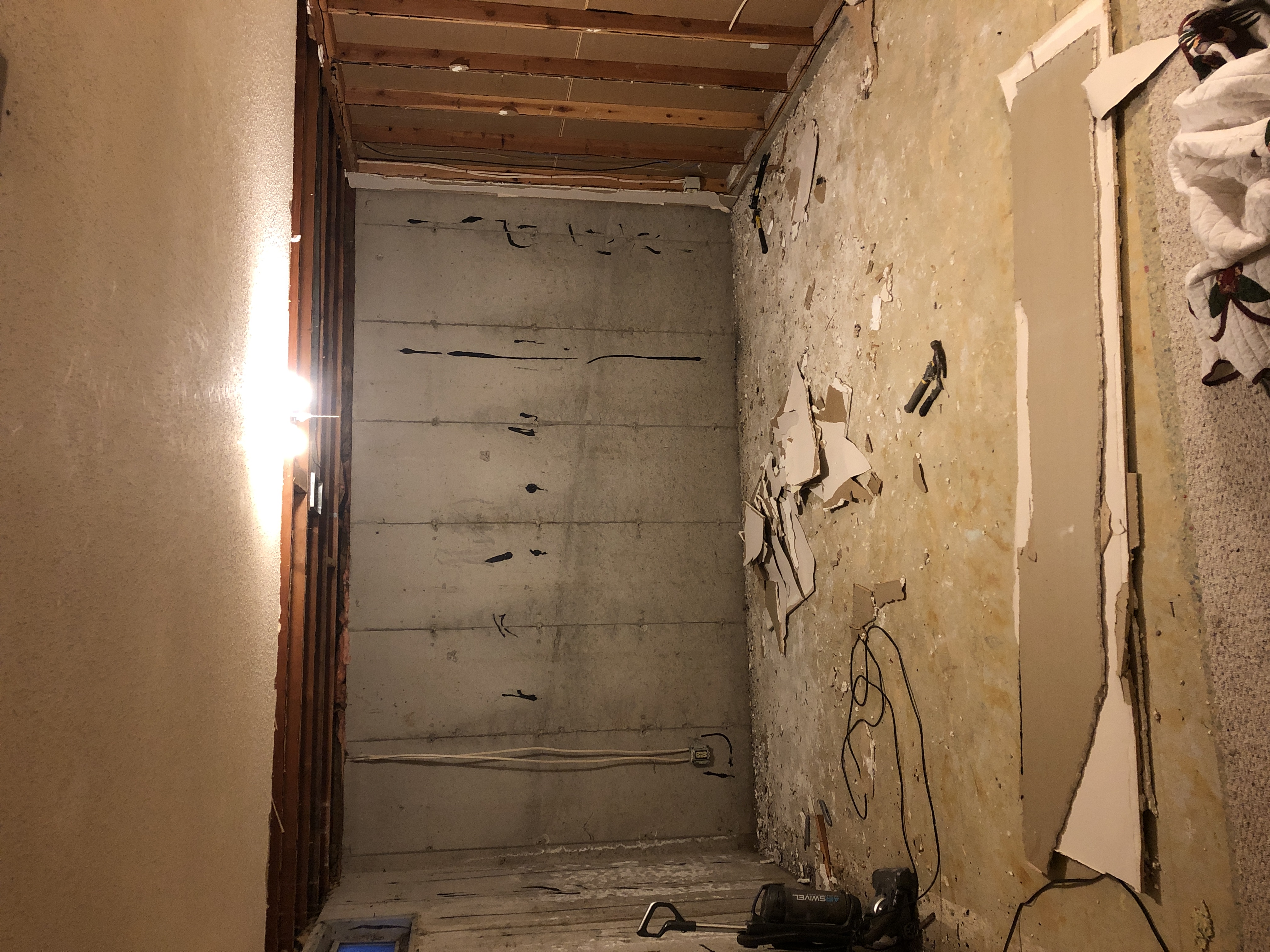
    The first stage of the remodel required me to demo the entire family room and one wall in her bedroom. It took some work, but it didn’t require much in terms of “construction” knowledge. I just had to tear out all the old drywall and paneling and remove the carpet and pad. This first picture is the beginning of the tear out phase. This is where the leak occurred. It was a little “rash” on my part to just start tearing things out, but as you can see along the base of the wall, it was only a matter of time before that 2×2 stud was completely rotted out. This wasn’t the first time that water had penetrated into that wall. The picture on the far right is about halfway through the demolition phase.
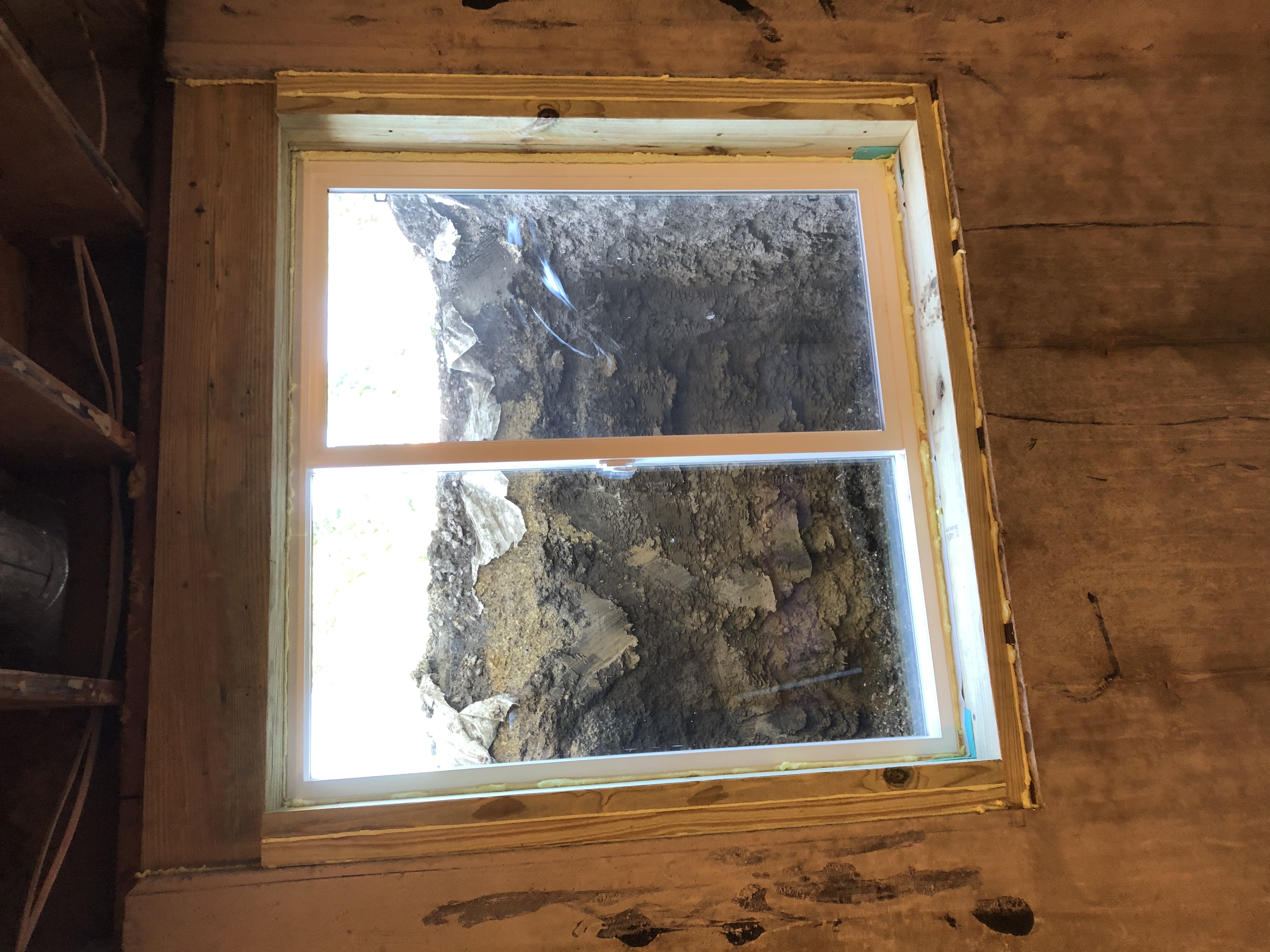
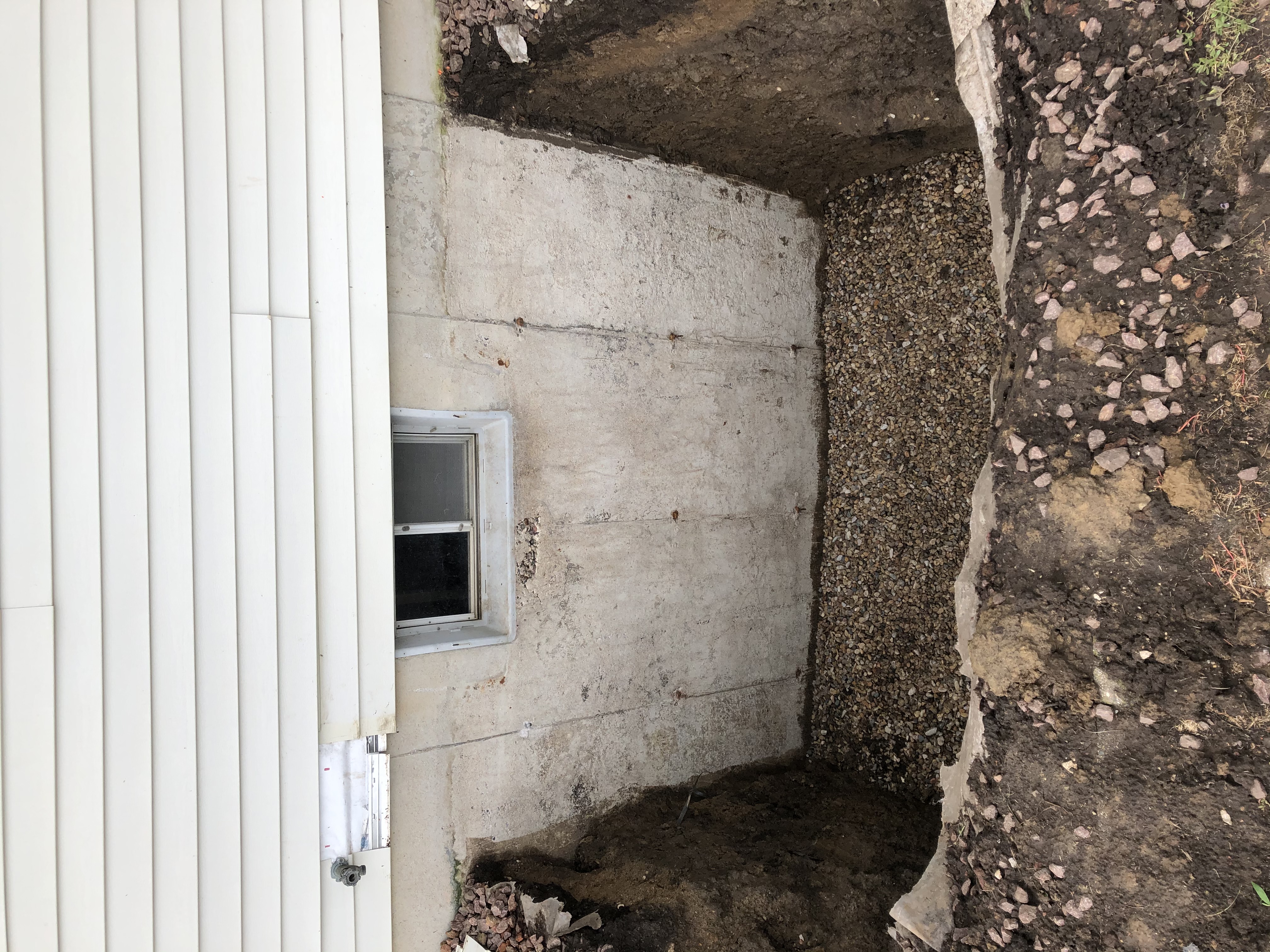
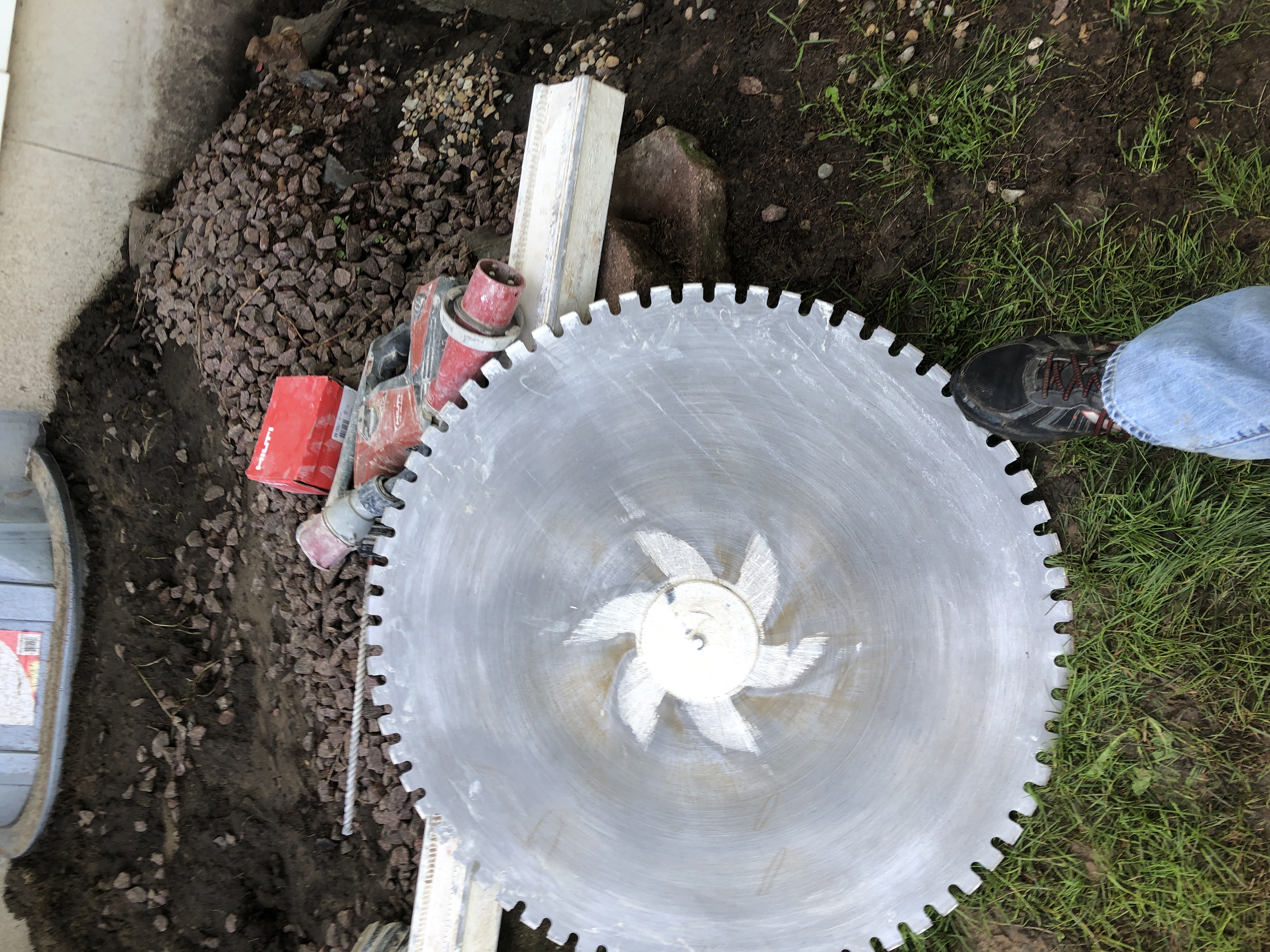
    The second phase of the project was the main reason for the renovation. The installation of the egress windows. As you can see in the pictures above, the previous windows were those small windows that would not allow anyone to escape. This phase of the project did require me to hire a company to do the actual cutting of the concrete. I was able to dig out the “well” for the window before they arrived as they told me, “We just cut. We don’t touch a shovel.” Boy, am I glad I hired them. They showed up with over $150,000 worth of equipment and a saw blade that made my size 12 shoe look like a kid’s toy. They completed the job in less than 2 hours. If I would have tried to cut it myself, they told me that it would have taken me a week and I would have had cuts that were completely unsquare. It ended up costing $1,150, but sometimes you need to bring in the professionals. Once they had cut the openings, I went right to work boxing in the opening with framing and installing the 48″x48″ sliding windows. The pictures below show the hole I dug and filled with 3/4″ rock, the saw blade they showed up with, and how it looked after I got one of the windows installed. Once the inside was finished. I moved to the exterior and installed the egress wells. It just so happened that I did this part on one of the hottest days of the summer, but I knew I wanted to get them in before we got any heavy rains. This was also the most expensive parts of the remodel as I went with a modular type egress system. The total for these was about $1,700. I attached them to the concrete foundation with a hammer drill and some anchor wedges. They turned out fabulous.
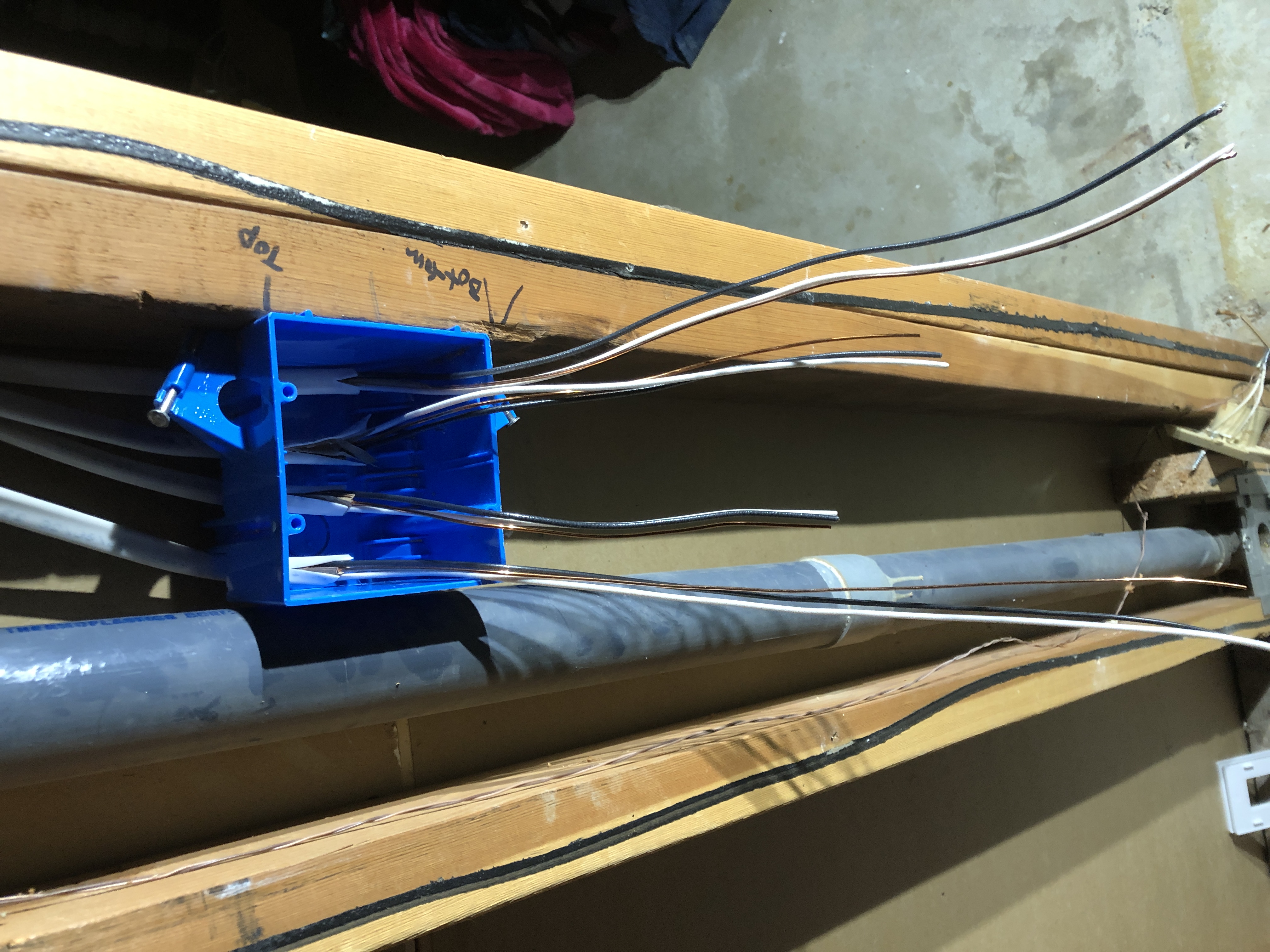
    Phase three of the project was installing can lights into the ceiling. I installed two rows of four cans separated an equal distance apart. This was a pretty easy installation. The more difficult part was the wiring. I contacted my brother-in-law electrician and we talked through the steps involved. I also watched a YouTube video. It took a solid 3-4 hours, but I was able to get everything wired into place. You can see the picture on the lower left below with the lights installed and on. The hardest part of this phase was the wiring in the box for the switches. I installed the lights so that they were controlled in two zones. The front four lights controlled by one dimmer switch and the back four lights on a separate dimmer switch. Again, speaking with my brother-in-law, I was able to get these lights wired correctly without any real problems.
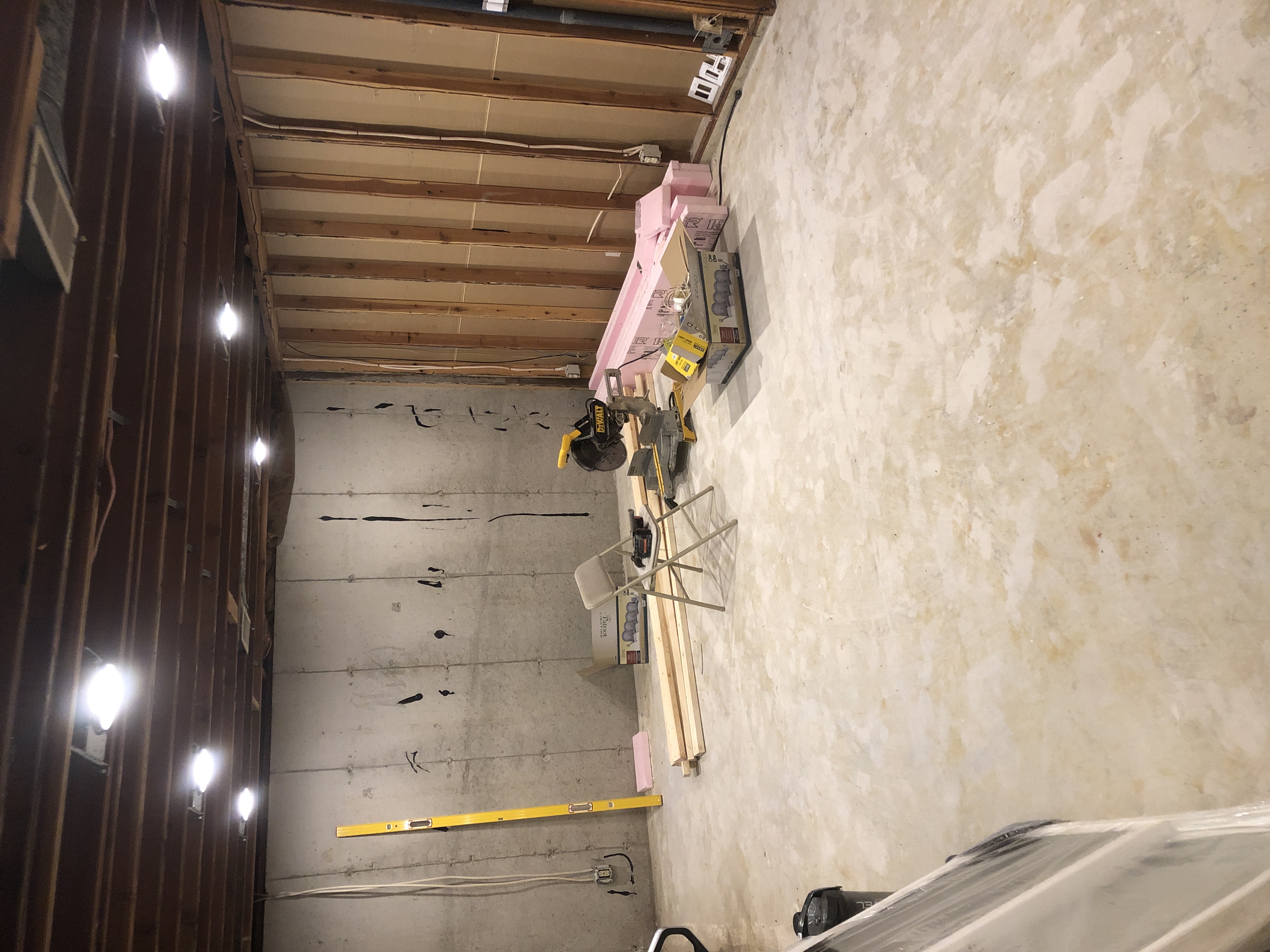
    The next phase was to install insulation on the exterior walls and frame out 2×4 walls. I watched a LOT of different videos to make sure that I framed the walls correctly. As I mentioned before, Basement Finishing Guy on YouTube really has some great videos on this part. I watched his 6-Part Basement Framing Series probably 4-5 times through to make sure I did everything correctly. I started by attaching 2″ rigid foam insulation to the bare concrete with proper adhesive. Once those were attached, I framed the two exterior walls following all the steps that were shown. This is where a remodel project really starts to take shape. There is something about seeing these perfectly straight 2x4s all lined up that is just so satisfying. The picture on the lower left is from the family room, and the lower right is from my daughter’s bedroom.
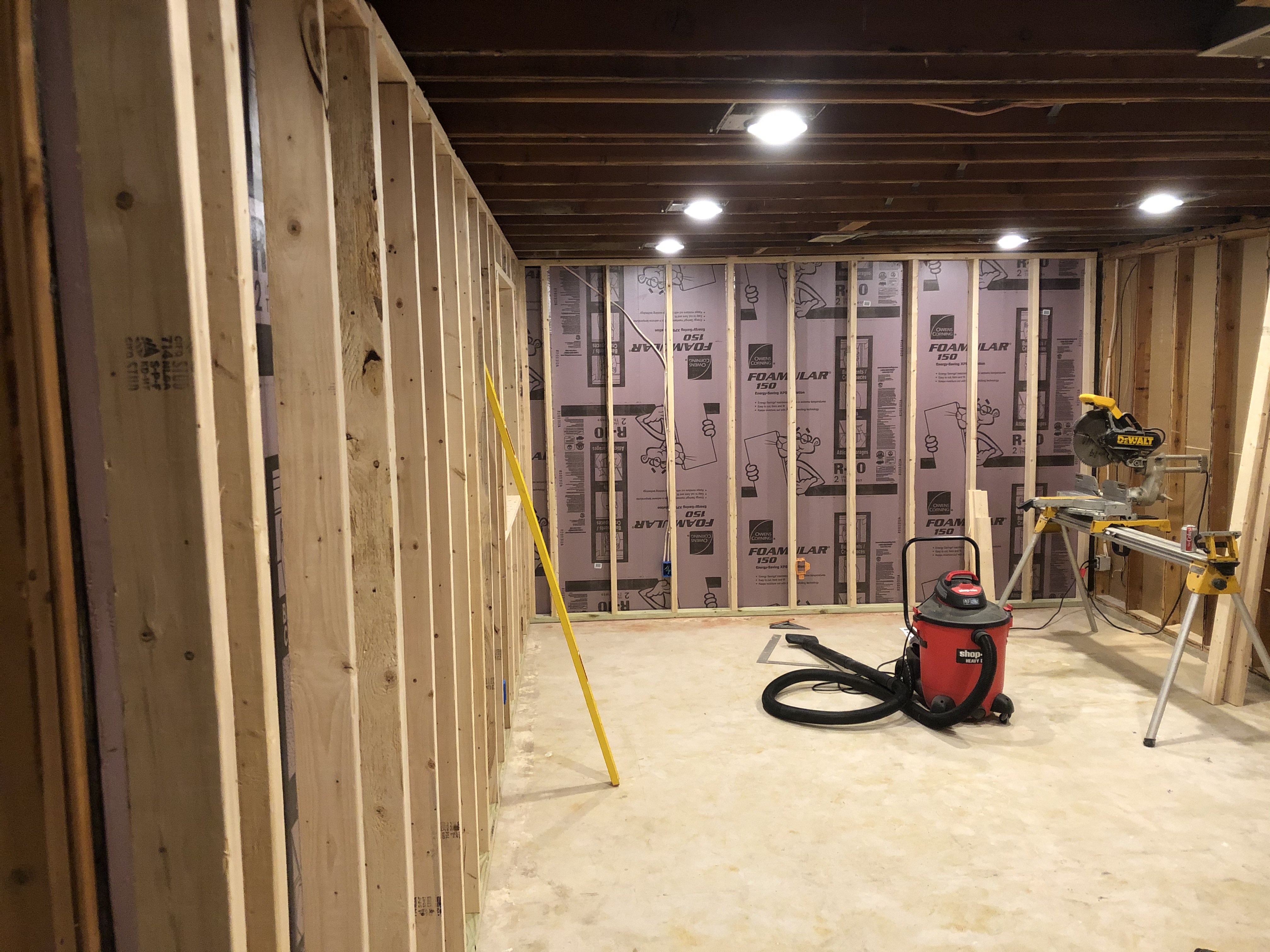
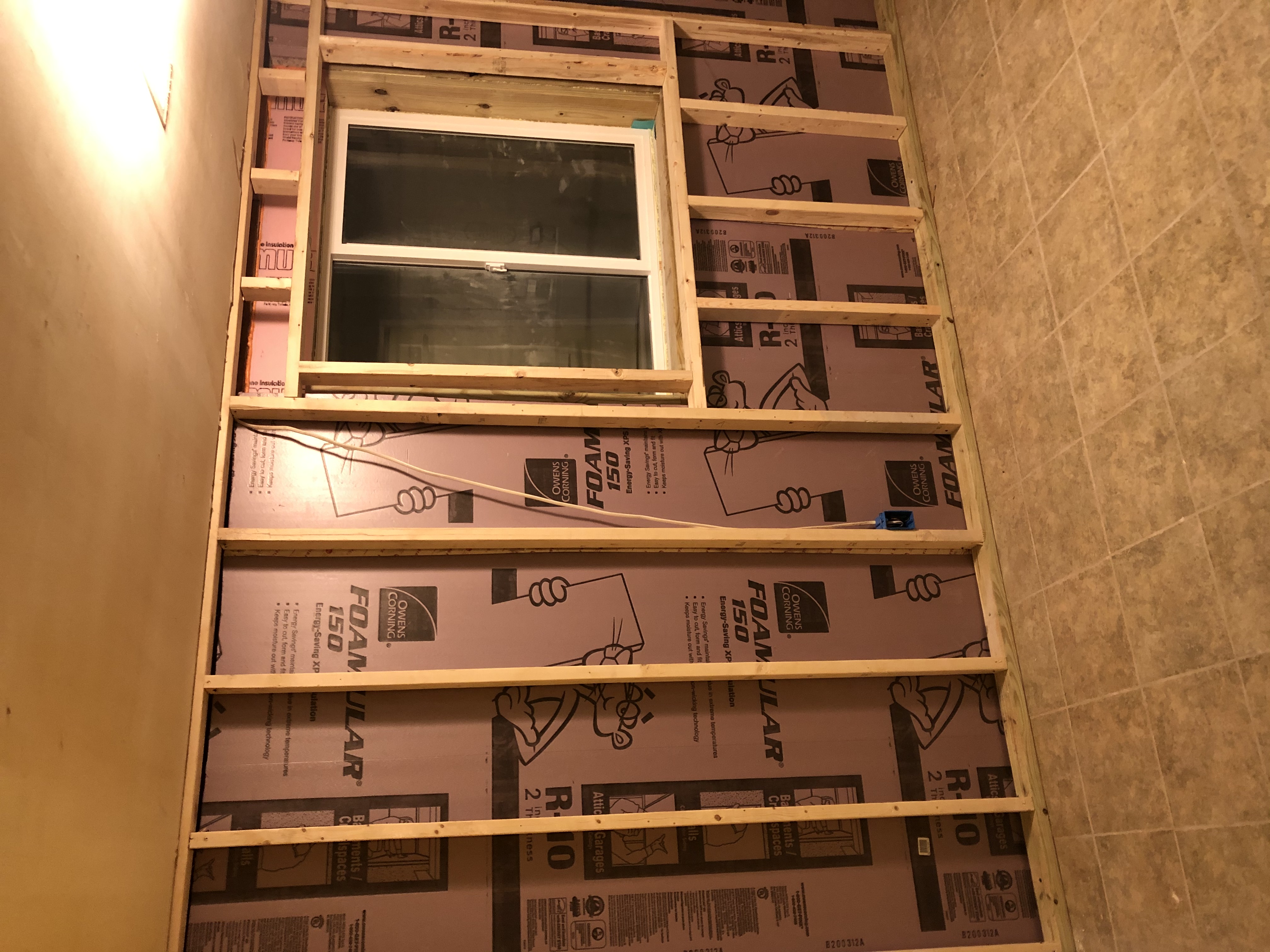
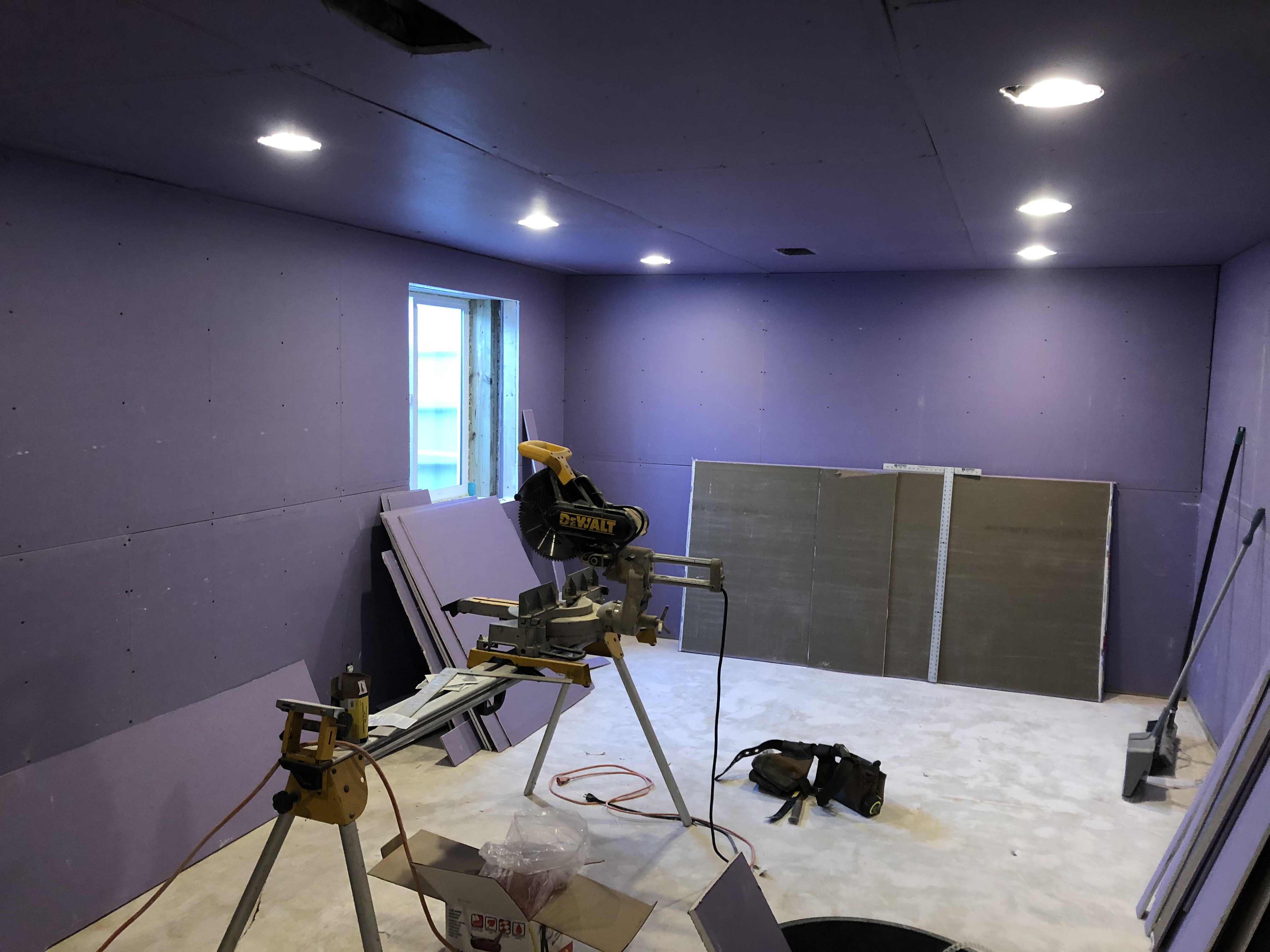
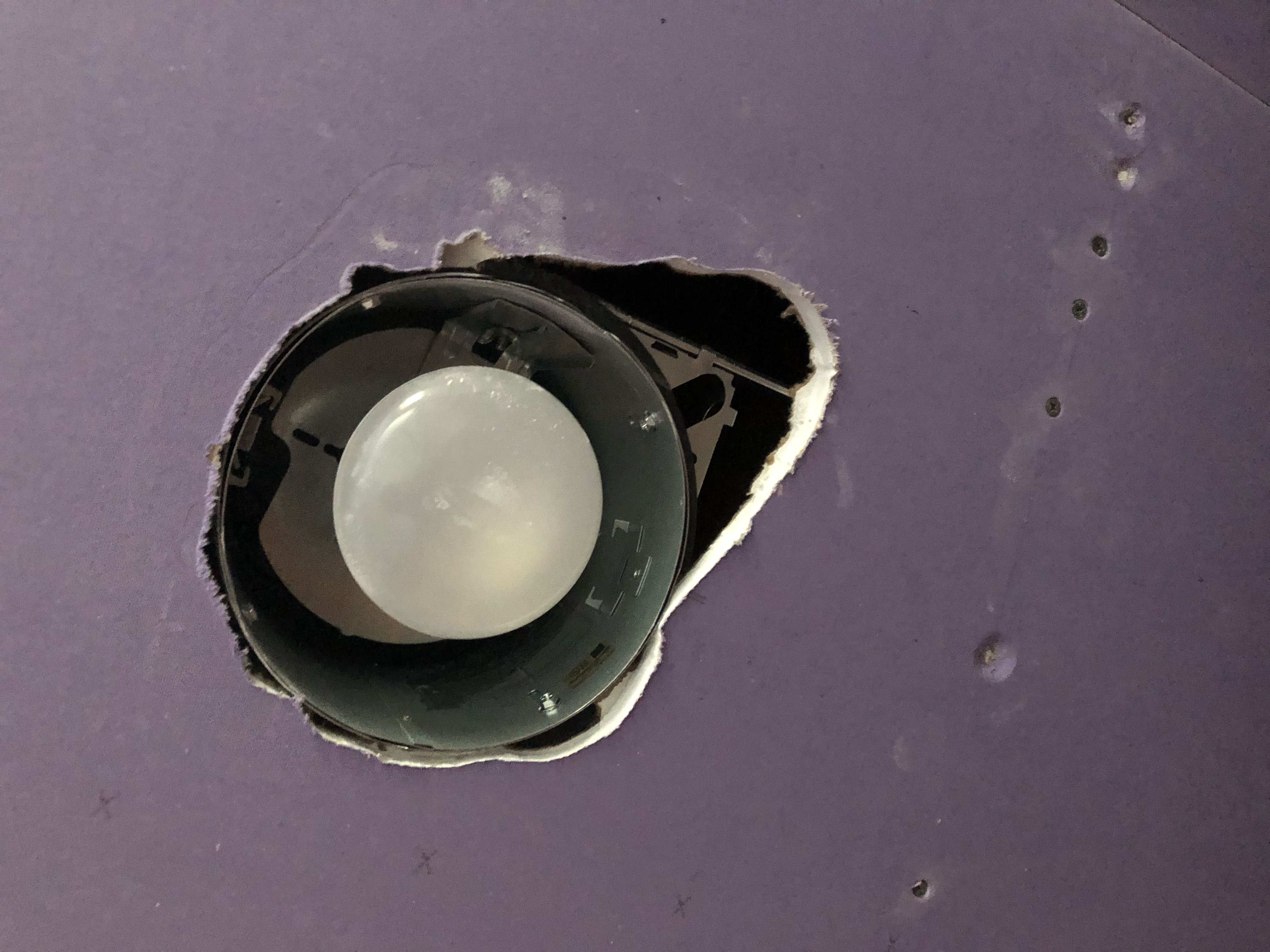
    Once the walls were framed up, I proceeded to attach new outlet boxes to the walls and wire them in. This was much easier than wiring in the can lights. I made sure to check the proper electrical codes and attach the boxes in the proper positions and secure the wires correctly. I only zapped myself one time when I grabbed the old metal box on the sides. It was a small jolt like back when we used to brush up against the electric cattle fence. Once that was complete, I started to hang sheetrock. Doing sheetrock, or drywall, is a pain in the ass. I had to have the TA come over one day to help hang the sheets on the ceiling because each sheet is about 50 lbs. Not only is the stuff heavy, but cutting out for lights and outlets is dusty as heck. A Rotozip tool makes it easy to cut the holes out, BUT it’s also easy to make a mistake as you can see in the picture on the lower left. One thing I would probably do differently if I did it again would be to add furring strips to the ceiling to even out some of the unevenness in the joists. There were a couple of them that caused us some issues during hanging. Even so, it turned out pretty well. As with everything, I watched a lot of videos on how to do the drywall properly. A big help for my was DIY Home Renovision’s Drywall Installation Guide. I watched these videos over and over as well. He’s also got other great videos on things you can do in your home.

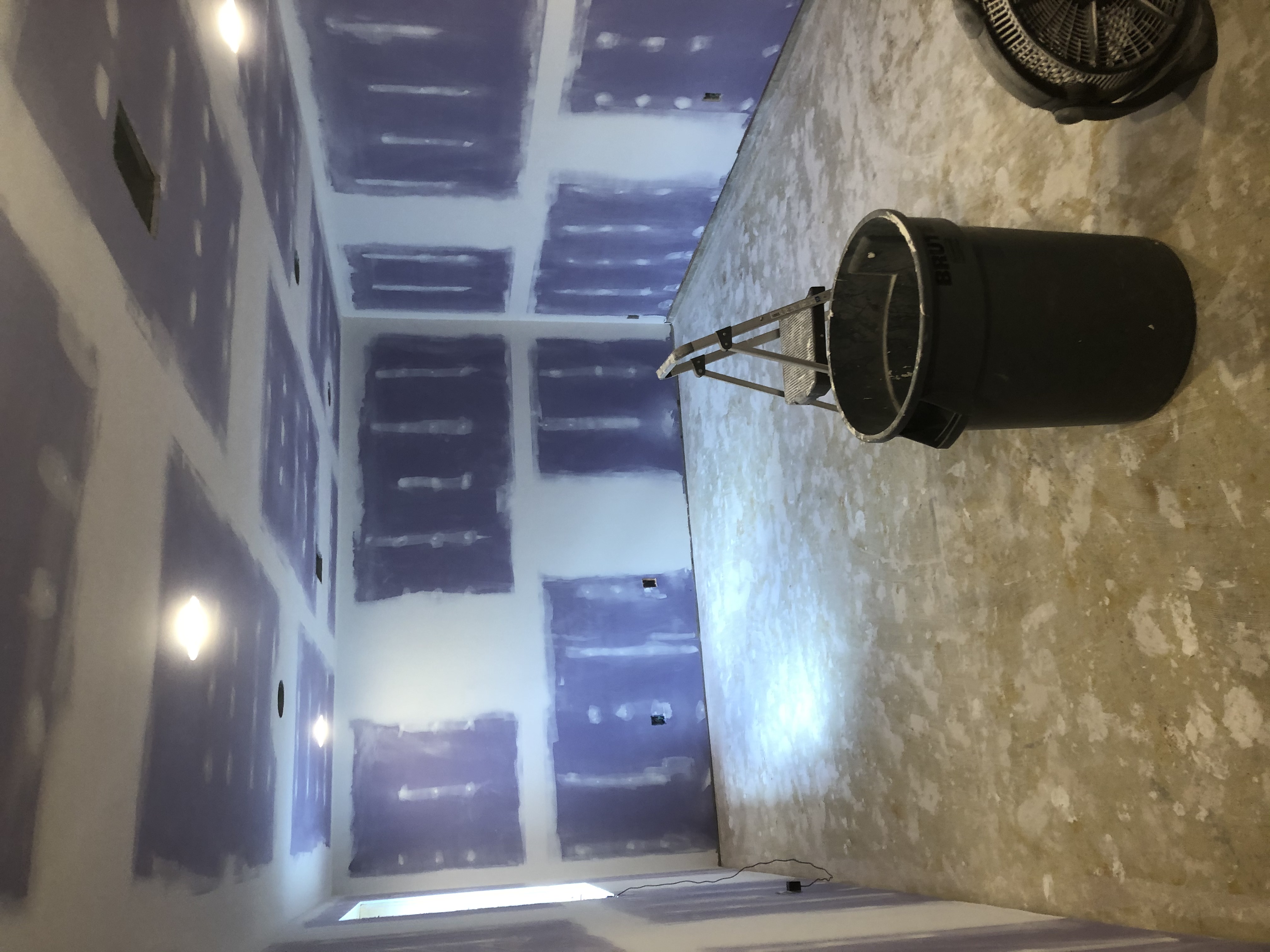
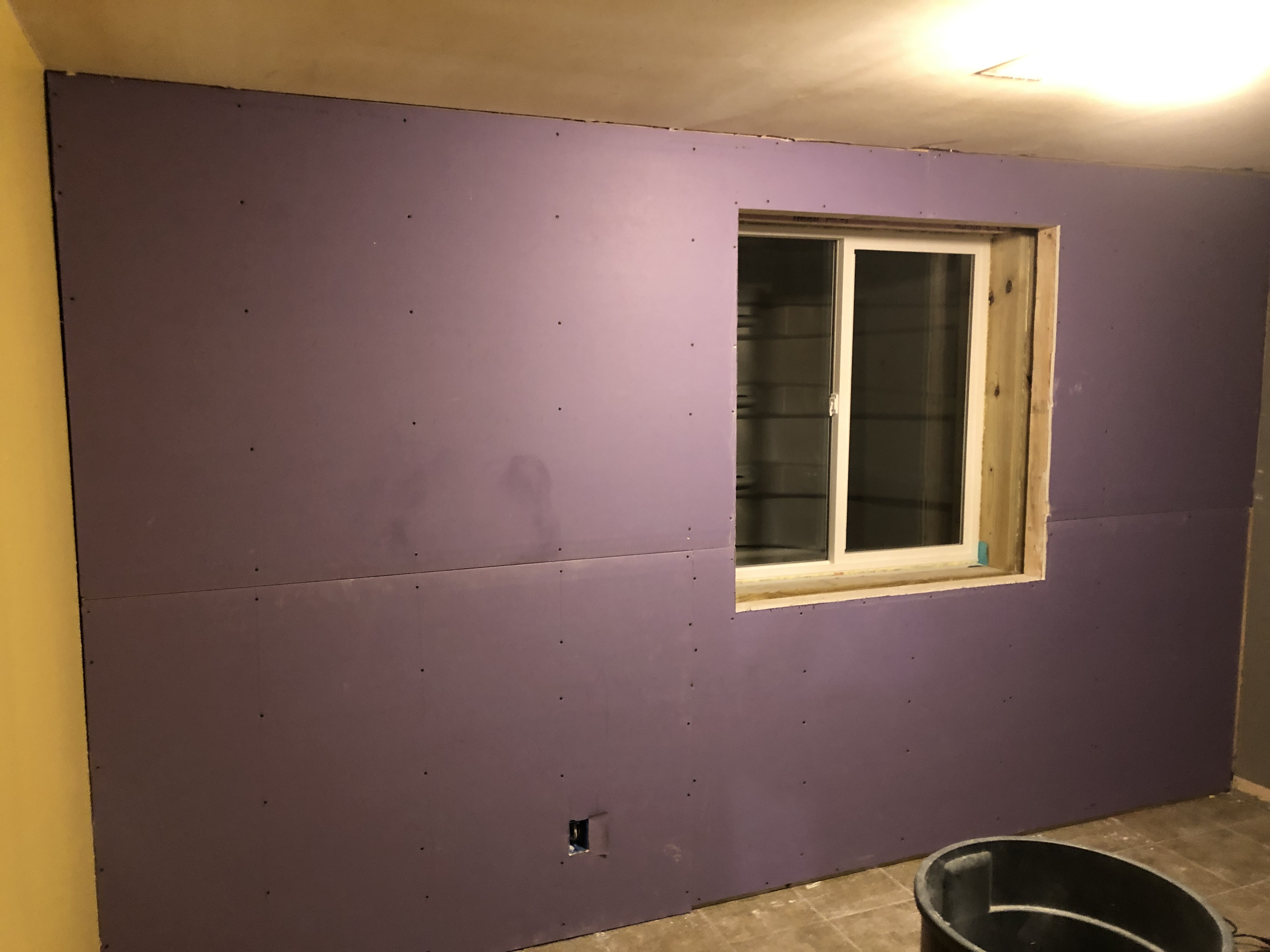
    Hanging the drywall took a day, and then it was time to mud and tape. This part of the job took me the longest time because it’s very fine work AND you have to give the drywall “mud” time to dry. It’s also TERRIBLY messy, especially when working on the ceiling joints. One YouTuber in particular, Vancouver Carpenter, was a great help in my “mudding” process. The middle two pictures are before I applied mud. The picture on the right is of my “finished” work in the family room.
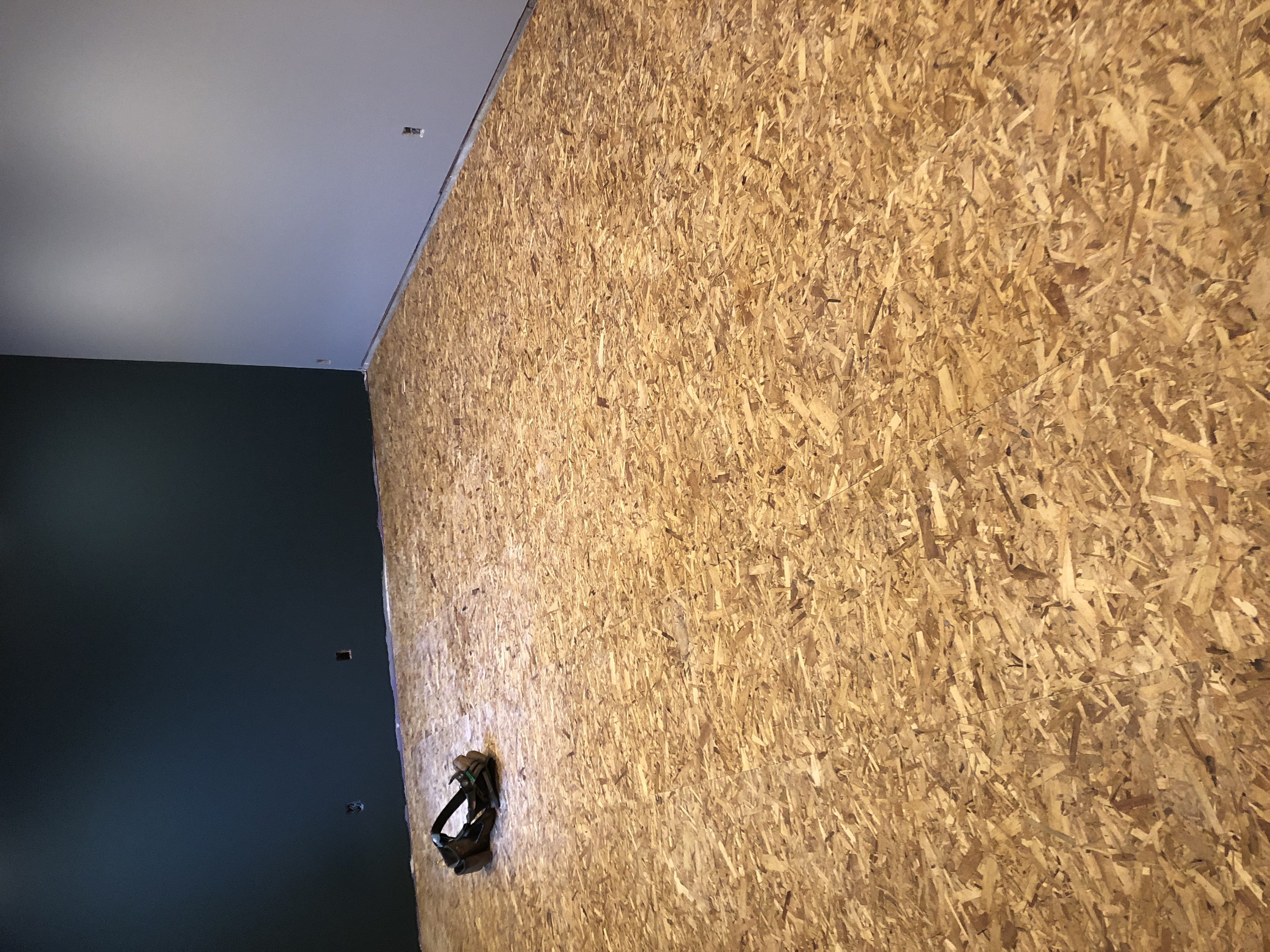
    Next, I primed all the walls with a quality primer/sealer, and then painted. Nothing too exciting there. Then I installed a Dri-Cor subfloor that will prevent the new carpet from getting wet again IF any water does happen to infiltrate the basement. This system involves 2×2 sheets of plywood that have a dimpled plastic laminated to the bottom to keep the organic material off the concrete floor. It also gives some R-value insulation to the floor to make it feel warmer. Again, I found a great video online that helped with this install. This was a pretty simple install as the pieces are tongue and groove. I did attach them to the floor in spots with a hammer drill and concrete screws as per the manufacturer’s instructions since we were going to be installing carpet underneath. Once that was finished, I installed trim and baseboard around the room before the final step.
    The final stage of the project was carpet installation. Again, I hired professionals to do this part of the job as it is another pain in the ass to lay carpet and padding out. This was another pretty large cost as we went with a higher quality carpet that will last and be resistant to mold, mildew, and stains. You can see in the two pictures below the before and after carpet look of the room.


    It definitely wasn’t a cheap project, but by doing a lot of the work myself, I was able to save a TON of money. My total cost for the project was about $12,000. That’s just for materials and a few tools I used on the project. Most contractors say to find your materials cost and double it to account for labor costs. I did pay for labor for the cutting of the concrete and for the carpet installation. I’d say a fair estimate for the total cost would have been at least $20,000 if I would have hired the whole project out. I’m glad that I did this project last year instead of this year as costs of some building products, especially lumber, have tripled!

    All in all, I think the project went very well. I didn’t really mind the electrical work and framing. The drywall and mud/tape was definitely a job that takes some skill and practice to do well. There are spots in my mud job where you can see imperfections, but for the cost, it looks pretty good to me!

    This all might seem like a lot of work and really complex, but YouTube can be your best friend. You can learn how to do almost anything by going there and watching videos. The videos I linked throughout this article are the ONLY reason that I was able to tackle this job. I was definitely nervous doing a project of this scope, but as we tell our students, “Knowledge is power.” With the explosion of the Internet the last 20 years, there has never been more knowledge out there available for everyone to take advantage of. That being said, I am NOT affiliated with ANY of the links that I have included in this post. I included them for you to see how easy it is to learn from people that are out there on YouTube.

    Hopefully this inspires you to look at your own situation and what you can do in your remodeling projects to save a little money and as always….

    KEEP STACKIN!

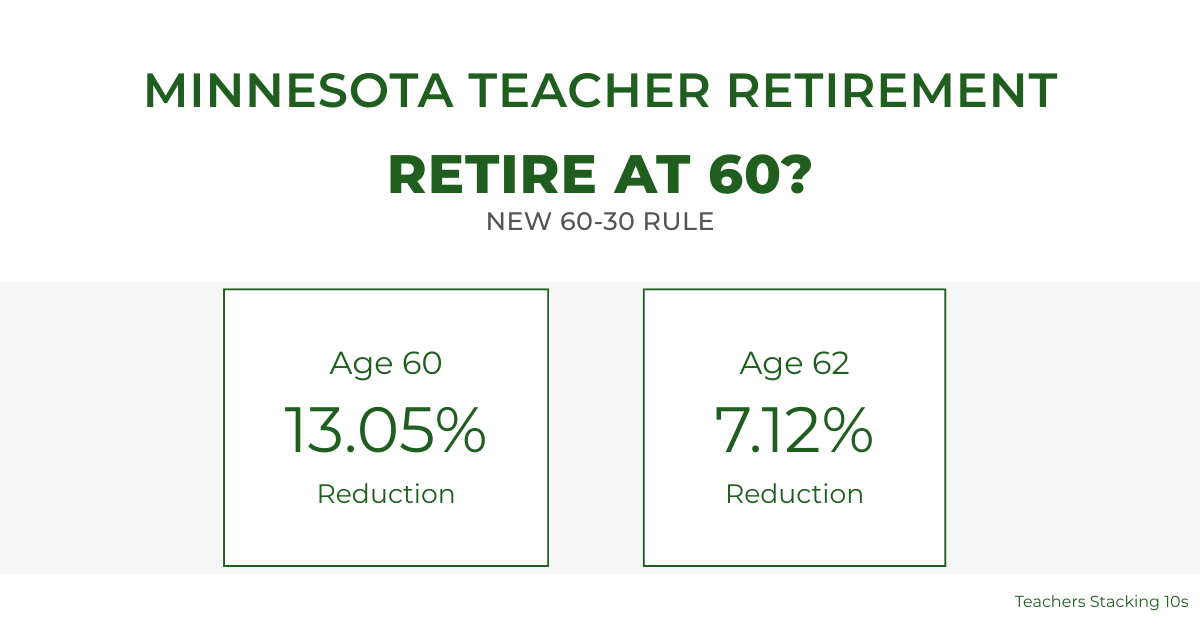
    Minnesota teacher retirement at 60 reduction comparison under enhanced 60-30 rule

    Minnesota Teacher Retirement at 60: Understanding the Enhanced 60/30 Rule

    For years, Minnesota teacher retirement at age 60 was financially unrealistic for

    Read More
  • THE PROFESSOR’S END OF Q1 2021 FINANCIAL UPDATE

    THE PROFESSOR’S END OF Q1 2021 FINANCIAL UPDATE

    This is my post showing how we are saving money both in and out of retirement accounts. I always like to read blogs that give real-life examples of those people practicing what they preach. Going forward, I will try and give a quarterly update of our financial position and the thoughts that go into it. I will warn you, I don’t have huge amounts of money socked away anywhere, but I think we have done a solid job in putting money aside. 

    Q1 in 2020 was good for us financially. We still aren’t as “liquid” as I would like. We need to increase our savings to be able to weather any financial storms, but we are working to get there.

    *Always keep in mind, these numbers DO NOT include my teacher pension. My goal is to make that money just a part of our financial future and NOT the entire amount we will have.

    12/31/2020 3/31/2021
    Assets December March Change % Change
    Cash – All checking and savings accounts  $      4,721.50  $     3,442.64  $         (1,278.86) -27.1%
    Stock Account (TD Ameritrade)  $      2,600.74  $     2,936.92  $             336.18 12.9%
    Index Fund (Vanguard)  $      5,314.19  $     6,708.94  $          1,394.75 26.2%
    Stock Account (M1 Finance)  $                 –    $        163.56  $             163.56 0.0%
    My 403(b)  $    73,831.44  $   80,516.82  $          6,685.38 9.1%
    My IRA  $         305.32  $        401.28  $               95.96 31.4%
    Wife 401(k)  $  183,688.06  $ 198,779.61  $        15,091.55 8.2%
    My HCSP  $    24,303.24  $   25,642.17  $          1,338.93 5.5%
    Total Assets  $  294,764.49  $ 318,591.94  $        23,827.45 8.1%
    Liabilities
    Current Debt (Credit Cards, Etc.)  $                     –   0.0%
    Clinic  $      3,587.24  $     2,387.24  $         (1,200.00) -33.5%
    Corolla Loan  $      6,075.97  $                –    $         (6,075.97) -100.0%
    RAV4 Loan  $    14,160.58  $   13,467.50  $            (693.08) -4.9%
    My Student Loan  $      5,559.16  $     5,559.16  $                     –   0.0%
    Property #1 Mortgage (Primary)  $  107,930.72  $ 106,381.55  $         (1,549.17) -1.4%
    HELOC (Primary)  $      8,000.00  $   10,000.00  $          2,000.00 25.0%
    Total Liabilities  $  145,313.67  $ 137,795.45  $         (7,518.22) -5.2%
    Total Net Worth  $  149,450.82  $ 180,796.49  $        31,345.67 21.0%

    Assets:

    Cash – $3,442.64 Down $1,278.86

    This includes all of our checking and savings account balances. I’m not a big believer in carrying 3-6 month emergency fund. We have enough room on credit cards to put any emergency purchases on and then pay them off with our other accounts before those bills are due. These types of accounts just don’t return enough in interest to provide any value to me. This account always seems to stay pretty steady. 

    We need to build this up more. My goal is to build this to $10,000 by the end of the year.

    TD Ameritrade (taxable) – $2,936.92 Up $336.18

    This is an account that I started so I could buy individual dividend growth stocks. I’ve sold some of my dividend stocks and put more into growth stocks. This is the reason for the increase in this account.

    Vanguard (taxable) – $6,708.94 Up $1,394.75

    This is an account that I use to purchase Vanguard index funds. This is where I prefer to keep my “emergency” fund. I know that I need to grow this out more in case of any significant emergency expense. My plan is to get between $10-15,000 in this account and let it grow and replenish as needed. We are putting in $500/month into this. Steady growth and savings here.

    M1 Finance (taxable) – $163.56 Up $163.56

    This is an account that I started so I could buy high growth tech stocks. It allows you to build a portfolio and put money into it and buy fractional shares instead of having to wait to save enough to build a position for each stock. Will add some as I can to this.

    My 403(b) – $80,516.82 Up $6,685.38

    This is my main retirement account. I have been paying into this since I started teaching. Our district currently matches $800 each year into this account. It is kind of small for having taught for 20 years, but my early years of putting money into this account robbed me of many gains. I was invested in annuities with heavy fees and surrender penalties. It’s just been in the last 8-10 years that I have really become more knowledgeable about these accounts. 

    It’s continuing to climb.

    My IRA – $401.28 Up $95.96

    This is where I will roll over my 403(b) to when I retire. I did add a little bit of money to this account, but only like $50.

    Wife 401(k) – $198,779.61 Up $15,091.55

    My wife has a good job as a nurse and the organization that she works for contributes 9% of her salary each year into this account. She’s also contributing 12.5% of her salary so about 20% of her salary goes here each year. This is the account that I learned first-hand the power of compounding.

    Market continues to go up. We did up her contributions to 12.5% from 11.5%. Closing in on that $200k mark! This account reinvests almost $2,500/year in dividends. The power of compounding!

    My Health Care Savings Plan (HCSP) – $25,642.17 Up $1,338.93

    This is an account through our school that we both contribute to each month. It can only be used for medical expenses AFTER I retire. It has grown nicely the last 5 years. It has also regained all its losses from the collapse and continues to grow and reinvest its dividends.

    Liabilities:

    Clinic – $2,387.24 Down $1,200

    It sucks to have low-back pain.  I just got my procedures done again. I’m paying $400/month at 0% interest until it’s gone.

    RAV4 Loan – $13,467.50  Down $693.08

    We had to add another vehicle to our “fleet” last spring due to another driver in the household. We also needed a little bit larger one with two teenage girls. Slowly working this one down.

    Corolla Loan – $0 Down $6,075.97

    This is the loan for the vehicle to replace our previous car that was totaled. It’s a nice fuel efficient vehicle. My goal is to have it paid off in the next 12 months. ACHIEVED! Used part of our most recent stimulus check to completely pay this off! One yearly goal accomplished.

    My Student Loan – $5,559 Unchanged

    This is what’s left of my loan for my Master’s degree. With the pandemic, I was given forbearance on this loan.

    Mortgage – $106,381.55 Down $1,549.17

    This is the mortgage that we have on our home. The house currently appraises for about $207,000, so we do have some equity in it. We signed on our refinance at 15 years and 2.5%. We will have the house paid off just as I am ready to retire from teaching. Great timing!

    HELOC – $10,000 Up $2,000.

    This is money that we pulled out to pay for the update in our basement. We pay 4.5% interest-only on this for 10 years and then we pay over the next 20 years on the loan. My goal is to pay this off within the year.

    We had to replace our hot water heater. This is a reason that I’m looking to build a little bit more of an emergency fund. For things like this. I just hate selling stock! I still would like to pay this off within a year. We will see if that is possible.

    Net worth (assets-liabilities) – $180,796.49 Up $31,345.67

    Key Points:

    You’ll notice that I don’t have assets linked for our major liabilities. I do NOT believe that you should include the value of your house or vehicles as assets for your net worth. You only realize those assets if you sell them, and I don’t plan on ever selling those things, but I DO have to pay off those loans. I think it gives a clearer picture of how much money you actually have.

    Goals for 2021:

    I’m going to keep a couple of goals here. I definitely want to get that clinic bill paid off and also fund a Roth IRA ($6,000) for the year. I was able to continue to grow the Vanguard Index account. I am planning to continue watching the current rental properties available in my area. If I can get one at a fair deal, I will definitely pull the trigger. We do have a senior that will be heading off to college next fall, so that will be a BIG expense, but one that will definitely be worth it for her. We also have another high schooler that will be getting her license in March. I am currently looking for an older vehicle that I can pay cash for. I do NOT want to take on another monthly payment.

    Quarterly Comments:

    Big quarter in the market really grew our net worth. We also were able to pay $4,400 cash for a car for our newest driver! Super nice to be able to bank roll that and not add another monthly payment. The water heater replacement was a bit of a disappointment as the previous one was only 8 years old. Paying off that Corolla loan was great. We are now putting that $400/month payment directly into savings to build up that cash position. The housing market is just too damn hot right now. There are no deals out there that aren’t gobbled up before they even get on the market. I would love to have a rental property or two for the cash flow, but it’s just not in the cards right now. Someday……

    So how’s your financial situation? Throw some thoughts down in the comments and as always….

    KEEP STACKIN!

  • THE PROFESSOR’S END OF Q4 2020 FINANCIAL UPDATE

    THE PROFESSOR’S END OF Q4 2020 FINANCIAL UPDATE

    This is my post showing how we are saving money both in and out of retirement accounts. I always like to read blogs that give real-life examples of those people practicing what they preach. Going forward, I will try and give a quarterly update of our financial position and the thoughts that go into it. I will warn you, I don’t have huge amounts of money socked away anywhere, but I think we have done a solid job in putting money aside. 

    For as bad as Q3 was in 2020, Q4 was just the opposite! It was a great bounce-back for our stock accounts. We have continued to put money into these accounts, regardless of the direction the markets are headed. The paying off of debt has been slow and steady. We did not do a great job of reaching my goals for 2020, but it seems that there are always expenses that pop of out of nowhere.

    *Always keep in mind, these numbers DO NOT include my teacher pension. My goal is to make that money just a part of our financial future and NOT the entire amount we will have.

    9/30/2020 12/31/2020
    Assets September December Change % Change
    Cash – All checking and savings accounts  $      4,938.64  $     4,721.50  $            (217.14) -4.4%
    Stock Account (TD Ameritrade)  $      1,891.34  $     2,600.74  $             709.40 37.5%
    Index Fund (Vanguard)  $      3,688.47  $     5,314.19  $          1,625.72 44.1%
    My 403(b)  $    62,968.53  $   73,831.44  $        10,862.91 17.3%
    My IRA  $         278.84  $        305.32  $               26.48 9.5%
    Wife 401(k)  $  160,149.30  $ 183,688.06  $        23,538.76 14.7%
    My HCSP  $    21,182.95  $   24,303.24  $          3,120.29 14.7%
    Total Assets  $  255,098.07  $ 294,764.49  $        39,666.42 15.5%
    Liabilities
    Current Debt (Credit Cards, Etc.)  $                     –   0.0%
    Clinic  $      4,323.24  $     3,587.24  $            (736.00) -17.0%
    Corolla Loan  $      7,442.44  $     6,075.97  $         (1,366.47) -18.4%
    RAV4 Loan  $    15,525.02  $   14,160.58  $         (1,364.44) -8.8%
    My Student Loan  $      5,559.16  $     5,559.16  $                     –   0.0%
    Property #1 Mortgage (Primary)  $  109,470.15  $ 107,930.72  $         (1,539.43) -1.4%
    HELOC (Primary)  $      8,000.00  $     8,000.00  $                     –   0.0%
    Total Liabilities  $  150,320.01  $ 145,313.67  $         (5,006.34) -3.3%
    Total Net Worth  $  104,778.06  $ 149,450.82  $        44,672.76 42.6%

    Assets:

    Cash – $4,721.50 Down $217.14

    This includes all of our checking and savings account balances. I’m not a big believer in carrying 3-6 month emergency fund. We have enough room on credit cards to put any emergency purchases on and then pay them off with our other accounts before those bills are due. These types of accounts just don’t return enough in interest to provide any value to me. This account always seems to stay pretty steady.

    TD Ameritrade (taxable) – $2,600.74 Up $709.40

    This is an account that I started so I could buy individual dividend growth stocks. Bought a few more shares of Altria to fill out a full position. Very good growth here.

    Vanguard (taxable) – $5,314.10 Up $1,625.72

    This is an account that I use to purchase Vanguard index funds. This is where I prefer to keep my “emergency” fund. I know that I need to grow this out more in case of any significant emergency expense. My plan is to get between $10-15,000 in this account and let it grow and replenish as needed. We are putting in $500/month into this. Steady growth and savings here.

    My 403(b) – $73,831.44 Up $10,862.91

    This is my main retirement account. I have been paying into this since I started teaching. Our district currently matches $800 each year into this account. It is kind of small for having taught for 20 years, but my early years of putting money into this account robbed me of many gains. I was invested in annuities with heavy fees and surrender penalties. It’s just been in the last 8-10 years that I have really become more knowledgeable about these accounts. 

    It’s continuing to climb.

    My IRA – $305.32 Up $26.48

    This is where I will roll over my 403(b) to when I retire. Not putting anything in here at this point.

    Wife 401(k) – $183,688.06 Up $23,538.76

    My wife has a good job as a nurse and the organization that she works for contributes 9% of her salary each year into this account. She’s also contributing 11.5% of her salary so about 20% of her salary goes here each year. This is the account that I learned first-hand the power of compounding.

    Massive climb with the market rebounding. Closing in on that $200k mark! This account reinvests almost $2,500/year in dividends. The power of compounding!

    My Health Care Savings Plan (HCSP) – $24,303.24 Up $3,120.29

    This is an account through our school that we both contribute to each month. It can only be used for medical expenses AFTER I retire. It has grown nicely the last 5 years. It has also regained all its losses from the collapse and continues to grow and reinvest its dividends.

    Liabilities:

    Clinic – $3,587.24 Down $736

    It sucks to have low-back pain.  I just got my procedures done again. I’m paying $400/month at 0% interest until it’s gone.

    RAV4 Loan – $14,160.58 Down $1,364.44

    We had to add another vehicle to our “fleet” last spring due to another driver in the household. We also needed a little bit larger one with two teenage girls. Slowly working this one down.

    Corolla Loan – $6,075.97 Down $1,366.47

    This is the loan for the vehicle to replace our previous car that was totaled. It’s a nice fuel efficient vehicle. My goal is to have it paid off in the next 12 months. Making good progress on this.

    My Student Loan – $5,559 Unchanged

    This is what’s left of my loan for my Master’s degree. With the pandemic, I was given forbearance on this loan.

    Mortgage – $107,930.72 Down $1,539.42

    This is the mortgage that we have on our home. The house currently appraises for about $207,000, so we do have some equity in it. We signed on our refinance at 15 years and 2.5%. We will have the house paid off just as I am ready to retire from teaching. Great timing!

    HELOC – $8,000 No Change

    This is money that we pulled out to pay for the update in our basement. We pay 4.5% interest-only on this for 10 years and then we pay over the next 20 years on the loan. My goal is to pay this off within the year.

    Net worth (assets-liabilities) – $149,450.82 Up $44,672.46

    Key Points:

    You’ll notice that I don’t have assets linked for our major liabilities. I do NOT believe that you should include the value of your house or vehicles as assets for your net worth. You only realize those assets if you sell them, and I don’t plan on ever selling those things, but I DO have to pay off those loans. I think it gives a clearer picture of how much money you actually have.

    Goals for 2020:

    My biggest goal for 2020 is to pay off the clinic bill. My goal is to fully fund ($6,000) my Roth IRA for the year. I’m also going to continue to grow my Vanguard Index account to use as a down payment on a rental property. Our goal is to have one cash-flowing rental property by this time next year. I am currently looking at a couple properties in our small town. Prices are still a little high, so not willing to pull the trigger yet. Was not able to achieve the goals of paying off the clinic bill or funding a Roth IRA during 2020. Having two high school girls who missed all class trips during the pandemic and now they are trying to “catch” up really puts a dent in saving.

    Goals for 2021:

    I’m going to keep a couple of goals here. I definitely want to get that clinic bill paid off and also fund a Roth IRA ($6,000) for the year. I was able to continue to grow the Vanguard Index account. I am planning to continue watching the current rental properties available in my area. If I can get one at a fair deal, I will definitely pull the trigger. We do have a senior that will be heading off to college next fall, so that will be a BIG expense, but one that will definitely be worth it for her. We also have another high schooler that will be getting her license in March. I am currently looking for an older vehicle that I can pay cash for. I do NOT want to take on another monthly payment.

    So how’s your financial situation? Throw some thoughts down in the comments and as always….

    KEEP STACKIN!

  • THE PROFESSOR’S END OF Q2 2020 FINANCIAL UPDATE

    This is my third post showing how we are saving money both in and out of retirement accounts. I always like to read blogs that give real-life examples of those people practicing what they preach. Going forward, I will try and give a quarterly update of our financial position and the thoughts that go into it. I will warn you, I don’t have huge amounts of money socked away anywhere, but I think we have done a solid job in putting money aside. 

    This quarter was big comeback. Almost everything that we lost came back. My 403(b) is the only one that did not show a massive jump. I’ll explain why later in this post.

    *Always keep in mind, these numbers DO NOT include my teacher pension. My goal is to make that money just a part of our financial future and NOT the entire amount we will have.

    3/31/2020 6/30/2020
    Assets March June Change % Change
    Cash – All checking and savings accounts  $      4,296.44  $     2,818.00
     $         (1,478.44)
    -34.4%
    Stock Account (TD Ameritrade)  $      1,335.64  $     2,144.66  $             809.02 60.6%
    Index Fund (Vanguard)  $      2,956.84  $     4,291.79  $          1,334.95 45.1%
    My 403(b)  $    55,796.67  $   57,218.72  $          1,422.05 2.5%
    My IRA  $         234.95  $        261.31  $               26.36 11.2%
    Wife 401(k)  $  122,374.07  $ 143,217.66  $        20,843.59 17.0%
    My HCSP  $    16,410.75  $   19,989.80  $          3,579.05 21.8%
    Total Assets  $  203,405.36  $ 229,941.94  $        26,536.58 13.0%
    Liabilities
    Current Debt (Credit Cards, Etc.)  $                     –   0.0%
    Clinic  $                 –    $                –    $                     –   0.0%
    Corolla Loan  $    10,133.29  $     8,794.60  $         (1,338.69) -13.2%
    RAV4 Loan  $    17,549.55  $   16,541.46  $         (1,008.09) -5.7%
    My Student Loan  $      5,559.16  $     5,559.16  $                     –   0.0%
    Property #1 Mortgage (Primary)  $  106,845.74  $ 111,000.00
     $          4,154.26
    3.9%
    Total Liabilities
     $  140,087.74  $ 141,895.22  $          1,807.48 1.3%
    Total Net Worth
     $    63,317.62  $   88,046.72  $        24,729.10 39.1%

    Assets:

    Cash – $2,818 Down $1,478.74

    This includes all of our checking and savings account balances. I’m not a big believer in carrying 3-6 month emergency fund. We have enough room on credit cards to put any emergency purchases on and then pay them off with our other accounts before those bills are due. These types of accounts just don’t return enough in interest to provide any value to me. Down here because we are currently remodleing our basement.

    TD Ameritrade (taxable) – $2,144.66 Up $809.02

    This is an account that I started so I could buy individual dividend growth stocks. Good recovery in stocks. Haven’t added any new money this quarter.

    Vanguard (taxable) – $4,291.79 Up $1,334.95

    This is an account that I use to purchase Vanguard index funds.This is where I prefer to keep my “emergency” fund. I know that I need to grow this out more in case of any significant emergency expense. My plan is to get between $10-15,000 in this account and let it grow and replenish as needed. We are putting in $500/month into this. 

    My 403(b) – $57,218.72 Up $1,422.05

    This is my main retirement account. I have been paying into this since I started teaching. Our district currently matches $800 each year into this account. It is kind of small for having taught for 20 years, but my early years of putting money into this account robbed me of many gains. I was invested in annuities with heavy fees and surrender penalties. It’s just been in the last 8-10 years that I have really become more knowledgeable about these accounts. 

    This is the first area of the big fall. Not much to do but ride it out. I am in the process of switching from TD to Vanguard in this account. It’s currently all cash. I just wish TD would have liquidated it about 3 weeks earlier than they did and I would have missed out on the big drop. 

    Now this account is FINALLY in Vanguard. It was sold at the bottom and bought back into the market after the big climb. Too bad it missed out on over $15,000 in gains….

    My IRA – $261.31 Up $26.36

    This is where I will roll over my 403(b) to when I retire. Not putting anything in here at this point.

    Wife 401(k) – $143,217.66 Up $20,843.59

    My wife has a good job as a nurse and the organization that she works for contributes 9% of her salary each year into this account. She’s also contributing 11% of her salary so about 20% of her salary goes here each year. This is the account that I learned first-hand the power of compounding.

    Massive climb with the market rebounding. Almost back to its peak.

    My Health Care Savings Plan (HCSP) – $19,989.90 Up $3,579.05

    This is an account through our school that we both contribute to each month. It can only be used for medical expenses AFTER I retire. It has grown nicely the last 5 years. It has also regained all its losses from the collapse.

    Liabilities:

    Clinic – $0 

    It sucks to have low-back pain.  I just got my procedures done again. It will give me another big bill here in a few weeks.

    RAV4 Loan – $16,541,56 Down $1,008.09

    We had to add another vehicle to our “fleet” last spring due to another driver in the household. We also needed a little bit larger one with two teenage girls. Slowly working this one down.

    Corolla Loan – $8,794.06 Down $1,338.69

    This is the loan for the vehicle to replace our previous car that was totaled. It’s a nice fuel efficient vehicle. My goal is to have it paid off in the next 12 months. Making good progress on this.

    My Student Loan – $5,559 Unchanged

    This is what’s left of my loan for my Master’s degree. With the pandemic, I was given forbearance on this loan.

    Mortgage – $111,000

    This is the mortgage that we have on our home. The house currently appraises for about $207,000, so we do have some equity in it. We are finalizing a $75,000 line of credit. I don’t plan on touching that line of credit for anything but an investment. We signed on our refinance at 15 years and 2.5%. We will have the house paid off just as I am ready to retire from teaching. Great timing!

    Net worth (assets-liabilities) – $88,046.72 Up $24,729.10

    Key Points:

    You’ll notice that I don’t have assets linked for our major liabilities. I do NOT believe that you should include the value of your house or vehicles as assets for your net worth. You only realize those assets if you sell them, and I don’t plan on ever selling those things, but I DO have to pay off those loans. I think it gives a clearer picture of how much money you actually have.

    Goals for 2020:

    My biggest goal for 2020 is to pay off the clinic bill DONE. My goal is to fully fund ($6,000) my Roth IRA for the year. I’m also going to continue to grow my Vanguard Index account to use as a down payment on a rental property. Our goal is to have one cash-flowing rental property by this time next year.

    So how’s your financial situation? Throw some thoughts down in the comments and as always….

    KEEP STACKIN!

  • 6 ways to Intelligently Spend Your Coronavirus Stimulus Check

    6 ways to Intelligently Spend Your Coronavirus Stimulus Check

    So… You are about to get some of your tax money back… What exactly should you spend it on? Unfortunately, many casinos don’t abide by the social distances rules so we can’t go and put it all on black. With that option taken out of the equation… Here are a few things you can do with that government hand back. 

    Quickly I’d like to point out that this is not free money, it’s your tax money that they have “Given back to you”. They’ll take it again next tax season don’t worry about that. So not technically free money but whatever, Let’s talk about how you can put it to work for you in order of importance. 

    1. Survive – If your family has been financial impacted by the Covid-19 quarantine of 2020, use that hand out in whatever way you need to to insure food, shelter and security. Thankfully, states are paying their teachers their salaries still, but perhaps a loved one is impacted. If you need to put that money to work for you in these next couple of weeks, make sure you take care of that first. 

    2. Pay down Debt – Have an outstanding balance on that credit card that’s been hanging over your head? Use that stimulus pay to pay down that debt. Remember credit card debt has an astronomical interest fee. It might not feel like that much but it is quickly adding up behind the scenes. Pay that credit card debt down and climb out from some of that debt. Break that pay-check to pay-check cycle.

    3. Stock up that emergency fund – This time has been a great reminder to keep a little cash cushion in your accounts for when times might get tough. We had all of about 5 days to prepare for society shutting down. The next great event that challenges the financial system will probably hit equally fast. Always a great reminder to have some of your money in liquid accounts (meaning you can easily cash out and use that money). Personally, I keep a small checking account and a chunk of money in the Vanguard Money Market in my brokerage account. Vanguard Money Market earns around 2% and I can easily use that money to cash out or buy stocks. 

    4. Put that money to work for you – No major debts? Still collecting your salary and haven’t had to dip into that emergency fund? You get a chance to put that stimulus check to work for you. The stock market is extremely volatile right now and will likely drop again and climb again and drop again and climb again etc. etc. Remember, no one can time the markets. Invest in low cost index funds and those index funds will continue to grow for you for years to come. They might drop over the short term, but remember our goal is to build long term wealth here. 

    5. Check out other sources to invest in – Have you always wanted to get into real estate investing? Interested in starting a side hustle? Thinking about making some renovations to your home that will increase it’s value? This stimulus check could be the perfect excuse to start seriously looking at these alternatives ways to increase your net worth. 

    6. Treat Yo’self (sort of) – I’ve always believed that the most important thing to invest in is yourself. This can be just the push you have needed to start investing in yourself. Maybe it is in the form of taking online classes, maybe it’s purchasing higher quality food to cook in your time at home, maybe it’s something as simple as purchasing a more supportive office chair so your back doesn’t ache every day. I don’t know that you should spend all of your stimulus check on treating yourself, but it’s okay if you spend some of it on you. I would challenge you to spend it on something that will genuinely enrich and add value to your life, not just feel good in the moment. Personally I am spending some time and money purchasing supplies and building a DIY modest home gym. That way I won’t have any excuses as to why I can’t exercise.

    However you choose to spend your check, please do so wisely, it’s likely that there won’t be another stimulus like this and this situation we are finding ourselves in is likely to last more than the next few weeks. Go through this list in order and make sure you feel good about each option before you advance to the next. Use your newfound time and money to grow your skill set and increase your knowledge. Look for new resources and tools to enhance your understanding of your financial situation. And as always… 

    KEEP STACKIN!


  • 5 ways to start the Financial Conversation with your Family.

    5 ways to start the Financial Conversation with your Family.

    Now it the time to have those conversations about money with the ones that you love. 

    A year ago, one of our firsts posts was discussing the importance of having money conversations with your family. It is challenging to have those financial conversations with the people around you. Often people can be ashamed and consider it a blow to their ego when comparing bank accounts. But now, a time of uncertainty is the perfect time to have these conversations. Some tips to start these conversations on the right foot. 

    1. Talk proactively – No one can control the previous money mistakes that we have made. We have all made several. I make financial mistakes almost weekly, and that’s okay. Don’t dwell on the past but instead frame your conversation as it applies to the future. Saying things like, “What bills and debts do we needs to pay down this month?”, “How much do you think we could afford to invest?” “How much do you think we should budget for groceries next month?” All of those kinds of questions avoid looking at past financial mistakes and focus on future expenses or investments. 

    2. Don’t compare bank accounts – Net worth is a very nice stat for individuals to track to monitor overall financial well-being. But what might be a good spot for you won’t necessarily be a good spot for someone else. Directly comparing salaries, bank accounts, investments, etc. has a way of demeaning one person or the other’s accomplishments. Just because my friend pulled in over 6 figures last year doesn’t mean that he is more successful than I am. It just means his incoming revenue from salary is higher. Instead talk about where people have their money stored. Is it in a savings account (bad)? Is it invested? Are they investing it wisely (for instance not spending money on speculative marijuana stocks)? What are their interest rates for their debt? What are their plans to pay off that debt? All of these are conversation starters that focus on actions people can take not just focusing on the dollar amount in their accounts. 

    3. Talk about the impact of a lost job – The Covid-19 quarantine serves as a great reminder that we need to have a plan ready should we lose our primary source of income. What a great time to have those conversations now. Things to bring up, “How long can we survive without our primary source of income?”, “What assets could we sell if we had to?”,”What could potentially be an alternative source of income for our family?”, “Should something happen to one of us do we have insurance or a will in place?”. Times like these provide us an all to real example that our day to day lifestyle can be temporary. It is better to prepare for those dire times now while we are relatively safe. 

    4. Learn what costs are essential in your life – As society strips down all to just essential businesses in operation we can also do the same in our financial life. What a great time to see what you physically must spend money on versus what is just fun to spend money on. During this time I have realized how much money I spend eating out, traveling, going to breweries, etc. These are all hobbies of mine and I’ve known that I spend money on them but during this quarantine I have felt first hand how much I have truly spent on them. It’s leading me to question how much I am spending. Yes I will go out to eat in the future and yes I will travel and go to microbreweries, but now I am aware that I can curb those things. It also has me realizing how much I am spending on gas and purchases I make in the gas station. Use this quarantine to talk with your family about what expenses you can permanently remove from your day to day lives. 

    5. Find a financial mentor – As you are talking about finances and reading through various websites and books it is important to also find a person that you trust that you can look to as a financial mentor. This person doesn’t have to be perfect. Just someone in a similar situation as you that is open to discussing finances. It’s helpful to have that person in a similar walk of life to bounce ideas off of. The Professor and I chat finances daily. Most of it is nonsense about what the markets are doing or what we think the future might hold but it’s helpful to have the person to bounce ideas of investments off of and someone that will tell you when a purchase you’re considering is stupid. Also a good idea to chat with someone from a similar walk of life. Conversing with a friend who’s income and expenses are ten times greater than yours might just lead to frustration. 

    There you have it, 5 ways to start that financial conversation at home and ways that we can use what we are experiencing during shelter in place to help curb our spending and grow our net worth beyond The Covid-19 outbreak of 2020. 

    Stay Safe and as always…

    KEEP STACKIN!

  • The Inevitable Crash is Here!

    The Inevitable Crash is Here!

    THE SKY IS FALLING! THE MARKET IS CRASHING! CATS AND DOGS LIVING TOGETHER! WHAT SHOULD I DO????!?!?!?!

    Step 1 – Relax. DO NOT SELL YOUR STOCKS!

    As with anything during these strange times of the corona virus, it is really important to weather the storm. It is a time for patience not panic. We are hoping to clear up some of the big financial questions that we are all asking at this time. 

    First up – What is a “market crash?”

    A market crash is a bit of an exaggerated term. It truly means that the overall value of all the stocks in the market have dropped a significant amount. Currently, in this last full week of March 2020 they are down 33% since the market’s high a few months ago. For many of us, it looks like our investment are way down. There is some truth to this. The index funds I bought in February for $300 a share are now worth closer to $225 a share. So on that investment, yes I am currently behind. But it is important to note that I have purchased a lot of index funds over the years at a variety of different price points. While it does seem like I have lost a lot of money in the short term, I am still up overall. I bought those same index for $160 a share in 2014. So overall, still ahead and I have been collecting dividends on those shares for the past 6 years as well. So despite these times of record losses, I can still sit here and joke around and smile because I understand that this “crash” like all crashes is temporary. 

    What is a correction? What is a bear market?

    Hopefully, as a teacher you aren’t tuned in to the daily back and forth of the stock market. Following the daily ebbs and flows can be draining and can take away from our overall goal. And that is to invest for the long term. If you have been following the talking heads, there is a lot of current talk about a correction and heading into a bear market. A correction is a natural process that occurs in the stock market. Stocks often times are over valued because of record profits and many people buying in when times are good. As a country, the USA had been riding an inflated market for most of Trump’s presidency. President Trump is a business man so much of his team’s focus has been to ensure stock market growth. This lead to a lot of confidence in the economy and lots of buying in the market driving the prices of everything way up. At some point we knew it wasn’t going to last forever. Many individual stocks and funds had become over-valued. Insert an event of uncertainty (A global pandemic) and we get the return back down to normal. Sometimes the correction can send the Stock Exchange into what’s called a bear market. It’s impossible to say for certain if this virus will launch us into a bear market but a lot of people smarter than us say that is likely the case. What does a bear market imply? A bear market is a 20% drop in stocks from their all time high, so yes, we are currently in a bear market. The question that we don’t know the answer to is how long with this bear market last. That will really depend on how long this coronavirus pandemic lasts. It may be surprising to here, but as a young investor, this drop in the market greatly excites me. It will really open the door for our generation to get into the market at a low point and see our wealth accumulate. It’s just unfortunate that it took a crisis like this to cause it. More on that later. 

    Why you can’t “time” the “crash”.

    Many times, I find myself walking the professor back from the metaphorical financial ledge. He is an aggressive investor and wants to accumulate wealth in a hurry. Who can blame him! He doesn’t have a much time as I do to sit back and let those index funds grow. He and others often talk to me about, “Oh if I only knew that this crash was coming I could have sold!” or “Why did I buy those stocks right before the downturn.” Or the best yet, “I don’t want to buy any now until I know it’s hit bottom and is on it’s way back up.” To all of those out there thinking things like this… NO ONE, NOT EVEN PROFESSIONALS CAN TIME THE MARKETS! SO GET THAT IDEA OUT OF YOUR HEAD! Absolutely no one can predict the short term day to day transactions of the markets. Especially not us. So now is a great time to stick to your monthly plan of investing. Whatever you do. DO NOT SELL! It is the worst time to sell your stock, and it is a move of panic. Leave that money in there. The one thing that we can predict about the market is that over time the market goes up. It might not be for a couple of years but it always goes back up. What a great opportunity for us to accumulate some cheap index funds!

    What about the different payment options that are being made available for my mortgage, student loans and other expenses.

    NO.

    If you still have paychecks coming into your household and you don’t have to defer those monthly expenses, don’t. The only thing those are doing is delaying your debt. You’re better off staying on whatever plan you have to pay that debt down versus trying to have more disposable income in your pocket while you are stuck twiddling your thumbs inside. If you don’t have a stable paycheck coming in currently, then obviously you should use common sense. Look at your budget and see if you can afford to keep paying those things or not. 

    Step 2 – Use this crash to your advantage

    At some point, the market will stop falling. It will level off as society moves back to its normal ways in the future, and the market will have a chance to start growing again. This Bear market should be seen as a golden opportunity for us a few years away from retirement. The inflated prices have come crashing down and have now been made more affordable for us future investors. We now have a chance to get in on the bottom as the nation’s economy rebuilds. 

    How to invest during a crash?

    Stay the course on whatever investment plan you have currently been using. For me, it’s a great time for index funds. relatively low risk and always go up in the long term. I just bought another batch with my last paycheck. And with the cheap prices I was able to afford more than I have purchased in a long time. Here at Teachers Stacking 10s, we are a big fan of Vanguard’s system. No particular reason why we just think it is easy to navigate. I have been purchasing more low cost index funds(<.04% fees) during our quarantined time here. There are other stocks out there that can be good buys. There is just more uncertainty with those in these current times. In general, I suggest index funds or something that pays a high dividend. But that’s a conversation for a different time. BUY INDEX FUNDS!

    What to do during the crash?

    Many teachers around the nation now have some extra free time that we aren’t used to. Use it to “Sharpen the Axe”. Now is a great time for reading, research, studying all things finance related, things that you never had time for. Use this time to read a personal finance book. We can recommend a lot of them! Check out the rest of this website plus our other favorites that you can find on our home screen. Take this time to go through your family budget and what your goals are for the future. We have a unique opportunity here to come out of the quarantine as more intelligent investors. Let’s use this time to our advantage. 

    All finance related inquiries a side. I truly hope this post find you well. We are living in weird times and I believe the nation is realizing how important that role of a teacher is. It’s a great time for all of us to step up and do what we can in our districts to continue to prove our value to society. Thanks for all that you do and spending time to read through our financial advice. Feel free to comment below with any questions or concerns you have during these strange times. 

    As always…

    KEEP STACKIN!

  • Trials of Adulthood – Replacing a Hot Water Heater

    Trials of Adulthood – Replacing a Hot Water Heater

    Using a small amount of intelligence and elbow grease to save yourself hundreds…

    I recently had the joy of my hot water heater going out. In the middle of a stretch of -20 degree days… 

    Finally, I was hit with the number 1 argument everyone always gives against buying your own home, the, “Well, What if (enter miscellaneous household appliance) goes out? You’re going to have to pay to get that replaced.” Yes, after all these years of owning a house, a crucial appliance quit functioning. Now what? 

    Clearly, my first step was to panic. At 5:15 in the morning when you realize the shower is never going to heat up it is a natural instinct to panic and assume the worst. After a 30 second shower, I was able to get to school and immediately begin to research the price of new hot water heaters. I automatically assumed the worst. 

    Later that night, I was able to gather my senses and relight the pilot light for the heater. A process that intimidated me for no other reason than gas + fire = bigger fire, and I had never worked with a hot water heater before. I felt victorious until I was unable to keep the burner lit for an extended period. It seemed as if my worst fear had been realized. I was going to have to call a professional. After doing some quick calling and internet research, I found a company that could come out after a few days for the sweet price of $129 just to check out what the problem might be. Not having a ton of experience, I assumed this was the only route I could take. However, after I started asking around, I found perhaps the problem was one I could solve myself and possibly for considerably cheaper. 

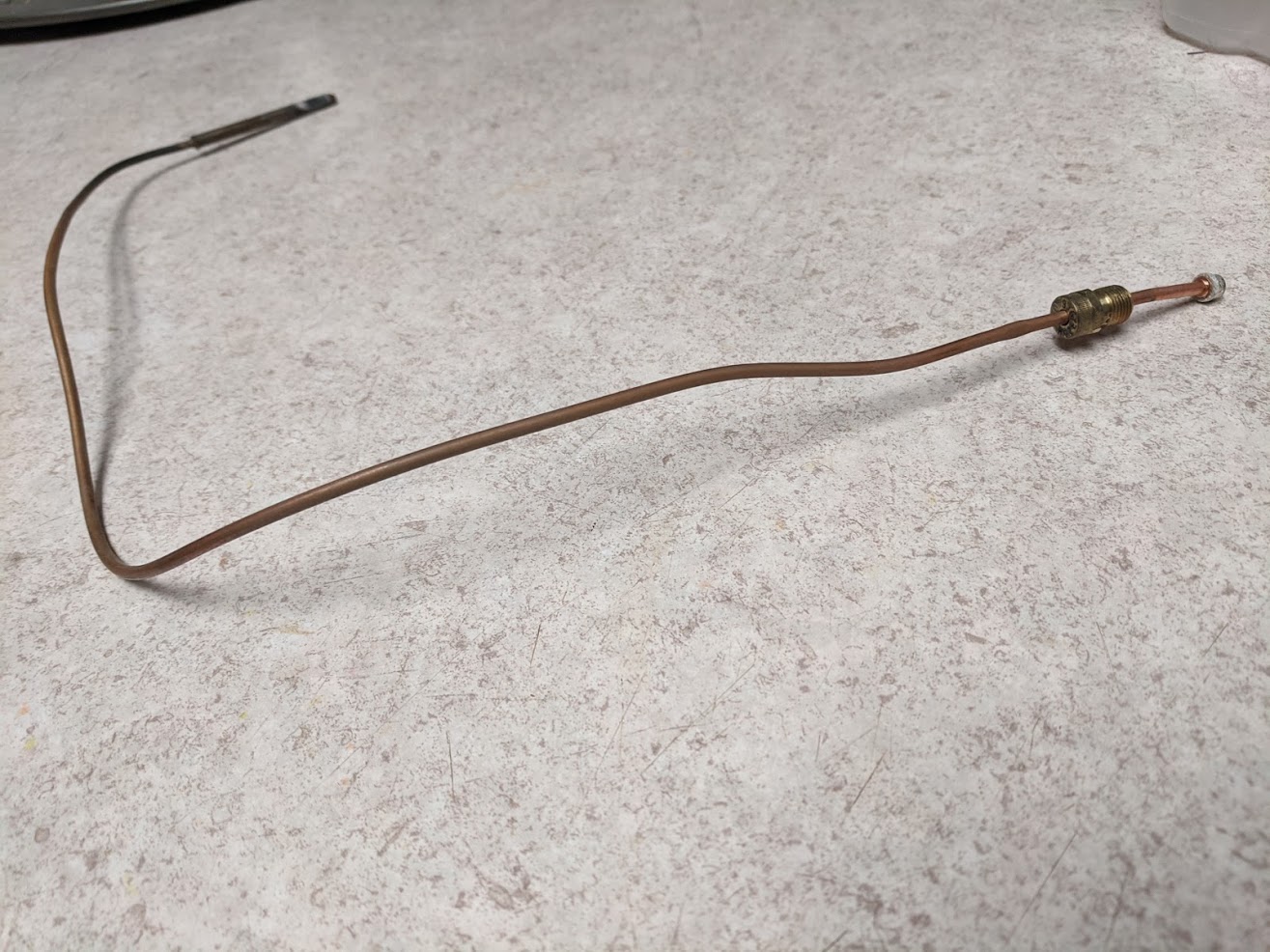
    After a quick stop to Home Depot and some help from the Ron Swanson-esque employee, I picked up the $12 thermocouple that I was hoping would solve all of my problems. After taking care to turn off and disconnect the gas from the heater, I followed some simple instructions from the #1 youtube video on replacing a thermocouple. Roughly 15 minutes later I had the water heater up and running and had to crack a cold one to celebrate being able to take hot showers again after 3 days of freezing ones.

    A month later and everything is still running smoothly, piping hot water and more money in my bank account. 

    Moral of the Story – Don’t get blinded by the frustration caused a problem. Stop and look for a solution. Who knows, It could save you time and money as well as give you an immense feeling of accomplishment by being a problem solver. 

    KEEP STACKIN!

  • What Should I Be Teaching My Kids About Money?

    What Should I Be Teaching My Kids About Money?

    Money is definitely something that you need to be teaching your kids about. The problem is that most people don’t know where to start. Heck, most of us here are teachers. We teach for a living, but we don’t know what or how to teach our children about money.

    The sad fact is that less than half of parents in America talk with their kids about saving and investing for retirement. Unfortunately, too many parents are themselves uneducated when it comes to managing their personal finances. This whole blog is designed to give you enough background knowledge and confidence to take charge of your own finances so that you can pass this knowledge on to other teachers, but more importantly, your own children.

    So where do I start?

    The Basics

    The first conversations about money with your child should focus on what money is, how you earn it, and where it goes. Start with talking to them about your check and how you earned that money. It’s very important that your child understands that the money you earn comes from you giving your time to your employer. It isn’t just “given”. After they see your paycheck, they will probably think that you are rich! The next step is to explain to them where the money goes. This money allows them to have a place to live, lights, food, etc… Explain to them that all of these items need to fit in your budget. A budget is an important part that many people skip and even fewer follow. They need to understand that without a budget, you can’t move into the next step of financial literacy.

    Savings

    Now that your child understands the basics. You can dive deeper into budgeting with them and show them that you should NOT be spending every dollar you earn. Start with a simple idea of a savings account. This is an important step for children. We live in an instant gratification society where people get what they want when they want it. Kids must learn the concept of delayed gratification and teaching this at a young age is paramount. Try to keep it very simple. Have them think of a reasonably priced item that they really want. Now it is up to them to save enough money to buy it. If your child is 8 or older, you could give them a small allowance for doing chores around the house. This is a golden opportunity for them to learn the concept of work for pay. Just like if mommy and daddy don’t go to their job, if you don’t do your chores, you don’t get your allowance. An important step of this is to make sure that you give them the money that they’ve earned. They need to have the ability to spend it when you go places. They need to see all of the temptations in everyday life. We’ve all made impulse purchases before. Your child needs to see that there are going to be things out there in the real world that are going to try and “persuade” you to give up your hard earned money. Whenever your child wants to spend on something that isn’t their “goal”, remind them of what they really want to get, but don’t stop them. If they do decide to spend on something else, keep talking up that “goal” that they have to create a little buyer’s remorse. They need to feel that at a young age. Better to feel some buyer’s remorse now on a $10 toy than 20 years from now on a $20,000 one! Once they’ve learned that lesson, it’s time to move on to the next step.

    Investing

    Now the real fun begins. Remember when you talked with your child that the way you earn money is by working? Now they need to learn that real wealth is made when your money makes money for you! To me, the best way to teach this lesson is to actually open an investing account for your child. I believe that a Roth IRA account is the best vehicle to do this. We talked about Roth IRA’s in this post. A Roth is a great choice because the money grows tax free and is NOT taxed when money is withdrawn. Your child can also withdraw any principal invested at any age. The con is that they may NOT withdraw any growth on the money until they are age 59.5. This investment also gives you a chance to talk with your child about retirement. Wouldn’t we all like to retire at age 59.5 with enough money to live our best life? Starting a Roth at an early age will allow your child to do that. Now this is the ultimate in delayed gratification! One caveat with a Roth is that your child can ONLY invest $6,000 or what they claim in earned income during a calendar year, so your child will need to have a documented job to invest in a Roth. Sorry, their allowance doesn’t count. Oh, your child has a mowing “business” that they are paid to mow your yard and a neighbors. Hmm. We may have something. Consult your personal CPA before committing to that. The Professor is NOT a certified CPA. 

    Conclusion

    Every parent wants their child to have a great life. Teaching them about money at an early age is a vital role for you as a parent. As a teacher, you KNOW that your children are NOT being taught these types of lessons in school. Ironically, high schools and colleges will teach students how to manage money in a business, but not your own personal finances! So, take the steps necessary to put your child on the right path here in Money 2020! Nobody will care about THEIR money more than THEM!

    Keep Stackin!

  • 5 ways to grow your net worth in 2020

    5 ways to grow your net worth in 2020

    In 2019 I was able to increase my net worth by $32,000 but only took home roughly $40k from my paychecks… How is this possible? It’s actually a lot simpler than you think. There are a few basic steps that we can all take in the new year to grow that net worth number. It’s really the only number that I am constantly paying attention to as a metric for my personal wealth. 

    Step 1 – Tracking your net worth. I like the app Personal Capital to track my accounts and every day expenses. My favorite feature of the app is the home screen that tracks your net worth for you! Looking at it everyday makes you aware of how much you have and plays a part in gamifying the process for you. Currently, I am down to just recording it annually. I started by recording every month in order to make sure I continued growth. Being aware of what this number is and the impact transactions have on it, has to be your first step in financial independence. Very few people out there will innately acquire wealth. We must be aware of where we stand in order to grow. 

    Step 2 – Owning a house. This one should have a big asterisk beside it. Owning versus renting is not a one size fits all decision. There are a lot of things to consider about your own situation but for me it looks to be a profitable experience. My mortgage payment is half of what the average rent is in my city. I bought an affordable fixer-upper in a popular part of town. As I slowly renovate rooms to modernize the place the property’s value is holding steady and my monthly payments are slowly going converting into equity. Whenever it is time to sell, I’ll likely make some money off of that. Whereas with renting, I can guarantee that I won’t make any money. One thing that is nice about Personal Capital is it automatically pulls your houses estimate from Zillow to keep tracking this for you. I’m able to follow the ebbs and flows of the market, and it gives me a very rough idea of what my property should be worth.

    Step 3 – No New Debt. Of course I say this after saying it can be profitable to buy a house! Housing is one of those expenses that you can expect from life. You’ll always have to pay for a place to live. When I talk about no new debt I talk about avoiding loans and payment plans for items you can live with out. Jewelry, electronics, furniture, renovations, all of these things can have payment plans that turn into debt that hangs over your head and pull that net worth down. Always try to make decisions that limit new debt. Pay outright for small things. These little debts add up much faster than you realize. Try to avoid them and seek alternatives if you can. 

    Step 4 – Pay down your existing debt. We all have debt in some way shape or form. Make sure you are taking active steps to pay yours down. Don’t miss a payment ever and prioritize what debt you have. 

    1st – Pay down any of those credit card debts that are wracking up. 18% interest can suffocate you for years if you are just making the minimal payment

    2nd – Car loans – depending on your interest rate take care of any vehicle or personal loans.

    3rd  – Student Loans – While these interest rates are high, federal student loans do not transfer should anything happen to you. In the event of death student loans are wiped out… Unlike your other debt

    4th – Mortgage – If you have recently purchased a house or refinanced you are probably sitting at a nice interest rate (something below 4%). At that rate I don’t feel that it is essential to throw down loads of money to pay that debt down. Yes it would be nice to own your house outright but at 3% interest you are better off putting that money to work in index funds that are returning at a 6-7% rate!

    Step 5 – Invest. Some of us out there are fantastic at saving money. They are frugal and always save more than they earn. But they never take that next step of putting that money to work for them. It sits stagnantly in a savings accounts at their local bank earning fractions of a percent in interest. This was a viable strategy for your grandparents due to the high savings accounts rates of the past but that time is no more. According to the FDIC, the national average interest rates on savings accounts is at… Wait for it… .09%!!! What a waste! In modern times the purpose of a savings account, if you even have one, should be a rainy day fund. A quick source of money that you can access immediately to cover repair costs on large items on your house or vehicle. A savings account is no longer a great tool to build net worth. Instead you should be putting those dollars to work for you in LOW COST INDEX FUNDS. Check out our resources on them. Challenge yourself to invest incrementally more each year or each quarter or maybe even each month. It is crazy how fast that net worth can snowball!

    Make these steps happen as soon as you can. We are all bad about putting things off thinking there will be a more convenient time later. Make these steps today so that your net worth can start its exponential growing process!

    KEEP STACKIN!