Category: Investing for Teachers

Investment strategies tailored to educators, including 403(b) plans, Roth IRAs, HSAs, asset allocation, and long-term wealth building.

  • Dividend Stacking – Passive, Exponential Growth for your Portfolio

    Dividend Stacking – Passive, Exponential Growth for your Portfolio

    We have talked at length about dividends in the investing world. What we haven’t mentioned is how we use dividends to grow our net worth exponentially through the art of dividend stacking. Dividend Stacking, much like our namesake of Teachers Stacking Tens, is a slow and patient investment strategy that starts with small quarterly and annual growth, and can balloon out to a substantial source of passive income. Like the name suggests, it is not a get rich quick scheme (Those don’t really exist). We aren’t over here trying to time the market buying low and selling high or anticipating the next crash. We are here, buying stable long term dividend growth stocks to increase our net worth. 

    How does dividend stacking work?

    Remember, stocks that pay a dividend will provide you a small pay out per share you own. Many stocks that do this pay out quarterly, some pay out annually and some pay out monthly. Index funds fall into this category. Since index funds are a slice of many stocks, they pay dividends based on those companies as well. So nothing new here, you own a share of a company that pays dividends. Then you’ll get a small deposit each time they post a dividend. It’s what you do with the deposit that matters. 


    Enter the DRIP – The Dividend ReInvesting Plan. Rather than have those small amounts added into our accounts we have them selected to get REINVESTED back into the company. So each time a particular stock pays a dividend, I am automatically using that money to buy more shares of that company. This embodies that Teachers Stacking Tens philosophy, constantly adding those dividend earning back into more stock which will, in turn, produce more dividends in which you will buy even more stock which will produce even more dividends! You get the idea. 

    So how do I do this? 

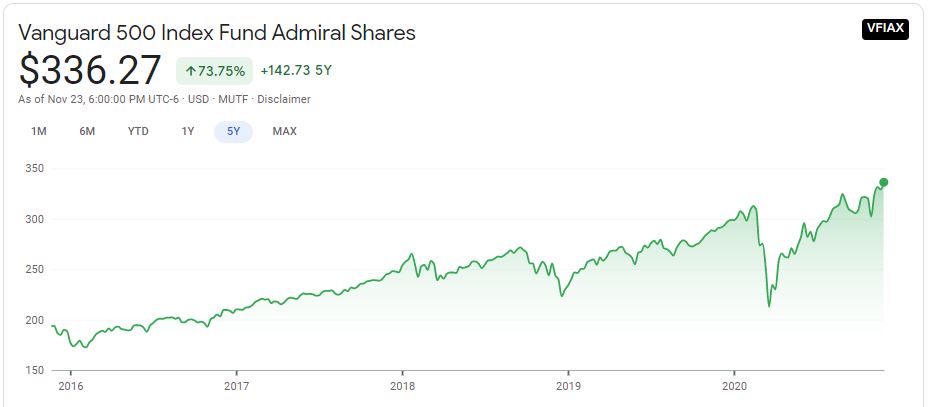
    Well, chances are your financial institution might be doing this for you already. When you are looking at your 403b or Roth IRA or 401K those accounts will have the dividends automatically reinvested… Nothing you have to do or worry about. For example, in the last 3 years my Roth IRA account has generated $950 in dividends. Those dividends in turn have purchased 3.558 shares of VFIAX. As of Today, that is worth $1,196. So in the last 3 years not only have I used those dividends to purchase more index funds, the value of those index funds have gone up as well. And to be honest I don’t have all that much money in my Roth IRA. Thanks to my need to continue to pay off my new car I haven’t been able to max out my Roth IRA like I would prefer. However, you can still see by being patient and letting our money work for us it has the power to grow exponentially. 

    So what are we doing with this now?

    Like I said, this is something you shouldn’t have to worry about in your retirement accounts. You shouldn’t have the option to cash out your dividends because, you know, taxes… Where this needs to be applied is in your taxable or brokerage account. 

    Brokerage accounts are a subject that we haven’t discussed in great detail on here for a few reasons. One, there are many financial needs that one needs to understand before getting a brokerage account and two. Brokerage accounts have only recently been redone to be more user friendly. Up until just a few years ago many institutions had a trading fee. Something like $7 a trade seemed to be pretty typical. It didn’t make as much sense to invest small amounts if you were going to get hit with a $7 fee every time. Now many institutions, such a Vanguard, have waived trading fees. There is no fee to purchase most domestic stocks. And many places now don’t have a minimum purchase requirement either. Just that you order in complete shares, and even that rule is changing. More on our Brokerage account set-ups at a later date. 

    What this has enabled us to do is invest in the market and take advantage of its growth in an account that we can access before retirement age. The Professor is in the second half of his career and is seeing the end in sight (Even if its a long ways down the road). I however am still in the first 1/3rd of my career, retirement benefits 30 years from now are not as clear as benefits that are only 15 years away. I have seen the benefits of investing in an account that I can access should I chose to leave teaching before the typical retirement age. Even though it is taxed, I enjoy this sense of freedom. 

    It also lets me pick individual stocks not just Vanguard funds. WARNING! – Do not start purchasing individual stocks unless you know what you are doing! This is what we call a pro-gamer move. We’ll have more info to come as we are getting data back from a year of investing in dividend growth stocks. But the short hand is it lets me pick individual companies, collect their dividends, and reinvest them into that company. After a year of experience, I’ve enjoyed it and thanks to dividend stacking, I have some decent returns to show for it and future growth ahead. 


    – KEEP STACKING!
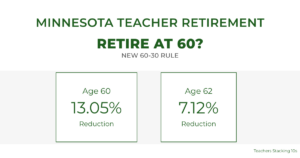
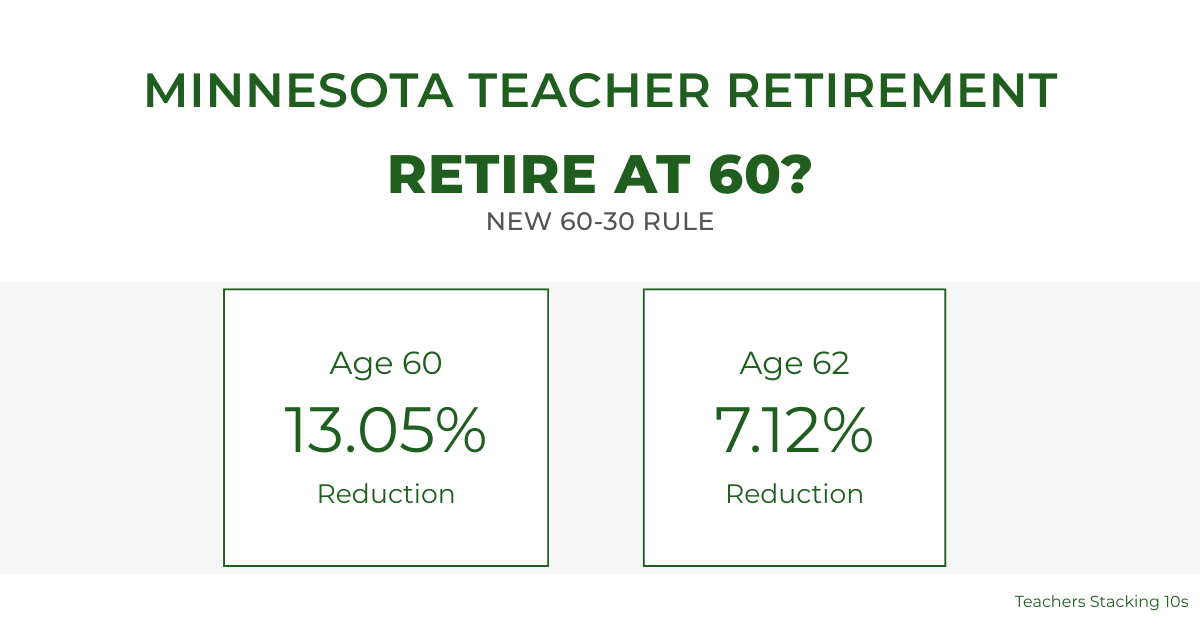
    Minnesota teacher retirement at 60 reduction comparison under enhanced 60-30 rule

    Minnesota Teacher Retirement at 60: Understanding the Enhanced 60/30 Rule

    For years, Minnesota teacher retirement at age 60 was financially unrealistic for

    Read More
  • The Most Exciting Rollercoaster Ride Out There – The STOCK MARKET!

    The Most Exciting Rollercoaster Ride Out There – The STOCK MARKET!

    Adrenaline…. Millions of people every year chase after an adrenaline “rush” by doing crazy, insane stunts, that could result in serious injury or even death! Why would people put their lives at risk just for this “feeling? It is because adrenaline is one of the most powerful hormones that we humans produce. It is produced when we feel fear, and it can cause us to make rash decisions. DON’T let this fear prevent you from investing your money in the market!

    The stock market is a much like this roller coaster to the right. It goes up, and it goes down. It can feel like it goes upside-down. What we need to remember as investors is that, unlike a roller coaster, the stock market never returns to the “ground”. It will not drop to “zero”. (I suppose it is possible that the market could drop to zero in theory, but that would mean that the US has collapsed as a country, and you probably have more important things to worry about than the market!) It is a roller coaster that always ends up higher than it started. It sounds easy, but you will be tested when you have a $200,000 retirement account that loses $15,000 in one day because of a dip in the market! You’ll want to sell, sell, sell to cut your losses, only to realize that the next day you missed out on the bounce-back that would have recouped much of your losses.

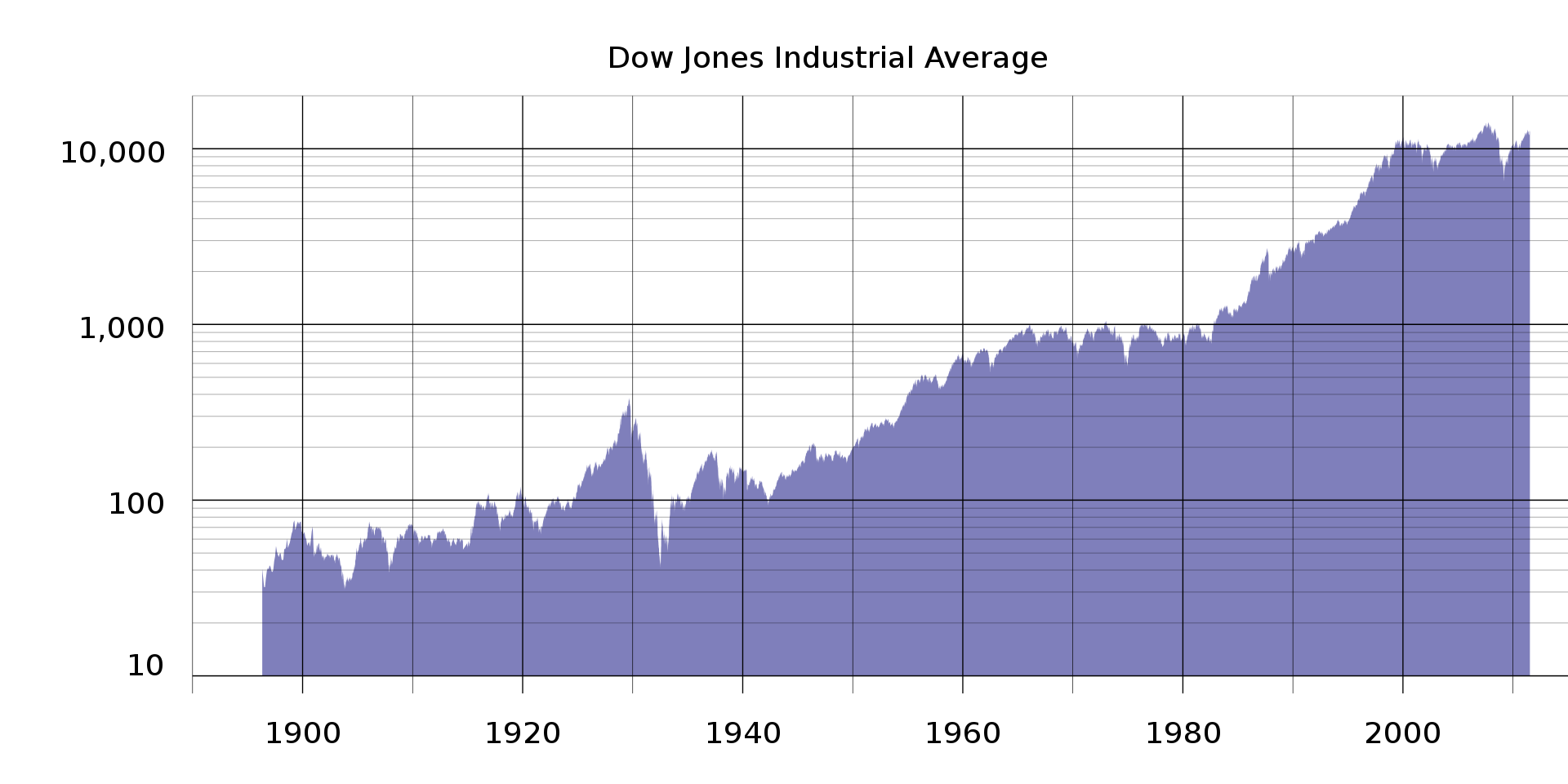
    Take a look at the chart below. It shows the Dow Jones Industrial Average from its beginnings in the 1890s up through about 2012. You will see that there are peaks and valleys all throughout its history, but what stand out for you is that the overall trend of the market is that it goes up!

    So what does this mean for investing? The key point is that no matter when you decide to invest, the market in the future will be higher than it is today. Detractors might say, “But what about the market crash that they say is coming?” You know. They are right. the market IS going to crash at some point, BUT it will rebound and go to higher highs than it was before that crash. The key is to consistently invest money into this “money-growing rollercoaster!” Don’t try to time those “dips” and ignore them when they happen! Don’t let the fear overtake your common sense and realize that “dips” are opportunities for you to buy shares when they are cheaper! This is especially important in the very volatile market conditions we are in right now. The market drops 10% one week, only to jump by 15% the next week.

    You should be more afraid of not preparing for your future than you should of investing in the market. Don’t let the fear win! Prepare for your future and…

    Keep Stackin!


    Minnesota teacher retirement at 60 reduction comparison under enhanced 60-30 rule

    Minnesota Teacher Retirement at 60: Understanding the Enhanced 60/30 Rule

    For years, Minnesota teacher retirement at age 60 was financially unrealistic for


    Read More

  • Selling TESLA and the Slow Grind of Investing

    Selling TESLA and the Slow Grind of Investing

    Yep, you read that correctly I bought TESLA stock way back in 2016 for under $200! I believe a lot in the future of electric cars and bought the stock to support the vision (boy was I naive back then). Two years later I sold it for $315. A sweet 57% turnaround after two years and a few hundred bucks in profit. I’m sure I used it to pay some bills or to buy some other stock. As sweet as that was, TSLA is currently trading for over $2,000 a share and is about to go through a 5-way split. Boy do I feel like a moron whenever I look at this. And yet, here you are, looking to me for personal finance advice! 

     What Selling TESLA has Taught me

    As painful as it has been watching that stock climb and realizing I could have made several paychecks worth of money on it, I have actually learned a bigger lesson in the personal finance/casual investor world. There are no get rich quick options, it is a slow decades long grind. That’s it, that’s the secret for all of us non-day traders out there, we need to invest for the long haul. When I was first buying and selling stocks I was under the impression of buy low and sell high, then use the profits to buy your next batch of stocks etc. Yeah, that doesn’t really work, not with any kind of sustainability for those of us that earn a median income. Buying and selling stocks short term turns quickly into an expensive gambling habit, and really to be successful at it you need to be paying close attention to the markets daily and to have a little bit of luck on your side. 

    Buy Stable Stocks with Consistent Payouts

    Here at Teachers Stacking Tens, we are clearly big fans of index funds. We seem to hit on them in every post we make about investing. They are extremely safe and the ultimate slow and steady hands off pay-out. However… They are kind of boring. Index funds make up over 90% of my portfolio for a reason, they work, but I like to have a little more diversity in my investments and I enjoy looking at the markets frequently. What made TSLA a frustrating stock for me was the fact that it never paid a dividend. It just sat in my portfolio not doing anything for years. The only way it had any real value to me was if I sold it. So I did for a profit and moved on to focus on Dividend Growth Investing. With dividend growth investing I’ve been able to invest in stable companies that kick out a quarterly or monthly dividend and I can reinvest that dividend back into the company giving me more shares! Using this I can set some more realistic goals for myself. Currently, I receive roughly $1,000 in dividend annually, it’s easy for me to work towards increasing that number and I can get some tangible results. Sitting on stocks that don’t pay out is tougher, at that point you are banking solely on their performance in the market which is much less predictable. 

    Investing for Teachers is a GRIND!

    Much like the grueling months of February and March, teacher’s investment plans are a very dreary. You aren’t going to receive a big flashy payday but consistent auto investing will begin to pay off in the long run. Heck even looking back at the past 5 years, it’s unbelievable the progress I have been able to make. The professor and I were just talking about our frustrations in not being able to invest more into the market and feeling how slow it has been, only to look back and realize that all of our accounts are quite a bit positive for the year 2020, and 2020 had the biggest drop since I’ve been investing. Another good reminder that discipline and consistency will win out every time. Don’t chase after miracle stocks like TESLA. Come up with an investment plan and stick to it. Now every time I see TESLA skyrocketing I am reminded to trust the process and keep grinding. 

    So keep those monthly contributions flowing, keep slowly raising them each year, and keep socking that money away into the market in stable long terms funds.

    Keep Stackin!


    Minnesota teacher retirement at 60 reduction comparison under enhanced 60-30 rule

    Minnesota Teacher Retirement at 60: Understanding the Enhanced 60/30 Rule

    For years, Minnesota teacher retirement at age 60 was financially unrealistic for



    Read More

  • Choosing a Real Estate Investing Strategy.

    Choosing a Real Estate Investing Strategy.

    One of the best things about real estate investing is that there are multiple strategies that you can implement to make money. Each strategy has it’s own pros and cons. Most importantly, is that you can switch strategies depending on the property that you are looking at. 

    The first two strategies are the ones that most people have heard of, but the other strategies can be just as successful. In fact, being able to move from one strategy to another can turn a bad deal into a great one.

    Strategy #1 – Flipping

    This strategy has become extremely popular over the last 15 years due to the abundance of flipping shows on networks like HGTV. People have seen the success of these shows and how “easy” they seem to make it look. Flipping involves buying a run-down property, rehabbing it, and then selling at a profit. Sounds simple, doesn’t it? Well, slow your roll! Before you jump into your first flip, you’re going to need to have some knowledge. First, you are going to have to find a property that you can add value to. And like I said, flipping is very popular, so you’re probably going to have some competition. Then you need to understand the cost of the rehab AND what the ARV (after repair value) will be. You may need the help of a contractor for the rehab portion and a real estate agent for the ARV portion. This is especially true if it is your first flip. The two biggest mistakes that first-time flippers make is that they underestimate the cost of the rehab and overestimate the ARV of the property. Another cost to keep in mind is the holding cost that you will have during the repair. You will have utilities, any loan costs, property taxes, etc., during the time you are holding the property. Now, I don’t want to make flipping sound like an impossible mission. In fact, the reason flipping is such an attractive strategy is that a successful flip can earn a smart investor large amounts of money in a short amount of time. A successful flip could get you $20,000 or more in 6 months or less. Some flippers that specialize in high-end properties can even bring in $100,000 or more in profit in under a year. These successful investors understand successful flips require knowledge and planning and also some risk.

    Strategy #2 – Buy and Hold

    This strategy might be the one that most people associate with real estate investing. This is the landlord strategy. You buy a property, hold it, and rent it out. This strategy requires an investor to understand property values and rents for an area. It will also require you to understand your income and expenses for a property. The monthly rent for the property is the first income people think of, but are there other incomes like coin operated laundry or garage rent as well? And then you must also understand your expenses. Mistakes that investors make in this strategy include underestimating expenses and overestimating rents. Another big mistake is some investors do not hold enough cash reserves to cover unexpected expenses that come with owning a property. For every property you plan on holding, you should have $10-15,000 in reserves for any large, unexpected expenses. Of course this amount can vary depending on the age of your property. If you have a brand new property, your reserves can be less. A 100-year old property will definitely require more reserves. As you acquire more properties, you could also bring that amount down per property. For example, if you have 10 properties, you probably don’t need $100,000 in reserves. Not every furnace or roof on all of your properties will go out at the same time, but as you use up some of those reserves, you’ll want to make sure you build them back up.

    This strategy might not pay out the large sums of money upfront like we see with the flipping strategy, BUT this strategy can produce many streams of income that would make George Clason proud! We will go into more depth on this strategy in a later post.

    Strategy #3 – Wholesaling

    Wholesaling is not actually “buying” real estate. This strategy involves you finding good deals and then getting them under a contract. You then sell that contract with your assignment fee. This fee varies by the size of the deal. This strategy is great for someone who doesn’t have the capital to purchase deals themselves but is good at finding and sourcing deals. It requires a lot of hustle and willingness. It can also dry up pretty quickly if you don’t build a good marketing funnel to constantly bring in new deals. Just be careful of the real estate “gurus” out there who are more than willing to “sell” you their wholesaling course for the modest sum of a few thousand dollars. If wholesaling was as easy as they make it seem to be, wouldn’t every real estate investor be doing it? Don’t get me wrong, it’s a great strategy for a person with the right mindset and hustle.

    Strategy #4 – House Hacking

    House hacking is a very popular strategy for first time real estate investors. This strategy is when an investor buys a property and then rents out one part of the property. It is a great strategy for a first-time investor because it can give an investor a place to live with little or no mortgage payment and gives you practice as a landlord. The negative is that you are right next door to your tenant. This strategy can also be a little easier to work if you don’t have a family because if you by a single family property, you would be renting a room to someone else. If you have a family, you’ll probably want to find at least a duplex so you don’t have someone living in your house with you and your spouse.

    This can also be a great strategy if you have a kid heading off to college. Once they are able to live off-campus, you purchase a property near campus and have your child live there and have their friends live with them paying you rent! It saves your college kid money in cost of living, and you are getting the mortgage on your property paid off by their friends! Once they are finished with college, you can continue to rent it out, or you can sell the property to another investor. Just make sure that you check into the city’s rental requirements before you jump at this option. Many college towns have specific zoning ordinances for rentals. 

    Conclusion

    Real estate can be a fantastic wealth generator for the smart investor. Any of these four strategies taken alone or in any combination can grow your money tremendously. There are also numerous other ways to get into real estate but before you jump into any of these investments, be sure to do your research! Read books, watch videos, read blogs, visit forums. Investing used to be controlled by those that controlled the knowledge. With the explosion of the Internet, that knowledge is out there for anyone willing to do the work. Now get out there and…

    KEEP STACKIN!

  • The Greatest Wealth Generator in History.

    The Greatest Wealth Generator in History.

    Here at Teachers Stacking 10s, we have talked in depth about saving and investing your money into stocks and index funds. We have spent a lot of time in this area because almost all of us as teachers have a 403(b) account in which we invest. It’s also a very simple method for growing your money, but is it the “best” way to grow your money? If you want to be a passive, hands-off investor, yes, stocks, especially index funds, are going to be your best bet. But as we have seen these last couple of weeks, the stock market can drop precipitously and without warning.

    This brings us then to the idea of real estate. As the title of the post states, real estate has created more millionaires over time than any other. So why is real estate such a powerful driver of wealth? To answer this question, we have to look at the four different ways that real estate can grow your wealth faster than most other investments.

    Wealth Generator #1 – Cash Flow

    This is the area that attracts most people to real estate investing. People hear of someone who is making an extra $300+/per month on this rental property that they purchased. This is the passive income stream that we have talked about in previous posts. Now, like index funds, this cash flow can go up and down. Factors such as capital expenses, vacancy, repairs can significantly impact your monthly cash flow. This is why real estate has a steep learning curve. You have to understand cap ex, taxes, vacancy rates, property management, etc.. All of these things can affect your bottom line. We could compare this to dividends in an index fund except real estate cash on cash returns can easily exceed 10% compared to 2-3% in a dividend fund.

    Wealth Generator #2 – Appreciation

    Appreciation is when the house you buy goes up in value over time. This is similar to buying an index fund and having it the price increase. The average house in America appreciates on average 3% each year. Of course, this can vary greatly from location to location so it is important to make sure you understand the area that you are purchasing in to guarantee yourself the best chance of appreciation. Unlike stocks, you have the opportunity of “forced appreciation” in real estate by improving your property through repairs or additions. But like stocks, the price of your home could drop in a housing market downturn like we saw in 2008.

    Wealth Generator #3 – Mortgage Pay Down

    This is where real estate starts to really show its true wealth building ability. Mortgage pay-down is the paying down of the loan that you took out when you purchased the property. Very few people in real estate pay all cash on a property. The most common method or purchasing real estate is to pay 20-25% down and then “leverage” other people’s money for the rest of the property. This is similar to buying stock on “margin”, BUT in real estate, your tenants are the ones paying down that loan. So if you purchased a $100,000 property for $20,000, after 30 years your tenants would pay off that $80,000 loan for you! When you buy stocks on “margin”, or borrowed money, nobody is paying that loan but you!

    Wealth Generator #4 – Tax Benefits

    This final area is the one that shows how real estate investing is the “favored” method of growing wealth in America.  Each year that you own the property, the government allows you to “depreciate” your asset. This means that the government feels that the house is going down in value by a certain amount each year due to wear and tear, and you can deduct that amount from your taxes. You cannot “depreciate” stock. Now, the government of course wants to recapture that depreciation that you have deducted when you go and sell that house, BUT there is something called a 1031 exchange that allows you to sell that property and purchase another, hopefully larger property, WITHOUT paying those taxes. With this 1031 exchange, you are able to delay these taxes forever. This enables an intelligent real estate investor to “trade up” properties every few years to improve their cash flow. So you could realistically start out with a single-family home. A few years later move up to a duplex. Maybe 5 years later exchange up to a four-plex, etc.. Continuing to do this could allow you to to upgrade from that SFH to a 16-unit apartment complex over the course of 20 years!

    As with all types of investing, there are risks. Successful real estate investing requires time, effort, and knowledge. You will not be able to jump right in to real estate investing without doing your homework. Fortunately, there are numerous sources out there for you to study. One of my favorites is the Bigger Pockets website. I have used this site for the past couple of years as I build my knowledge in real estate. I have also started attending our local real estate investor meetings. Real estate is huge “relationship” business. You have to be willing to meet people and connect with others in the industry. Through these relationships, I am hoping within the next year to make my first purchase of a rental property. In my next post on real estate, I will discuss the different strategies when entering real estate. In the meantime, everybody….

    KEEP STACKIN!

  • HSA 101

    HSA 101

    Everything you need to know about what might be one of the best investment tool to add to your portfolio.  

    First things first, if you are single and under the age of 26, you should be staying on your parents’ health insurance plan. Typically this makes the most financial sense. Sometime right before that 26th birthday you’ll be looking for what kind of health insurance you should be getting. I would suggest getting a high deductible plan with an HSA.

    What is an HSA? An HSA is a Health Savings Account. They were created in 2003 in order to help out people that had a high deductible health insurance plan. For young people, it makes a lot of sense. Typically, young people don’t need the more expensive plans with better coverage but much higher premiums. In my 8 years of employment, I have only recently gone to the doctor for a cholesterol check. Other than that I haven’t had the need to schedule a doctors appointment. Therefore, it wouldn’t make a ton of sense for me to pay large sums of money each month for a high end health insurance plan when I don’t need one. Enter the high deductible plan. First up, a deductible is the amount of money you have to pay out of pocket before your insurance kicks in. For us single young people that are healthy, our best bet might be going with a high deductible plan with that HSA account. 

    HSA accounts are Triple Tax Advantaged – meaning…

    1. It is put into an account pre-taxed – When you contribute to your HSA it comes out of your check before taxes are taken out. We haven’t discussed a lot about taxes here on Teachers Stacking 10’s but whenever we can lower our taxable income that is a big win! There is a limit to your contributions however – $3,550 for single and $7,100 for family plans. ​​

    2. The gains on that account are not taxed – Your HSA can be invested. I have recently switched my HSA from my local bank into a Fidelity HSA account. This means I can have take those couple thousand dollars and leave it sitting in index funds to grow. On top of that I will not be taxed on those gains! Unheard of. 

    3. The money is not taxed when you spend it. You can spend your HSA on anything related to medical expenses… This is the current list as to what qualifies for a medical expense – http://www.hsabank.com/hsabank/learning-center/irs-qualified-medical-expenses. So long as you are spending that money on medical expenses you never have to pay taxes on it! 

    So rather than spend a lot of money each month for a health insurance plan with a big premium I have gone with the high deductible plan. My current deductible is roughly $5,000. I know that seems like a lot. But since I am a healthy person without any kids I don’t have medical expense. Instead I have chosen to bank up my HSA for the emergency where I might need to use that big time deductible. The main benefit of that is more money is at my disposal while still being covered in the event of a catastrophe.  

    Health care is pricey. But using an HSA we can help offset some of these costs

    If you decide that an HSA is right for you, where should you open an account? 

    The decision as to where to open your HSA does carry some significance. During the initial stages of my HSA, I simply opened up an account with my local bank. It has been a smooth process. No problems with the deposits or setting up an account, and they provided a separate debit card for me to use on qualifying purchases, which have been low. So for the most part the money just sits there, gaining .15% interest. Yes that is a fraction of a percent interest which translates to a couple of bucks a year… OUCH! Recently, the account has grown and I have decided that the minor conveniences are not worth the dollars that I throw away each year in interest. With about $2,000 in my account the difference is roughly $3 a year interest compared to $140 if that were invested in Index funds. That is reaching the point of interest earning me a free check-up at the dentist every year. I CAN’T MISS OUT ON THAT! 

    So enter FIDELITY. After a lot of research in various sources time and time again I came across Fidelity as the most recommended vendor for HSA accounts. A couple of things have stood out to me about them. 

    1. They do not have a minimum cash holding balance before you can invest. What this means is that some vendors require that you have an amount ($2000 cash) that must stay in your account and is not invested. Thus you invest on every dollar past that minimal required amount. Not great for me. Yes, I have some money in my account but I’m in no rush to start socking money away into it. Fidelity doesn’t do this. The first dollars you deposit with them can be invested. This pleases me.

    2. A wide variety of low-cost index funds to choose from. While it is true that Vanguard is the god father of the index fund, Fidelity also has some very good options with a very small expense ratio, some below .03%! This is big to all for my investment options to keep those expense ratios down. On paper those percentages can look small and be easy to miss, but over the lifetime of your accounts can add up to thousands of dollars!

    ONE DRAWBACK 

    The Fidelity account won’t have a debit card. To keep an HSA in an investment account, you lose the ability to immediately pay your bills with that HSA while you are still in the office. Instead you pay using your credit card or checking account, then later if you would like to reimburse yourself for that expense you can deposit that money from your HSA into your checking. It’s important here to keep a copy of the receipt. I usually just save a digital copy to show proof of the expenses you are covering with that money. Remember, an HSA is tax free so the IRS likes to keep it that way. So long as you have the receipt of purchase you’ll be just fine.

    So the Fidelity HSA experiment has begun. I’ll be keeping an eye on how my investments grow and seeing how convenient the account is to access when I need it. Overall I’m excited to put more money to work for me gaining that compound interest! Check out the expected growth of $2,000 over 20 years below. $7,739 vs. $2,061!

    So it’s important for you to start looking at the numbers for yourself. If you have a lot of reasons to go to the doctors frequently (aka kids) maybe the high deductible plan isn’t the right fit for you but for the rest of us it is definitely worth considering. I have roughly $2K sitting in my HSA which is invested in index funds which are currently earning 7% per year, think about how that can grow! To me in my situation that makes much more sense. 

    KEEP STACKIN!

  • Vanguard is our new best friend.

    Vanguard is our new best friend.

    It’s happening! The TA and I are going to be getting Vanguard as a 403(b) vendor in the New Year! Wait, you aren’t as thrilled as we are? You should be. This is great news!

    What’s the big deal Professor?

    Well, everybody loves saving money! This is what Vanguard is going to do for us. Most teachers don’t realize that a 403(b) vendor charges fees to “advise” you on how to invest your money. Depending on your vendor, these fees can range from $100’s to even $1,000’s of dollars per year. This can cost you MASSIVE amounts of money over the course of your teaching career. Our current vendor charges a fee of 1% to manage our money. I have about $70,000 in my account, so they charge me $700/year! Vanguard charges a $5/month record keeping fee, so my yearly cost will be $60! That’s a savings of $640/year! No matter how much money I add into my account, I will still only be paying $60/year!

    There has to be a catch? 

    Yes. The “catch” is that you can only purchase Vanguard funds. This is fine with the TA and me since we are big fans of Vanguard’s low expense ratio funds. We both actually hold them outside of our 403(b) in personal IRA and taxable accounts.

    Friend with benefits

    Not only will we save money with Vanguard as our provider, but we will also have more control of where our money goes. With our current vendor, we have to talk with our adviser about where we want our money. We have to tell them the percentages and then we have to listen to them try to “persuade” us to invest in high expense ratio funds. We can log in to see our accounts, but we have ZERO direct control over anything that happens in the account. We have to contact our adviser to make changes. With Vanguard, we will be able to log in and set our investment profile directly. 

    A typical conversation with my 403(b) rep.

    Don’t get me wrong. My adviser is a nice guy and I know he means well, but I’m an intelligent investor and the person I trust most with my money is me. I hope that doesn’t come off as arrogant, but I have put the time in to learn about good investing strategies. You can do it too! Just go back and read our post on understanding stocks, ETFs, and funds.

    Remember, an adviser makes his money by telling you what to do with your money. Even if you aren’t confident in making your own money decisions, there are three key questions that need asking.

    • What is your company’s expense ratio?
    • What is the expense ratio of the funds you are recommending?
    • Is there a penalty for moving money from one fund to another?

    The first two questions will give you an idea of how much of your money you are losing. If the answer to either of these questions is over 0.50%, then you are being charged too much.

    If the answer to the third question is yes, RUN! This will mean your money is in some kind of annuity. These are bad! You should NEVER be penalized or required to keep your money in a fund for a certain amount of time.

    The Hurdle

    The one hurdle that you have to get past is having limited options when it comes to 403(b) vendors. Every school district has a list of approved vendors. You cannot choose anyone outside of this list to administer your 403(b). The TA and I did not have a great list of vendors available to us, so we decided to ask our school if Vanguard could be added. We were lucky, for us it was simple. We are a small school district, so we don’t use a 3rd party administrator to oversee our 403(b). Our school board quickly approved adding Vanguard. You can try the same thing with your district. Show them the comparisons between a company like Vanguard and your current choices. It can be a powerful influence to show them the amount of money that their employees could be saving.

    I just wish I would have learned this 20 years ago!

    Keep Stackin!

  • What is a Dividend?

    What is a Dividend?

    Investing can be complicated. Through this website, the T.A. and I have tried to simplify it into terms that the average teacher can understand. The focus of this post will be on dividends.

    So far, we have talked about saving your money and investing it into primarily index funds to make things as simple as possible. Now that you are starting to get a better understanding of what stocks and index funds can do, I want to explain the importance of dividends in your portfolio.

    In it’s simplest terms, a dividend is in the interest that a company pays you for you “borrowing” them your money. By purchasing a company’s stock, you are “loaning” them your money. They use that money to improve their business and grow profits. If you have purchased stock in a good company, they will have a profit each quarter, and they may pay their stockholders a percentage of those profits. A key point is that NOT ALL COMPANIES pay dividends. This does NOT mean those are bad companies. Maybe it’s a company that is still growing and is investing their profits into growing and are not yet ready to pay out dividends. The stock price is climbing because their company is growing and your money is still growing. Index funds, ETFs, and mutual funds may also pay dividends out to their shareholders.

    Dividends can be paid at different times during the year. Some companies will distribute a yearly dividend at the end of their fiscal year. Others will distribute them semi-annually, quarterly, or even monthly. There really is no set rule as to when companies will distribute them. Some companies will even announce a “special” dividend if they have an extra profitable fiscal quarter or year.

    Dividends are measured in their annual yield. This yield is figured by dividing the total yearly dividend paid by their stock divided by the stock’s price. Let’s take a common ETF that we have discussed in previous posts, Vanguard Total Stock Market Index Fund (VTI).

    VTI’s share price as of this post is $155.83. The dividend paid over the last 12 months is $2.74. If you divide $2.74 by $155.83, you get 0.176. Multiply by 100 and you get 1.76%. So currently, VTI has a yield of 1.76%. It’s really not that difficult to calculate.

    So the quick decision people make is, oh, just find the stocks with the best yield and buy all of them! Not so fast… You need to make sure that the dividend for that stock is sustainable. Maybe their share price has plummeted due to a poor quarterly report. Their yield will jump, but they may have to cut their dividend because they didn’t make enough money to pay the previous dividend amount. It is important to keep an eye on a company’s earnings per share (EPS) each quarter. If a company only profited $1.32/share for the previous year, paying $1.40/share dividend isn’t going to be sustainable.

    So how can we use dividends to grow our wealth?

    A popular way of dividend investing is to invest in strong companies that have a history of raising their dividends over time. This is a great way of increasing your yield. It is commonly referred to as Dividend Growth Investing or DGI. Let’s take a look at an example of how your yield can grow over time.

    You decide to buy Company A. They are a solid energy company that has continually raised their dividends over the last 10 years. You decide to purchase 100 shares at $100/share. At the time of your purchase, the company had a yield of 1.5%, so for your $10,000 investment, you were paid $150/year in dividends.

    Fast forward 10 years. You’ve held those 100 shares in Company A over the last 10 years. Each year, you have received your dividend. Also, the stock price has steadily climbed and is now $140/share. During this time, the dividend continued to increase each year as well. Now they have an annual yield of 1.75%, so based off of that $140 share price, the yearly dividend in now $2.45/share. So if we look at your original purchase of $100/share, your yield on cost (YOC) is now 2.45%! This is how dividend growth works. It’s not unheard of for people that have held their stocks for 20-30 years to be receiving 10% yields or more on that money they originally invested.

    The negative of dividends is that if they are in your taxable accounts, you will have to pay taxes on them depending on your tax bracket. If you have held the stock for under a year, any dividends you receive will be “unqualified” and you will have to treat them like income and pay taxes on them according to your tax rate. If you have held them for longer than a year, they are considered “qualified” dividends and are subject to a different tax rate that will depend on your income level.

    This is why many people hold their dividend stocks in their tax-sheltered accounts like your 403b, IRA, or Roth.

    While index funds are still our #1 recommendation for investing dividends can be a great way to provide yourself passive income and add some diversity to your account.Your money making money for you, and that will help you to…..

    KEEP STACKIN!

  • How to Analyze and Buy Stocks, ETFs, and Mutual Funds

    How to Analyze and Buy Stocks, ETFs, and Mutual Funds

    So you followed my advice and opened a Roth IRA at Vanguard. You invested some money into it and think you are done. WRONG! This is a common mistake that I’ve seen many teachers make. They invest money into their retirement accounts, do nothing, and expect it to grow. It might grow, but it’s not going to grow by much when it’s only invested in a simple money market account, which is what happens to your money when you don’t designate it into purchasing a specific stock or fund. In this post, we are going to show you how to analyze the important information from an equity quote.

    Let’s start out with a simple stock. We will look at a popular stock from a strong company, Apple (AAPL). Apple has been a strong company for over a decade with their strong sales in technology.

    Detailed quote information

    Open 196.31
    High 198.07
    Low 194.04
    Prev close 193.34
    52 Wk high 233.47
    52 Wk low 142.00
    Average volume 24.62 M
    Bid (Size) 196.80 (2,000)
    Ask (Size) 197.00 (2,100)
    Outstanding shares 4.60 B
    Market cap 873.74 B
    EPS 11.78
    P/E ratio 16.41
    Div yield 1.59

    So, we see Apple’s current quote above. Let’s look at each line.

    OPEN – This is the price that the stock started the day at.

    HIGH – This is the highest price of the stock on the day.

    LOW – This is the lowest price of the stock on the day.

    PREV CLOSE – This is where the stock closed on the previous day.

    52 WEEK HIGH – The highest price of the stock in the last year.

    52 WEEK LOW – The lowest price of the stock in the last year.

    AVERAGE VOLUME – This is how many of the stocks are bought and sold in a given day.

    BID (SIZE) – This is the price that someone is willing to pay for the stock and how many shares they want to buy.

    ASK (SIZE) – This is the price that someone is willing to sell the stock at and how many shares are available.

    OUTSTANDING SHARES – This is how many shares are available in the company.

    MARKET CAP – This is how much the company is worth based on the number of shares outstanding and the price per share.

    EPS (Earnings per share) – This is how much money the company makes for each outstanding share. This number can be negative as well. Some companies, especially new, rapidly growing companies, invest their money back into the company and show no profit.

    P/E Ratio (Price to Earnings Ratio) – This is the price per share divided by the earnings per share. The higher this number is, the more investors believe that the company will grow. It could also mean that the stock is overpriced.

    Dividend Yield – This is the percent that you will earn from each share. So from Apple, you would earn 1.59% on your money each year. This dividend is paid out from the company from its profits. Sometimes a company will increase their dividend, but other times, they may decrease it. Some companies pay out no dividend at all. They choose to reinvest their profits to grow their company. Amazon is a company like this.

    Next, let’s look at a “fund”, which is a collection of stocks. 

    Last price as of 08/06/2019

    $147.03

    $1.89 1.30%

    52-week high
    07/26/2019

    $154.37

    52-week low
    12/24/2018

    $119.54

    $34.83 29.14%

    (52-week difference)

    NAV
    as of 08/05/2019

    $145.08

    -$4.45 -2.98%

    30 day SEC yield
    as of 07/31/2019


    1.83% B

    Open

    $146.19

    Previous close

    $145.14

    Day range

    $145.21 – $147.08

    Bid

    $146.34

    Ask

    $147.03

    You can see that most of the information for a fund is the same. Why would someone buy a collection of stocks? Instead of taking a gamble on one company, you are betting on all of those companies doing well. If you invest in a single company, that company could go broke, and you could lose all of your money. Now, odds are that a company like Apple will definitely not be going broke, but some people like to spread their risk. “Funds” can come as a mutual fund or an ETF (exchange traded fund). These funds are very similar except that an ETF usually only requires that you buy one share at a time, and a mutual fund requires a minimum dollar investment.

    There is another big different between them. When you purchase a stock, you will have to pay a commission to buy that stock. Usually it’s a flat fee no matter how many shares you purchase at a time. When you purchase a fund, for example VTI from Vanguard, VTI is a Vanguard fund, so you will pay no fees!

    How does Vanguard make their money? They have something called an expense ratio. The expense ratio is one of the most important things to look at when deciding on which fund to buy. The lower the expense ratio, the more money you keep instead of paying to the brokerage. Do NOT buy into the idea that a “managed” fund is any better than an index.

    The expense ratio for VTI is 0.03%. This is very good. Now VTI is an ETF. This means you must purchase full shares. The “con” of this is that you may have money sitting in a money market while you wait for enough to purchase a full share. VTSAX is the “big brother” of VTI. It holds the same stocks, but with VTSAX, you can buy partial shares which means every one of your dollars is invested and at work!

    Last thing. Pay attention to those fees. They can sneak up on you. The reason I like Vanguard so much is the fees stay low on their funds. It’s also where you need to be careful about what a financial adviser might try to sell you for funds. Some of them can have up to 1% fees. That’s 30x the amount you’d pay for index funds you can manage yourself. 

    Hopefully this post shed some light on how to analyze a stock or fund and eliminates some of the confusion as to what all those symbols mean.

    Keep Stackin!

  • How to Set Up Your Roth IRA at Vanguard in 20 minutes or less!

    How to Set Up Your Roth IRA at Vanguard in 20 minutes or less!

    YES! You have finally decided to open up your own Roth IRA account. This is a big step to your securing your financial future. I know that it might seem daunting at first, but it’s really not that difficult to do. This guide will walk you through setting up your Roth IRA at Vanguard. I know. I know.. Vanguard again.. The T.A. and I both recommend them as a solid company, but it’s not the only option out there. There are other reputable investing companies, but the T.A. and I both highly recommend Vanguard for their low-cost options.

    Setting up your Roth at Vanguard will take you only about 20 minutes. Before you begin, make sure to have your bank routing and account number ready. It will make the process go much more smoothly.

    Step 1: Open a web browser and go to https://investor.vanguard.com/home/. You can do this on a mobile device, but it will be easier on a computer. This is their landing page for personal investors. Looking in the upper-right-hand corner, you will see a link that says open an account. I have circled those words in red on the diagram on the right.

    Step 2: After clicking on open an account. Vanguard will ask you what you would like to do. Are you setting up a new account, or are you moving money from a different account into Vanguard. For this example, You will be setting up a new account since you are just getting into this investing business!

    Step 3: So now you have to decide how to fund your account. There are three different methods you can use.

    1. Electronic Fund Transfer or move from another Vanguard account.
    2. Rollover from your employer plan.
    3. Transfer investments from another financial firm.

    You will be doing an electronic fund transfer since it’s our first account you are opening.

    Step 4: Now Vanguard wants to know if you are a registered on Vanguard. Obviously if you are following this guide, you are not registered, so click no. You will get to register as you go through this application. Now comes the good stuff.

    Step 5: This isn’t really a step, but this screen will show you what you will be deciding on the next few pages. Obviously you are opening a Roth IRA. You will need your bank routing number and account number to complete the application. This is how Vanguard will transfer money in to your account. Don’t worry. It’s perfectly safe!

    Step 6: This is the part where Vanguard starts to ask more specific questions about exactly what you are trying to create. Don’t worry. These answers may change later as you get more experienced as an investor. This is a guide. This first page asks if you are setting up an account for retirement, general savings, or education. In this case, you are looking for retirement, so select retirement and wait a few seconds. Another choice will pop up. It now asks if you want a Roth IRA or a Traditional IRA. You want to select Roth IRA and click continue.

    Step 7: This step is one that confuses some people. Vanguard asks you what your objectives as an investor are. You will have to select a primary and secondary objective. The choices are capital preservation(NO!), income (OK), growth (YES!), speculation (MAYBE). You can really choose whatever you want here, but I am going to select growth as my primary objective and speculation as my secondary. You could go with income as your secondary as well. Remember, this is not a “final answer”. The other part of this page is that you have to choose the source of funds for this account. There are many options, but most likely, you will choose salary/social security benefits.

    Step 8: This step starts the personal questions that Vanguard needs to ask. You will fill in your personal information. Yes, you do need to include your social security number since retirement accounts are considered part of the “tax code”. Don’t worry, as a Roth IRA, you won’t owe any taxes and your social security number is safe. Just keep pushing forward!

    Step 9: You will need money to fund this account. This step sets up where those funds will come from. The easiest way is to have the money electronically transferred from another account. You will need the routing number and account number from your bank. Once this is established, you will be able to transfer money in on a regular basis, or whenever you have some extra money lying around!

    They will also ask you what you want to do with the dividends from your investments. The best idea is to have the dividends reinvested. This will allow your money to keep working for you with no effort on your part.

    Step 10: Now you get to review your information to be sure that it is accurate. You will then electronically sign that you are agreeing to open this account. We are getting close!

    Step 11: Finally you will sign up for web access. This is an important step because you will need to use that access to purchase the funds that will be in this account.

    Step 12: Now you will need to wait for confirmation e-mails that your account is created. Vanguard will also make a couple of small deposits into your bank account. Once they do, you will need to log in to enter those amounts to verify your account information. Now you can transfer in whatever money you want! (Up to $6k/year)

    Step 13: You are NOT done yet. You now have money invested into your Roth IRA. If you do nothing from this point on, that money that you put into the account will be swept info a money market fund that will bring in about 2% in interest. Not bad, but you need to invest that money into something so that it grows even more. 

    If you are a more visual learner, this Youtube video will also walk you through creating a Roth IRA at Vanguard.

    https://www.youtube.com/watch?v=WXpBkW6luUs

    In our next post, we will show you how to purchase funds inside this new account.

    Keep stackin!